
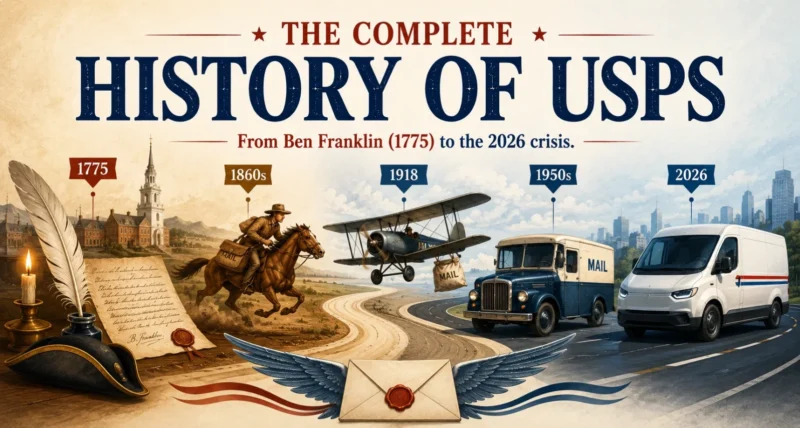
The history of USPS is, in many ways, the history of America itself. Nearly a year before the Declaration of Independence, the founders created a postal system. They put Benjamin Franklin in charge of it. For 250 years, the United States Postal Service has bound a sprawling nation together. It has carried letters by horse, rail, plane, and truck to every doorstep in the country. Today, that same institution is fighting for its survival, warning it could run out of cash within a year. This is the complete story, from a quill pen in 1775 to a full-blown crisis in 2026. It is told simply, start to finish.
| The Short Version The U.S. Postal Service was founded on July 26, 1775, with Benjamin Franklin as the first Postmaster General, before the country even existed. Over 250 years it grew with the nation through the Pony Express, postage stamps, airmail, and ZIP codes. It became the independent USPS in 1971. But email, a costly 2006 funding law, and falling mail volume drained its finances. By 2026 it is in crisis: a $9 billion yearly loss, a warning of insolvency within a year, and a fierce debate over privatizing it. |
The Birth of American Mail (1775 to 1800s)
Benjamin Franklin and the First Post Office
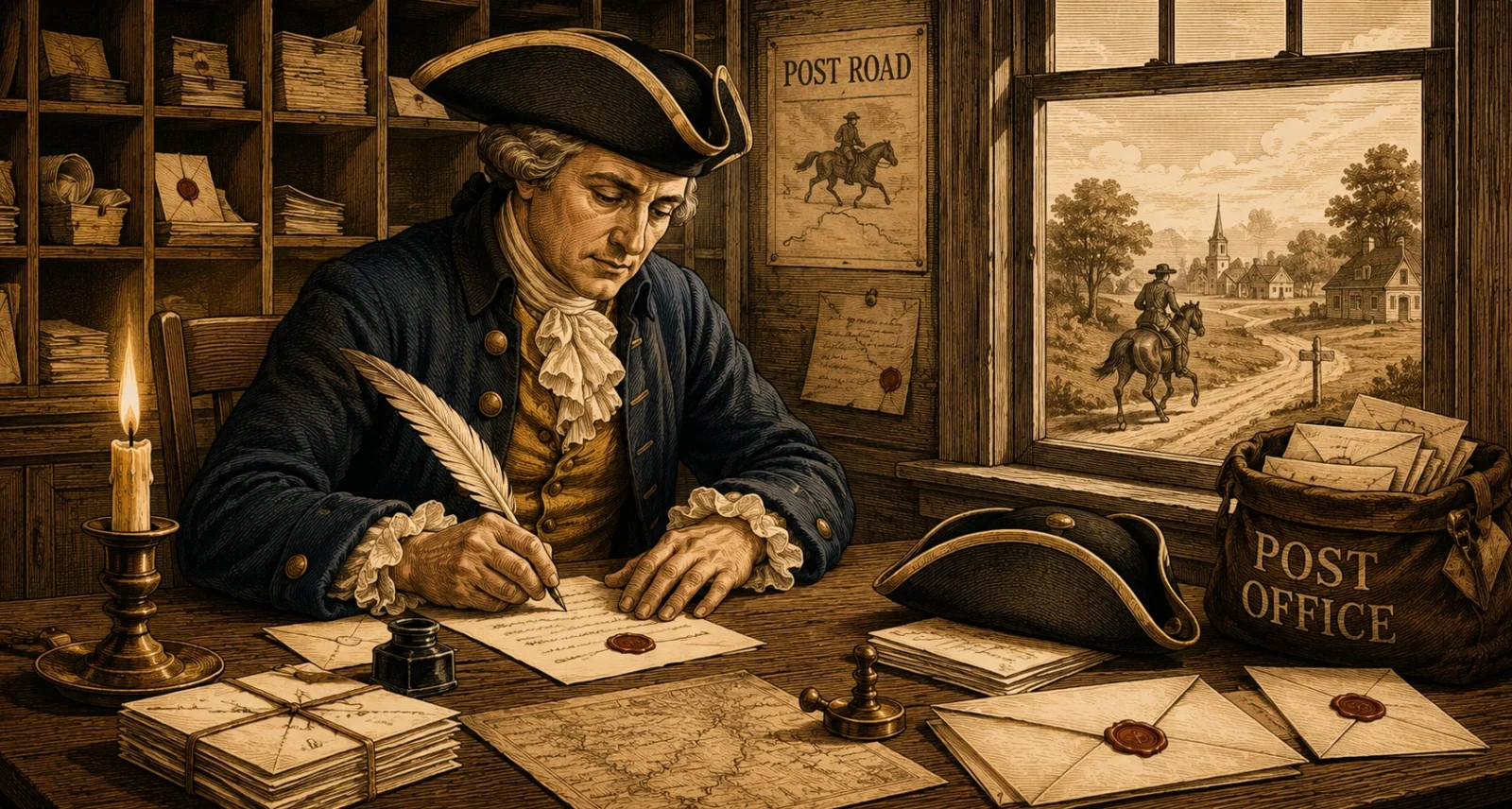
The story begins on July 26, 1775. The Second Continental Congress created a national postal system and unanimously chose Benjamin Franklin as the first Postmaster General. This was almost a full year before the Declaration of Independence. That timing tells you how vital reliable mail was to the revolution. The colonies needed a way to share news and coordinate that did not run through the British Crown.
Franklin was the obvious pick. He had run the colonial mail for the British for over two decades. In that time he surveyed postal roads and standardized rates by weight and distance. He even set up overnight delivery between New York and Philadelphia. The British fired him in 1774 for siding with the revolutionaries. That only made him the perfect choice to lead an American system. He served just over a year before leaving for France as a diplomat, but he had laid the foundation.
The Constitution and the Act of 1792
When the Constitution was written, the post office was important enough to be built right in. Article I gives Congress the power to establish post offices and post roads, a clause known as the Postal Clause. Then came the Postal Service Act of 1792, signed by President George Washington. It made the Post Office Department a permanent institution and shaped the nation in three big ways.
First, it set very low rates for mailing newspapers, deliberately subsidizing a free and informed press. Second, it made it a crime for postal workers to open people’s mail, protecting privacy. Third, it let Congress create new postal roads, a powerful tool for expanding into new territory. The founders genuinely believed that a democracy could not survive unless information flowed freely to its citizens. The mail was how that happened.
| Why It Matters From day one, the U.S. post office was not designed purely to make money. It was designed as public infrastructure, to spread news, protect privacy, and tie distant communities into one nation. That founding idea sits at the heart of every debate about its future, right up to today. |
Expanding With the Nation (the 1800s)
As America pushed westward, the mail went with it. The 19th century turned a small government service into a continent-spanning network. It also produced some of the most iconic chapters in American history.
Postage Stamps and the Famous Pony Express
The first U.S. postage stamps appeared in 1847, a 5-cent Franklin and a 10-cent Washington, which clerks literally cut from sheets with scissors. But the most romantic chapter was the Pony Express. Launched in April 1860, it used relays of horse riders to carry mail across the country. The route ran nearly 2,000 miles between Missouri and California in about 10 days. That was an astonishing speed for the era.
Young riders, including a teenage Buffalo Bill Cody, galloped 75 to 100 miles each through dangerous territory. Yet for all its fame, the Pony Express lasted only about 18 months. It was a private company, never part of the post office, and it lost over $200,000. The transcontinental telegraph made it obsolete almost overnight in late 1861. Its legend, though, has far outlived its short life.
Delivery Comes to Your Door
For most of early American history, you had to go to the post office to collect your mail. That changed in stages. Free city delivery began in 1863, which is why Americans suddenly needed street addresses. Then, in 1896, Rural Free Delivery started bringing mail directly to farms and country homes. It was a genuine revolution for rural families. They had been cut off from the daily flow of news and goods.
Behind the scenes, mail moved by rail through the Railway Mail Service, with clerks sorting letters aboard speeding trains. The post office also launched money orders in 1864. They gave people a safe way to send money during the Civil War. Not everything was glorious, though. In the Star Route scandal of the 1870s and 1880s, officials and contractors rigged rural mail routes. The scheme defrauded the government of around 4 million dollars. It is a reminder that the postal system has weathered corruption before.
The Modern Mail Revolution (the 1900s)
The 20th century transformed the post office with technology and scale. It connected the mail to the rise of mail-order shopping, aviation, and eventually the computer age.
Parcel Post and the Birth of Mail-Order Shopping
Before 1913, the post office could not carry packages heavier than 4 pounds. Heavy items went by costly private couriers instead. That changed when Parcel Post launched on January 1, 1913. The effect on the economy was electric. Suddenly anyone, anywhere, could order goods by mail and have them delivered. Companies like Sears exploded, handling five times as many orders the very first year and doubling revenue within five years.
| The Cool Part When cheap Parcel Post arrived, a few families realized the rates were so low they could literally mail their small children to visit relatives, with postage stamps attached to their clothes and a trusted mail carrier escorting them. It really happened, a handful of times, until the Postmaster General officially banned mailing humans. |
Airmail Takes Off
The post office helped invent American aviation. Regular airmail service began in 1918, flown at first by daring pilots in open-cockpit planes. The work was so dangerous it killed many of them. In 1934, a political scandal erupted over how airmail routes were handed out. The government briefly used Army pilots instead. Flying in winter with little experience, they suffered a wave of deadly crashes. Mail was quickly returned to commercial airlines. That episode helped shape the modern airline industry we know today.
ZIP Codes and the Computer Age
As mail volume soared after World War II, the post office needed a faster way to sort it. The answer arrived in 1963: the ZIP code, short for Zoning Improvement Plan. A friendly cartoon mascot named Mr. ZIP encouraged Americans to use it. Those five digits, later nine, allowed mail sorting to be mechanized and eventually computerized. They remain essential to deliveries today.
The Great Transformation of 1971
This is the turning point that created the USPS we know now. By the late 1960s, the old Post Office Department was underfunded and tangled in political patronage. It paid some workers so poorly that they qualified for food stamps. The pressure finally exploded.
In March 1970, fed-up postal workers in New York launched a massive wildcat strike. It spread to more than 200,000 workers across the country and shut hundreds of post offices for eight days. It was the largest strike against the federal government in U.S. history. President Nixon even sent in around 24,000 military personnel to try to sort the mail, which did not go well.
The strike forced real reform. The Postal Reorganization Act abolished the old cabinet-level department. In its place came the independent, self-funding United States Postal Service, which began operating on July 1, 1971. Postal workers won the right to bargain collectively. The Postmaster General lost their cabinet seat, and taxpayer subsidies were gradually phased out. From this point on, USPS was expected to pay for itself through postage, not taxes.
| In Short Before 1971, the post office was a government department funded by taxes. After 1971, it became the USPS, an independent agency expected to fund itself through stamp and service sales. That single shift explains almost every financial pressure it faces today. |
The Digital Age and a Manufactured Crisis (1990s to 2020s)
The modern era brought the two forces that would push USPS toward the brink. They were the internet and a single controversial law.
Email and the Decline of the Letter
The rise of email and online bill paying slowly drained the post office’s core business. Mail volume peaked at about 213 billion pieces in 2006 and has since fallen by roughly half. First-class mail, long the financial engine of the system, dropped to its lowest level since the 1960s. People simply stopped sending letters.
The 2006 Law That Changed Everything
Just as mail began its decline, Congress passed the Postal Accountability and Enhancement Act of 2006. It contained one fateful requirement. USPS had to pre-fund retiree health benefits decades into the future, paying around 5.5 billion dollars a year. No other government agency or private company faced anything like it.
When the 2008 recession hit and mail volume collapsed, USPS could not make these enormous payments and began defaulting. Its watchdog later did the math. It estimated that about 87% of USPS losses from 2007 to 2016 came from this pre-funding mandate, not from actual operations. Critics across the political spectrum called it a manufactured crisis. It was finally repealed in 2022, but by then the damage to the agency’s finances and reputation was done.
| Worth Knowing This is the single most important fact to understand about modern USPS finances. For years, the agency looked like it was hemorrhaging money. Yet most of those losses came from a unique law forcing it to pre-fund benefits for employees who had not even been hired yet. That said, declining mail and an outdated business model are real, separate problems that repeal alone did not fix. |
Packages, the Pandemic, and Controversy
As letters declined, e-commerce packages surged, putting USPS in direct competition with UPS and FedEx, and in partnership with Amazon. Then came 2020. A new postal chief took the helm. The new Postmaster General, Louis DeJoy, a major political donor with no postal background, took over and made deep cost cuts. Those cuts slowed mail right as tens of millions of Americans planned to vote by mail during the pandemic. The backlash was enormous, and he suspended the changes until after the election. Investigators later found the 2020 election mail was largely delivered on time.
The 2026 Crisis: Can USPS Survive?
That brings us to today, and the most serious threat the postal service has faced in its 250-year history. The crisis has several moving parts, so here is a clear breakdown.
On the Financial Brink
The numbers are stark. In fiscal year 2025, USPS reported a net loss of 9 billion dollars, far worse than it had projected. It has lost roughly 25 billion dollars over three years and around 118 billion since 2007. In March 2026, the Postmaster General gave Congress a chilling warning. At its current rate, the Postal Service “will be out of cash in less than 12 months” and could be unable to deliver the mail.
| $9B | net loss in fiscal year 2025, far worse than projected |
| <12 mo | until USPS could run out of cash, per its 2026 warning to Congress |
| $166B | approximate total debt and unfunded liabilities, about 204% of yearly revenue |
USPS has hit its 15 billion dollar borrowing limit from the Treasury, a cap unchanged since 1992. Now it is asking Congress to more than double it. As the Postmaster General put it, USPS is “regulated worse than a monopoly, because even a monopoly is allowed to make money.” A government watchdog agreed. The current setup, it said, is simply unsustainable, and that only Congress can truly fix it.
New Leadership and the Privatization Push
Louis DeJoy resigned in early 2025. The new Postmaster General, David Steiner, is a former Waste Management CEO and FedEx board member. His appointment alarmed postal unions, who fear the agency is being steered toward private hands. At the same time, the Trump administration pushed to privatize USPS. The effort was led by the Department of Government Efficiency under Elon Musk. One option floated was folding it into the Commerce Department.
This is the heart of today’s debate. Supporters of privatization argue a private company could run mail more efficiently. Opponents include the postal unions and a bipartisan group in Congress. They counter that a private operator would raise prices and abandon unprofitable rural areas. One financial analysis estimated prices might need to rise anywhere from 30% to 140%. Even President Trump acknowledged the problem. Private carriers like FedEx and UPS do not want to deliver to remote rural areas six days a week. Any actual privatization would require an act of Congress, which had not happened as of mid-2026.
| The Big Picture The core question is simple: is the Postal Service a business that should turn a profit, or a public service that should reach everyone no matter the cost? USPS is legally bound by a Universal Service Obligation to deliver to every U.S. address at the same affordable rates. Rural communities, elderly Americans receiving prescriptions, small businesses, and mail-in voters all depend on that promise. |
Cuts, Slower Mail, and Pricier Stamps
To save money, USPS has been shrinking. It cut tens of thousands of jobs, including more than 10,000 workers who took early retirement in 2025. In all, it shed roughly 35,000 positions over four years. It also slowed some delivery standards starting in 2025, meaning certain long-distance mail now takes a day or two longer. And stamp prices climbed. The Forever stamp rose to 78 cents in 2025, with a further increase to around 82 cents planned for mid-2026.
Why USPS Still Matters Today
For all its troubles, the Postal Service remains one of the most remarkable institutions in the country. It is also one of the most trusted. Here is the scale of what it does every single day.
| USPS by the Numbers (2025) | What It Means |
| 170 million delivery points | It reaches virtually every address in America, six days a week |
| About 530,000 employees | One of the largest civilian employers in the United States |
| Nearly 31,000 post offices | The largest retail network in the country |
| About 263,000 vehicles | One of the largest civilian vehicle fleets in the world |
| Zero tax dollars for operations | Since 1982, it funds itself through postage and service sales |
The public verdict is striking. Despite the financial gloom, USPS is consistently the most trusted and most favorably viewed federal agency, with around 7 in 10 Americans viewing it positively. It is also modernizing. The agency is slowly rolling out a new fleet of Next Generation Delivery Vehicles, many of them electric. They will replace its decades-old mail trucks.
| Good to Know That famous line, “Neither snow nor rain nor heat nor gloom of night …,” is not actually the official USPS motto. The Postal Service has no official motto. The phrase comes from the ancient Greek historian Herodotus, describing Persian messengers, and was carved into a New York post office building in 1914. It stuck. |
The Takeaway
The history of USPS is a 250-year story of an institution that helped build a nation. It runs from Benjamin Franklin’s first post roads onward. The rural routes, airmail lines, and ZIP codes all knit the country together. It survived war, scandal, and the telegraph, reinvented itself in 1971, and weathered a manufactured financial crisis. Now it faces perhaps its greatest test. It is caught between mounting losses and a heated debate over whether it should remain a public service at all. Whatever happens next, one thing endures. The Postal Service’s core promise, to deliver to every American, everywhere, at the same fair price. It remains as relevant in 2026 as it was in 1775. Its next chapter is being written right now.
You may also like: how technology and AI are reshaping the workforce
Frequently Asked Questions
Who Founded the USPS?
The U.S. postal system was founded on July 26, 1775, by the Second Continental Congress. It appointed Benjamin Franklin as the first Postmaster General. This was nearly a year before the Declaration of Independence. Its modern form, the United States Postal Service, was created later, in 1971, by the Postal Reorganization Act.
How Old Is the USPS?
The American postal system dates back to 1775. That makes it 250 years old in 2025, older than the United States itself. Its modern independent form, the USPS we know today, was established on July 1, 1971.
Why Is the USPS Losing So Much Money?
There are three main reasons. The rise of email sharply reduced profitable first-class mail. A 2006 law forced USPS to pre-fund retiree health benefits at huge cost. That is blamed for most of its losses through 2016. Its business model has also struggled to adapt. In fiscal 2025 it lost about $9 billion.
Does the USPS Use Taxpayer Money?
Generally no. Since 1982, the USPS has funded its operations through the sale of stamps and services, not tax dollars. It does have the ability to borrow from the Treasury, and it received some special relief during the COVID-19 pandemic. Even so, it is largely self-funding.
Is the USPS Being Privatized?
As of mid-2026, no. The Trump administration and DOGE pushed to privatize the USPS or merge it into the Commerce Department. But any actual privatization requires an act of Congress, which had not passed. Postal unions and a bipartisan group of lawmakers strongly oppose it, especially over rural service.
Is ‘Neither Snow nor Rain’ the USPS Motto?
No. The USPS has no official motto. The famous phrase comes from the ancient Greek historian Herodotus, describing Persian couriers. It was inscribed on the James Farley Post Office in New York City in 1914. It became associated with the postal service but was never made official.
What Was the Pony Express?
The Pony Express was a fast mail service that started in 1860. It used horse-and-rider relays to carry mail nearly 2,000 miles between Missouri and California in about 10 days. Despite its fame, it was a private company, not part of the post office. It lasted only about 18 months before the telegraph made it obsolete.

