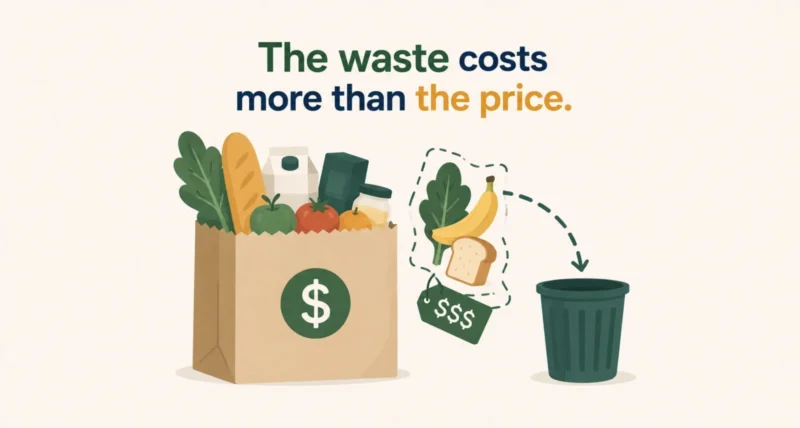
Coupon advice assumes the problem is the price you pay. For most American households it is not. The bigger problem is what happens to the food after you carry it home, and the numbers on that are genuinely startling.
This guide covers how to save money on groceries by fixing that first, then by changing a handful of habits before and during the shop. No apps, no clipping, no loyalty schemes. The single biggest change is understanding a label that most people have been reading wrong their entire lives.
| The Short Answer Start with waste rather than price. The Department of Agriculture estimates the average American family of four loses about $1,500 a year to food that never gets eaten, and a large share of that is thrown out because of date labels that were never about safety. Learn what those labels actually mean, shop from a list built around what is already in your kitchen, compare unit prices instead of sticker prices, and cook a little more often than you order in. Those four habits beat any coupon strategy, and none of them require an app. |
The Biggest Saving Is Not at the Checkout
Before any shopping advice, the number that reframes everything.
The US Department of Agriculture estimates that food waste runs at 30 to 40 percent of the American food supply, and that the average family of four loses roughly $1,500 a year to food they bought and never ate. That is not a rounding error. For most households it is larger than anything coupons could realistically save.
Think about what that means practically. Cut your household waste by even a third and you have found several hundred dollars a year. That happens without changing where you shop or what you buy.
| Quick Take Reframe the goal. You are not trying to pay less per item. You are trying to eat more of what you already pay for. Those sound similar and lead to completely different habits, and the second one is where the real money sits. |
Learn What Date Labels Actually Mean
This single misunderstanding may be costing you more than anything else in this article.
Roughly three quarters of Americans believe the date printed on food indicates safety. With one exception, it does not. Manufacturers choose those dates voluntarily. They are not federally regulated as safety cutoffs, and they describe quality rather than risk.
| The Label | What It Actually Means |
| Sell by | An instruction to the store about display time. Not for you |
| Best if used by | Peak flavor and quality. Explicitly not a safety date |
| Use by | Last date for peak quality. Closest to a safety date, mainly on highly perishable items |
| Infant formula | The one federally regulated date. Never use past it |
The scale of this is well documented. Research from Harvard’s food law clinic found that 43 percent of Americans discard all food at or near the label date. Around a fifth of all food waste in the country traces back to date-label confusion. The FDA and USDA have been working to standardize the wording for exactly this reason, and Alabama Cooperative Extension sets the distinctions out clearly.
| The Golden Rule Use your senses, which is what the USDA itself advises. Look at it, smell it, and if something is genuinely off, throw it out. But do not bin a perfectly good yogurt because a voluntary quality date passed on Tuesday. Two exceptions matter: never use infant formula past its date, and be more cautious if you are pregnant, older, very young, or have a weakened immune system, since the risk is not equal for everyone. |
How to Save Money on Groceries Before You Leave Home
Most of the damage is done before you reach the store, and this is the part people skip.
- Shop your kitchen first. Look in the fridge, freezer, and cupboards, and write down what needs using. Build the week around that rather than starting from a blank page.
- Plan meals that share ingredients. A bunch of cilantro used in one recipe rots. The same bunch used in three does not.
- Write the list and stick to it. This is unglamorous and it works, because unplanned items are where the budget actually leaks.
- Eat something first. Shopping hungry is a genuinely expensive habit, and it is the easiest one on this list to fix.
- Check what is in season. Seasonal produce is cheaper and better, and it is the one price difference you can predict months ahead.
The In-Store Habits That Actually Work
Four things inside the store are worth the effort. The rest is noise.
Compare unit prices, not package prices
The small print showing price per ounce or per pound is the most useful number in the store. Most people never look at it. Bigger packages are not automatically cheaper per unit. The loudest deal signage frequently sits above worse value than the plain box beside it.
Buy imperfect produce
Fruit and vegetables with blemishes taste identical and often cost a fraction of the price. Many stores now have a discounted section for them. If you are chopping it into a soup, cosmetic perfection is worth nothing to you.
Know where the store is working against you
Products at eye level tend to carry higher margins. Cheaper equivalents often sit higher up or near the floor. Staples like milk and eggs are usually placed far from the entrance so you walk past everything else to reach them. None of this is sinister, but knowing it makes you a slightly more deliberate shopper.
Check the reduced section early
Items approaching their date get marked down. Those are precisely the items the previous section explained are usually fine. Buy them, then actually cook them that week rather than transferring the problem to your own fridge.
What to Do With What You Already Have
Storage decides how much of your shop survives long enough to be eaten.
| Habit | Why It Saves Money |
| Keep a use-first shelf | One eye-level spot for things nearing their end stops them hiding |
| Freeze before it turns, not after | Bread, milk, herbs and cooked meals all freeze well |
| Store produce properly | Many items last far longer with the right temperature and humidity |
| Cook once, eat twice | Deliberate leftovers cost nothing and replace a takeout order |
| Keep a stock list | You stop buying a third jar of something you already own |
On that last row, eating out is worth naming plainly. Bureau of Labor Statistics figures put average household spending on food away from home above three thousand dollars a year. Cooking one extra meal a week rather than ordering it will move your finances more than any in-store tactic in this article.
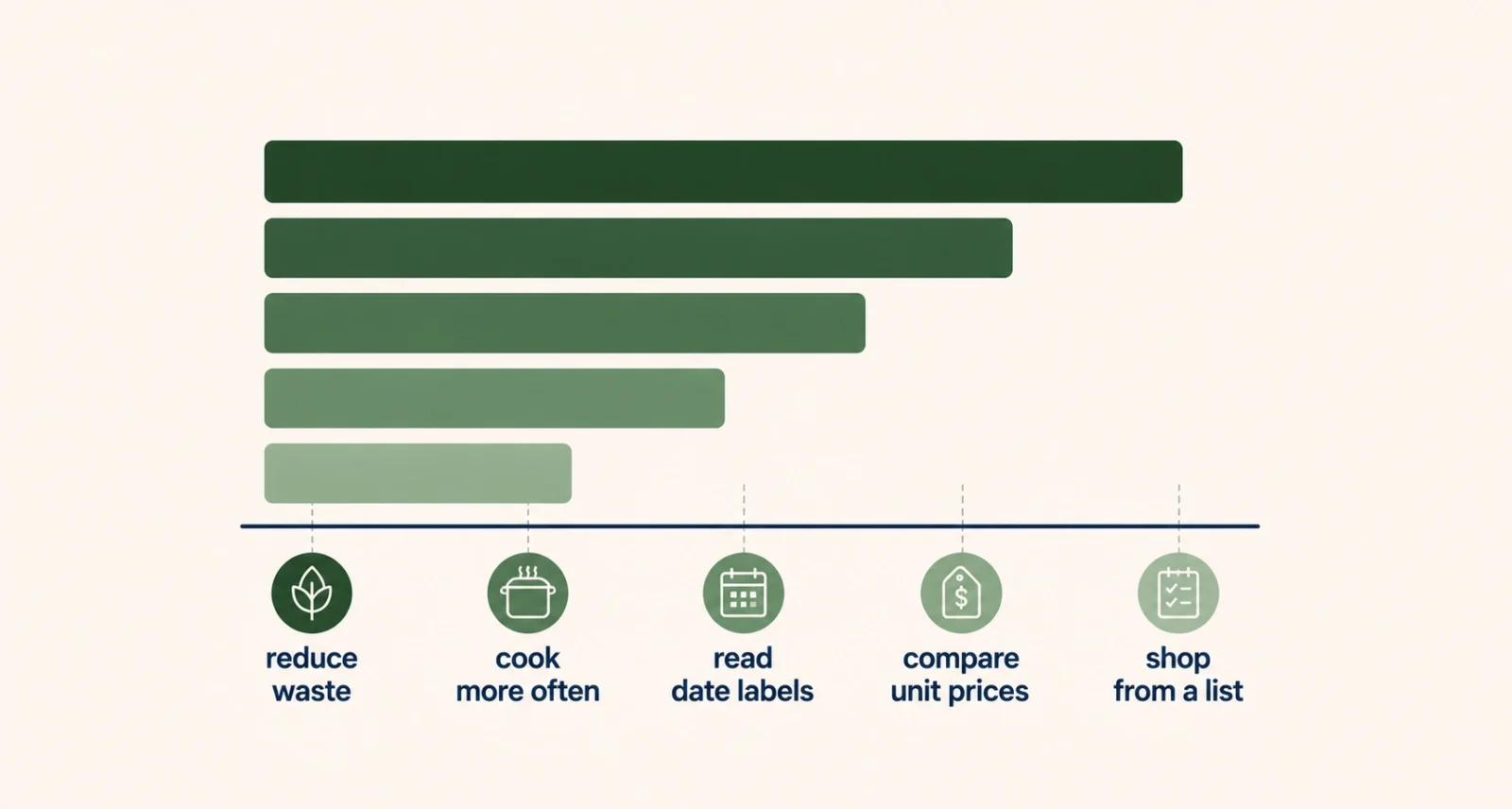
The Savings, Ranked
If you only change one thing, make it the top row.
| Change | Roughly How Much It Matters |
| Stop throwing food away | Largest by a distance, up to around $1,500 yearly for a family of four |
| Cook more, order in less | Very large, given typical spending on food away from home |
| Read date labels correctly | Large, since date confusion drives about a fifth of food waste |
| Compare unit prices | Moderate but constant, on every single item you buy |
| Shop from a list, not hungry | Moderate, and it costs nothing to adopt |
| Buy imperfect produce | Small per item, and it adds up weekly |
The grocery advice industry focuses on the checkout because that is where the transaction happens. The waste happens later, quietly, in your own kitchen, and it is bigger. Cutting it does not require discipline so much as information, which is why the date-label section matters more than anything else here.
Frequently Asked Questions
What is the best way to save money on groceries?
Reduce what you throw away. The USDA estimates the average American family of four loses about $1,500 a year to uneaten food, which is larger than most people could save through coupons or store-switching. Shopping from a list built around what you already have, and understanding date labels, addresses that directly.
Is food safe to eat after the best by date?
Usually yes. Best if used by describes peak quality rather than safety, and manufacturers set these dates voluntarily rather than under federal safety regulation. Use your senses, as the USDA advises. The exception is infant formula, which is federally regulated and should never be used past its date.
What does sell by actually mean?
It is an instruction to the store, not to you. Sell by tells staff how long to keep an item on display. Food bought at or near that date is normally fine for some time afterward if it has been stored properly and shows no signs of spoilage. It is not a safety deadline for your kitchen.
Do I really need to compare unit prices?
It is the highest-value habit inside the store. The unit price, shown in small print as price per ounce or pound, lets you compare packages of different sizes honestly. Larger packages are not automatically better value, and prominent deal signage often sits above products that cost more per unit than the alternative.
How can I save money without meal planning every week?
Do a lighter version. Before shopping, spend five minutes looking through your fridge and cupboards, then write down only what genuinely needs using and what you are missing. That alone captures most of the benefit without planning seven dinners in advance, and it is far more likely to become a lasting habit.
Is buying in bulk always cheaper?
Only when two things are true. The unit price has to be genuinely lower, and you have to use all of it before it goes bad. Bulk purchases of perishable food are one of the most common ways households waste money, because the saving on paper disappears the moment part of it gets thrown out.