
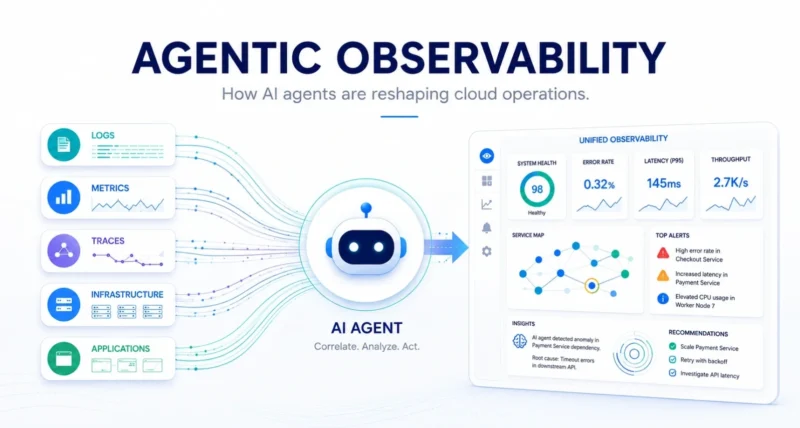
Running software in the cloud is getting harder, fast. Modern systems are now full of AI agents that act on their own and change constantly. They also depend on each other in tangled ways. When something breaks, finding out why can take hours or even days. Microsoft thinks the answer is a new approach called agentic observability, and it just made its key tool generally available. As Microsoft announced on its blog, the Azure Copilot Observability Agent is here to help teams find and fix problems far faster. Here is what it all means, in simple terms.
| The Short Version Cloud systems are becoming “agentic,” packed with AI agents that act on their own and change fast, which makes problems much harder to trace. Microsoft has announced the general availability of the Azure Copilot Observability Agent, built on Azure Monitor. It pulls together logs, metrics, traces, and more into one clear view, then uses AI to spot the root cause of issues in minutes instead of hours. Early customers like KPMG say it is saving them hundreds of engineering hours a month. |
First, What Is Observability?
Let us start simple. Observability is the ability to understand what is going on inside a software system. You do it by looking at the signals the system produces. Those signals are mainly logs, metrics, and traces. Logs are records of events, metrics are numbers like response time, and traces show the path a request takes through the system. Good observability lets engineers answer one key question. Why is this slow or broken right now?
| Quick Take Think of observability like the dashboard and warning lights in a car. You cannot see the engine directly, but the gauges tell you what is happening inside, whether you are low on fuel or overheating, so you know what to fix. |
So What Does “Agentic” Mean Here?
Software is changing. Instead of fixed programs that do exactly what they are told, more systems now run AI agents, software that can reason, make decisions, and take actions on its own. This is what “agentic” means: systems built around autonomous agents.
That power comes with a catch. These agentic systems evolve faster and act more independently. They also connect across a growing web of apps, models, APIs, and infrastructure. Because everything is so interconnected, things rarely fail in just one place. Instead, a problem in one service ripples out and causes failures across others. That makes the real cause very hard to pin down.
| Why It Matters When systems were simpler, one engineer could hold the whole picture in their head. Today, no single person or team can track every moving part. That is exactly why the industry is turning to AI agents to help understand and manage the very systems that AI is making more complex. |
The Problem: Cloud Complexity Is Outpacing Teams
This is not just a Microsoft talking point. In a survey of 250 IT decision-makers by Microsoft and Material, the numbers were striking. They show that teams are struggling to keep up with how complex the cloud has become.
| 84% | of organizations report that their cloud complexity is increasing |
| 69% | say that complexity is now outpacing their current way of operating |
The pain is felt most in security, cost management, and performance, and it stretches across the entire operations lifecycle. As the pace of change speeds up, it becomes impossible for people alone to diagnose and fix issues fast enough. That gap is what is driving the shift toward agentic operations, where AI helps carry the load.
Microsoft’s Answer: The Azure Copilot Observability Agent
To tackle this, Microsoft has announced the general availability of the Azure Copilot Observability Agent, built on Azure Monitor. In simple terms, it is an AI assistant for understanding and fixing what is happening across your cloud systems. Rather than making engineers jump between many different tools, it brings everything together. It also does much of the detective work for them.
How It Works, Step by Step
The Observability Agent follows a simple flow. It takes a team from a problem to a fix much faster than before.
| Step | What Happens |
| 1 | It connects all your signals: logs, metrics, traces, system topology, and operational context, across different environments |
| 2 | It reasons across those signals in real time, instead of leaving you to piece them together manually |
| 3 | It unifies everything into a single, clear operational view inside your existing workflows |
| 4 | It pinpoints the likely root cause and suggests what to do next, turning raw data into clear, actionable insight |
The big win is speed. Before, teams spent hours or days hunting through scattered data. Now they get to the root cause and a recommended fix almost immediately. The agent translates messy logs, metrics, and traces into clear, readable insights and fix suggestions. It does this all within the tools teams already use.
| The Standout The agent does not just tell you what broke. It helps explain why it happened and what to do about it. That shift, from raw alerts to clear answers and next steps, is the whole point of agentic observability. |
Real Results: What Early Customers Are Seeing
The most convincing proof comes from companies already using it. Microsoft shared results from several early adopters, and the time savings stand out.
The headline example is the global firm KPMG. Its audit application support team reports a dramatic reduction in manual work since adopting the agent.
| ~250 hrs | of engineering time reclaimed every month at KPMG, now spent building new features |
According to KPMG’s Narmada Krishnaswamy, teams can now use everyday language to detect, diagnose, and remediate issues faster than ever. Deep investigations and fix recommendations arrive almost immediately, instead of taking hours or days. Other early adopters echo the same theme. The software company PolicyVault says it moved from manual incident hunting to faster, AI-guided investigations. These clarify not just what broke, but why. The security firm Ontinue says the agent helps its teams move more quickly from signal to insight. That frees them to focus on what matters most.
| In Short Across very different companies, the message is the same: less time lost to manual investigation, faster incident resolution, and clearer answers. For busy engineering teams, that translates directly into saved time and lower stress. |
The Bigger Picture: A New Way to Run the Cloud
Observability is just the start. Microsoft frames this as part of a larger move toward agentic operations, a continuous cycle where the system runs itself smarter over time. It works as a feedback loop, and understanding it makes the whole vision click.
| Stage | What Happens in the Loop |
| Generate | Systems constantly produce signals about how they are behaving |
| Interpret | AI agents read and reason across those signals to understand what is going on |
| Act | Agents take action to fix or improve the system |
| Learn | Agents learn from the outcome, so each cycle makes the next one better |
Over time, this loop makes systems more resilient and efficient on their own. It moves cloud operations away from people reacting to problems after the fact. Instead, systems continuously learn, adapt, and improve.
But Can You Trust AI to Run Your Systems?
Handing more control to AI agents raises an obvious question: how do you keep it safe? Microsoft’s answer is that governance has to be built in. As agents take on bigger roles, governance keeps them in check. Clear rules, auditability, and guardrails make sure their actions stay within the boundaries an organization sets.
Importantly, human oversight stays essential. The goal is not to remove people. It is to keep them in the loop, building trust and ensuring reliability as automation grows. Microsoft argues Azure is well positioned here because it combines three things in one connected platform. Those are observability (understanding systems), automation (acting on them), and governance (keeping it all controlled and accountable).
| Good to Know This focus on guardrails and human oversight matters. It is what separates responsible automation from simply letting AI loose on critical systems. The aim is confidence and control, not blind trust. |
Cloud systems are filling up with autonomous AI agents. The old way of manually hunting through dashboards simply cannot keep up. Agentic observability is Microsoft’s answer. The newly available Azure Copilot Observability Agent puts it into practice, uniting all your signals and using AI to find root causes in minutes, not days. With early customers like KPMG reclaiming hundreds of engineering hours a month, the appeal is clear. It points to a future where cloud systems increasingly understand, fix, and improve themselves. People guide the way through smart guardrails. For anyone running software in the cloud, this shift toward agentic operations is well worth watching. You can read the full announcement on the official Microsoft blog.
Frequently Asked Questions
What Is Agentic Observability?
Agentic observability is an approach to understanding and managing cloud systems that are increasingly run by autonomous AI agents. It uses AI to connect and reason across all the signals a system produces, like logs, metrics, and traces, so teams can find and fix the root cause of problems far faster than by checking tools manually.
What Is the Azure Copilot Observability Agent?
The Azure Copilot Observability Agent is an AI-powered tool from Microsoft, built on Azure Monitor, that helps teams operate their cloud systems. The agent correlates signals across agents, applications, infrastructure, and services. It then identifies likely root causes and suggests fixes inside a team’s existing workflows. Microsoft announced its general availability on June 23, 2026.
What Does “Generally Available” Mean?
“General availability” (GA) means a product has moved past testing and preview stages and is now fully released, supported, and ready for everyone to use in production. So the Azure Copilot Observability Agent is now available to all Azure customers, not just a limited preview group.
How Is This Different From Traditional Monitoring?
Traditional monitoring shows you that something is wrong, often through separate dashboards and alerts you have to interpret yourself. Agentic observability goes further. It uses AI to automatically connect the dots across all your data, explain why an issue happened, and recommend what to do, which saves significant time during incidents.
What Are Logs, Metrics, and Traces?
They are the three main types of signals software produces. Logs are timestamped records of events. Metrics are numerical measurements like CPU usage or response time, and traces follow a single request as it moves through different parts of a system. Together they give a picture of system health.
Does AI Replace Human Engineers Here?
No. Microsoft is clear that human oversight remains essential. The agent handles time-consuming investigation and offers recommendations, but people stay in control through governance, guardrails, and final decisions. The goal is to free engineers from tedious work, not to remove them.

