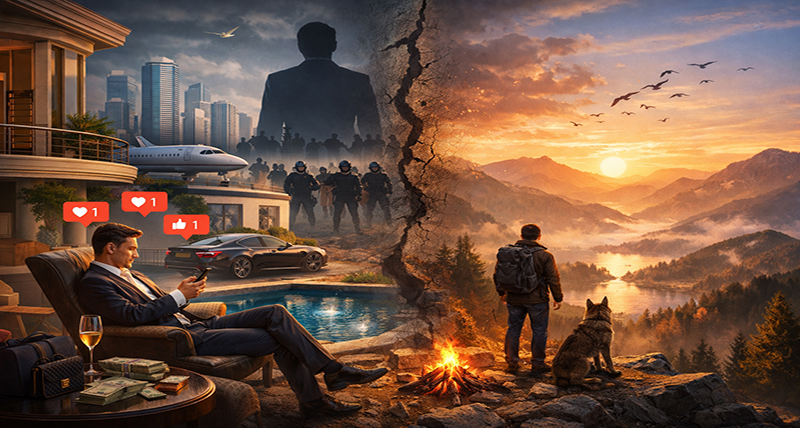
Are We Truly the Most Advanced Civilization or Just the Most Comfortable?
The twenty first century is widely described as the most advanced phase of human civilization.. We have artificial intelligence, global connectivity, instant communication, and unprecedented material ease. Yet beneath this progress sits a difficult question.
Are we truly evolving as humans, or are we only perfecting comfort while slowly losing belief, courage, and meaning?
People no longer centered their lives on survival in the 2000s. Instead, they center it on displaying survival. Comfort no longer means only rest or safety. It has transformed into ego, social approval, visibility, and identity. The measurement of this comfort is money, a concept created by humans and now used to define human worth.
In moments of collapse, when belief is tested, or life falls to pure instinct, money cannot save us.
Comfort Has Replaced Conscious Living
Comfort today is psychological and social more than physical. People use it to perceive us, rank us, and determine how secure we feel among others.
Modern comfort shows itself through validation, comparison, digital presence, and recognition. Society repeatedly reinforces the idea that money must come first and meaning later. Thought is only respected after financial success is achieved.
But history proves the opposite. In moments of loss, crisis, or moral collapse, belief and clarity are what sustain life. Comfort only delays discomfort. It does not resolve it.
The Era of Displayed Life and Manufactured Belief
Social media has changed how people form beliefs. Platforms built on attention reward visibility rather than truth. From celebrities to corporate leaders to everyday individuals, life is curated and projected rather than lived and understood.
What we see repeatedly becomes familiar. What is familiar becomes acceptable. Wrong actions slowly normalize. Exploitation blends into routine. Silence becomes safety.
Belief no longer comes from inner understanding. It comes from what performs well on a screen.
Herd Thinking and the Fear of Standing Alone
Human beings once lived with awareness and accountability for their own decisions. Today, people treat standing alone as a risk.
People label anyone who steps outside accepted paths as unstable, impractical, or irresponsible. Economic pressure, social judgment, and isolation ensure conformity.
Resistance demands constant energy. Comfort demands obedience. Most people choose comfort because it allows survival without confrontation.
Who Shapes Desire in the Modern World
Modern society defines success narrowly. High income, material ownership, and visible status dominate aspiration. People rarely encourage others to question why these goals exist or who benefits from them.
Democracy exists in structure, yet deep questioning of systems is quietly discouraged. Not through force but through incentives such as stable jobs, predictable income, and social approval.
Dependence replaces force as the primary method of control.
Why Questioning Authority Feels Dangerous
From early life, beliefs are carefully implanted. Safety is praised. Risk is discouraged. Obedience is rewarded. Responsibility toward family becomes intertwined with fear of losing stability.
Over time, these beliefs harden into internal barriers. People begin policing their own thoughts before external control is even necessary.
Power does not fear rebellion. It fears independence of thought.
The Slow Development of Hate
No human is born with hate. Children respond honestly to emotion. Anger and sadness pass naturally.
Hate forms gradually through repeated injustice, suppressed expression, unaddressed pain, and continuous compromise. These experiences accumulate silently and reshape behavior.
People eventually harm others or systems without conscious intention. They act this way not because they are cruel, but because they feel exhausted, disconnected, and emotionally burdened.
Comfort distracts from this internal decay.
The Growing Distance Between People and Power
Modern systems have created a widening gap between common people and those in control. Storytelling replaces transparency. People accept corporate and institutional narratives without scrutiny.
Most individuals never question how large organizations built their power or who paid the unseen costs. Acceptance is easier than inquiry when livelihood depends on compliance.
Money becomes permission to stop questioning.
Nature Is Experienced But Not Felt
People travel to mountains, villages, and forests searching for escape. Yet everyone filters out experiences through cameras, captions, and online validation. Documentation replaces the idea of being present at the moment.
Very few consider living simply rather than temporarily consuming simplicity for content. Recognition has replaced connection.
Nature offers balance freely. Modern systems monetize disconnection.
Desires That Were Never Ours
Modern systems plant many desires in people instead of letting them discover what they truly want. They turn needs into wants and shape those wants into identity.
Division and comparison sustain control. When people compare, they do not unite. When they compete, they do not question.
This structure is not accidental. It is functional.
Artificial Intelligence as a Mirror of Humanity
The growing interest in artificial intelligence reflects deeper human anxiety. AI exposes patterns humans avoid confronting. Intelligence without ethics, efficiency without purpose, and automation without responsibility.
AI itself is not the threat. Unexamined human intent is!
People searching for meaning in AI are ultimately searching for clarity in themselves.
Conclusion: What the 2000s Era Reveals About Us
Technology does not define this era. People define it through exchange.
People have exchanged belief for comfort. Curiosity for security. Awareness for approval.
Humanity is not collapsing because of machines or systems alone. It is weakening because people are slowly forgetting how to question, how to stand alone, and how to live consciously.
Progress without awareness is not evolution.
The defining question of this era is not how advanced we have become.
It is how much of our humanity we are willing to surrender for comfort.