
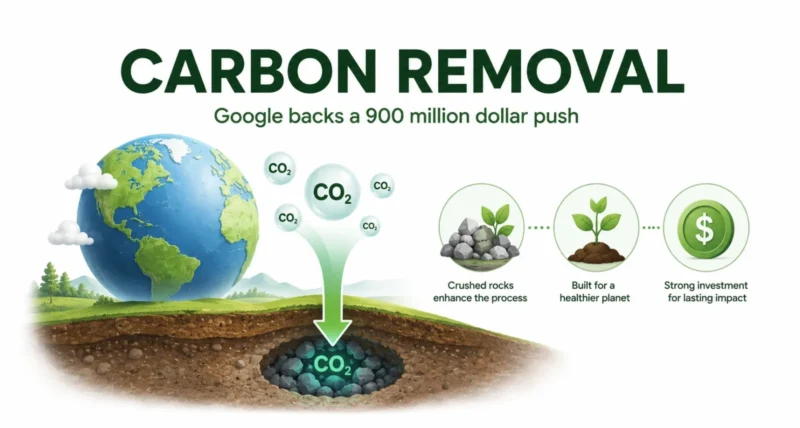
Cutting pollution is only half the climate fight. The other half is cleaning up the carbon already floating in our air, and that is much harder. Now Google is putting serious money behind it. As Google announced, it is backing a new commitment of more than $900 million through a program called Frontier to scale up technologies that permanently remove carbon dioxide. Here is what that means, in plain terms.
| Quick Answer Google is helping fund Frontier’s new commitment of over $900 million to speed up carbon removal, technology that pulls CO2 back out of the air and stores it for good. Google co-founded Frontier in 2022, and this is a big expansion. The money supports promising methods like crushing rocks to capture carbon and locking it away in biomass, helping these young technologies grow. |
The Two Halves of the Climate Fight
To see why this matters, it helps to know there are two different jobs in tackling climate change, and we need both.
- Cutting emissions means putting less carbon into the air, by using clean energy, driving electric cars, and wasting less.
- Removing carbon means taking the carbon that is already up there back out, and storing it so it cannot warm the planet.
We have made real progress on the first. The second is newer, harder, and badly needed. Even with deep emission cuts, a lot of carbon is already in the sky. That is the gap this funding aims to close.
| Why It Matters Think of the atmosphere like a bathtub that is overflowing. Cutting emissions turns down the tap, but carbon removal actually drains some water out. To stop the overflow, we need to do both at once. |
What Is Frontier, and Why Does It Matter
Frontier is not a single company or machine. It is a funding program with a clever design. It solves a chicken-and-egg problem in climate tech.
New carbon-removal methods are often too expensive and too small to survive early on. Investors hesitate because there are few buyers. Buyers hesitate because the tech is unproven. Frontier breaks that cycle using something called an advance market commitment.
In simple terms, big companies promise in advance to buy carbon removal as it becomes available. That guaranteed future demand gives startups the confidence to build and scale. Google co-founded Frontier in 2022, and this new commitment of over $900 million is a major expansion of that promise.
| The Cool Part An advance market commitment is basically a group of companies saying, build it and we will buy it. That single promise can turn a fragile lab idea into a real industry, which is exactly what carbon removal needs right now. |
How These Carbon-Removal Methods Actually Work
The funding backs several real techniques. Here are the main ones, explained simply.
- Enhanced rock weathering. Certain rocks naturally absorb CO2 as they break down. Crushing them and spreading the dust on farmland speeds that up. It captures carbon while improving soil health for crops.
- Biomass carbon removal. Plants pull carbon from the air as they grow. This method captures that carbon-rich plant material and locks it away, so the carbon cannot return to the air. It can support local economies too.
- Restoring natural ecosystems. Healthy forests and soils are natural carbon sponges, so protecting and restoring them removes carbon too.
- Eliminating superpollutants. Some gases trap far more heat than CO2. Cutting these gives a fast, powerful win for the climate.
Why a Mix of Methods Is the Smart Play
No single method can fix the climate alone. Each works on a different timescale: some act fast, others lock carbon away for centuries.
Google’s point is that these approaches are more than the sum of their parts. Combined, they can neutralize the warming impact of emissions across every timescale, from the next few years to the next thousand. It is a portfolio approach, spreading bets across many promising solutions rather than gambling on one.
| Worth Knowing Permanent carbon removal aims to store carbon for hundreds or thousands of years, not just a season. That durability is what separates these newer methods from quicker fixes, and why they are worth the investment. |
Frontier Carbon Removal at a Glance
| Detail | What to Know |
| The commitment | Over $900 million through Frontier |
| Google’s role | Co-founder since 2022, now expanding support |
| The goal | Permanently remove CO2 already in the air |
| Key methods | Enhanced rock weathering, biomass removal, and more |
| The strategy | A portfolio that tackles warming across every timescale |
Why You Should Care
This is not just corporate news. The reason it matters to everyone is simple: carbon-removal technology is still young, and it needs early support to grow into something that works at a global scale.
When large companies guarantee demand, they help bring down costs and prove these methods work. That can turn today’s small experiments into tomorrow’s everyday climate tools. It is the same way early funding once made solar power cheap.
Google backing a $900 million carbon-removal push is a hopeful sign for climate tech. By guaranteeing demand for young technologies like enhanced rock weathering and biomass removal, programs like Frontier help turn fragile ideas into real, scalable tools. Cleaning up the carbon already in our air is one of the hardest parts of the climate fight, and money like this is how that work gets off the ground. You can read the announcement on the Google blog.
Frequently Asked Questions
What Is Carbon Removal
Carbon removal is technology that pulls carbon dioxide back out of the atmosphere and stores it, so it cannot keep warming the planet. It is different from simply cutting new emissions.
What Is Frontier
Frontier is a climate funding program that uses advance purchase commitments to help carbon-removal startups grow. Google co-founded it in 2022 with other companies.
How Much Is Being Committed
Frontier announced a new commitment of more than $900 million to accelerate permanent carbon-removal technologies, which Google is helping to support.
What Is Enhanced Rock Weathering
It is a method where crushed rock is spread on farmland. The rock naturally absorbs CO2 as it breaks down, capturing carbon while also improving soil health.
Why Not Just Cut Emissions Instead
We need both. Cutting emissions slows new pollution, but a lot of carbon is already in the air, so removing it is also necessary to limit warming.
Does Carbon Removal Really Work
The science is real, but many methods are still early and expensive. Funding like this helps prove them out and scale them up so they can make a bigger difference.

