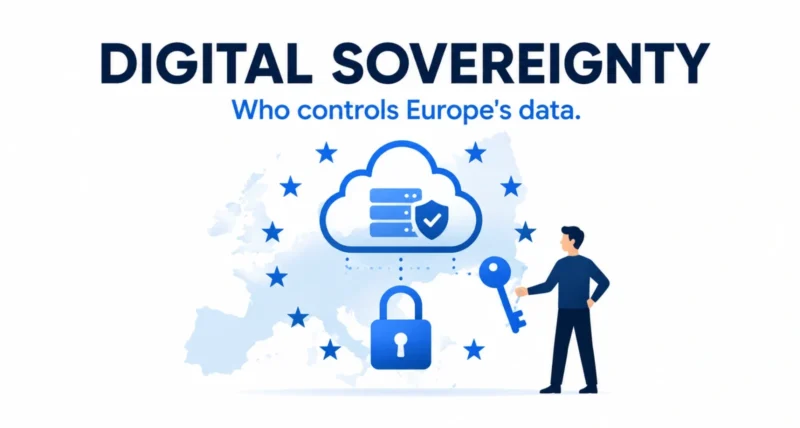
When your data lives in the cloud, who actually controls it, and which country’s rules apply? That question is at the heart of a big debate in Europe right now. As Google Cloud shared in a new policy post, Europe is reshaping the rules for its digital future, and Google is laying out how it thinks that should work. Here is what digital sovereignty means and why it matters, explained simply.
| Quick Answer Digital sovereignty means a country or region having real control over its own data, software, and digital infrastructure, including who can access it and which laws apply. The EU is advancing a Tech Sovereignty Package to strengthen that control. Google Cloud says it supports the goal and offers tiered Sovereign Cloud solutions, but it is urging the EU to keep the rules open to trusted global providers rather than locking them out. This is Google’s position in an ongoing policy debate. |
What Is Digital Sovereignty
Digital sovereignty is the idea that a country or region should control its own digital life: its data, its software, and the infrastructure it runs on. In practice, that means three things. You decide where data sits, who can access it, and whose laws govern it.
It matters because so much of modern life now runs on cloud computing, from hospitals to banks to government services. If that cloud is controlled entirely from outside your borders, you may have less say over your own critical systems. That is the concern Europe is trying to address.
| Why It Matters Think of your data like money in a bank. Digital sovereignty is about knowing which bank holds it, who can open the vault, and which country’s rules protect it. For governments with sensitive information, those questions are a very big deal. |
Why Europe Is Acting Now
Europe wants to be more competitive and secure in technology. It also wants to depend less on infrastructure it does not control. So the European Commission introduced a Tech Sovereignty Package, a set of measures to boost the region’s digital strength.
The Commission says its strategy rests on openness, partnership, and fair competition. It includes steps to tackle vendor lock-in, boost open-source software in the public sector, and build data centers faster. A key part is a proposed law called the Cloud and AI Development Act, or CADA.
| Quick Take Vendor lock-in is when switching providers feels so hard or costly that you feel trapped, like a phone contract you cannot leave without losing your number. A big goal of Europe’s plan is to make switching easier. |
What Google Cloud Is Offering Europe
Google’s pitch is simple: you should not have to choose between strict data control and good technology. It offers a tiered menu of what it calls Sovereign Cloud solutions. Organizations pick the level of control they need.
| Level of Control | Who It Suits |
| Public cloud with European data boundaries | Organizations needing data kept within Europe |
| Independently operated regional cloud | Those wanting local operation and oversight |
| Fully air-gapped solutions | The most sensitive public-sector systems, kept offline |
Google also points to its Made with Europe partnerships with regional companies, like S3NS in France and T-Systems in Germany. These are designed to meet each country’s rules. One French partner, S3NS, has earned SecNumCloud, Europe’s highest sovereignty bar. Google argues that this kind of trusted partnership is the model the EU should follow.
| The Standout A fully air-gapped cloud is physically cut off from the public internet. For a government’s most secret systems, that isolation is the strongest possible guarantee. Outside parties simply cannot reach the data. |
Google’s Three Main Recommendations
The heart of the post is Google’s advice to EU policymakers. It supports the goals, but it wants rules that keep trusted global providers in, not out. Here are its three points, simplified.
- Refine how sovereignty is certified. Google worries the proposed rules judge providers mainly by geography. That could exclude global companies even when they offer strong security. It argues control should be proven by technology, like letting customers hold their own encryption keys, not just by where a company is based.
- Promote real interoperability and end lock-in. Google backs the EU’s push for an open, switchable ecosystem. It says that openness should reach across infrastructure, AI models, and apps. It calls for letting people move software licenses freely, fair pricing for legacy software, and software that runs equally well on any cloud.
- Build sustainable, open AI infrastructure. Google supports faster data-center build-out and chip investment, with priority for energy-efficient, sustainable projects. It notes that it already runs 13 cloud regions in Europe.
| Worth Knowing One concrete tool Google highlights lets customers keep their encryption keys outside Google’s own systems. In simple terms, even the cloud provider cannot read your data without your explicit say-so. That is control proven by technology, not just promises. |
The Bigger Debate, Fairly Put
It is worth being clear-eyed here. This is a policy argument from a major cloud company. So it naturally favors an outcome where global providers like Google keep full access to the European market. That is a reasonable position, but it is one side of a genuine debate.
Some European policymakers and local providers argue the opposite. They say true sovereignty needs stronger preference for EU-based companies, precisely to reduce reliance on foreign firms. Both sides share the goal of a secure, competitive Europe. They disagree on how open the rules should be to outside partners. The final package will reflect how that tension is resolved.
Digital Sovereignty at a Glance
| Term | What It Means |
| Digital sovereignty | A region controlling its own data, software, and infrastructure |
| Tech Sovereignty Package | The EU’s set of measures to strengthen that control |
| CADA | A proposed EU law on cloud and AI development |
| Vendor lock-in | Being stuck with one provider because switching is too hard |
| Air-gapped cloud | A cloud system kept physically offline for top security |
Digital sovereignty is really about a simple question with complex answers: who controls the data and systems a society depends on. Europe is drawing new lines to strengthen its control. Cloud giants like Google are making the case for rules that stay open to global partners. Whether you run a business or just care where your data lives, this debate will shape the internet you use for years. You can read Google’s full position on the Google Cloud blog.
Frequently Asked Questions
What Is Digital Sovereignty
It is the idea that a country or region should control its own digital data, software, and infrastructure. That covers where data sits, who can access it, and which laws apply.
What Is the EU Tech Sovereignty Package
It is a set of measures from the European Commission to strengthen Europe’s control over its digital future. It covers cloud, chips, AI infrastructure, and open-source software.
What Is a Sovereign Cloud
A sovereign cloud is a cloud service built for a region’s data-control and legal requirements. Options range from keeping data within borders to fully offline, air-gapped systems.
What Is Vendor Lock-In
Vendor lock-in describes a situation where switching providers feels so difficult or costly that a customer feels trapped. Reducing it is a key goal of Europe’s digital plans.
What Is Google’s Position
Google says it supports Europe’s sovereignty goals and offers tiered sovereign solutions. But it urges the EU to keep rules open to trusted global providers, rather than excluding them by geography.
Is This a Neutral Report
No. The source is a Google Cloud policy post arguing its own view. This article explains it clearly. It also notes that other parties in the debate favor stronger preference for EU-based providers.