Walk into almost any grocery store today and you will see the word organic on a hundred labels. The hard part is knowing which ones are real. Some stores certify every shelf, others sprinkle a few organic items between conventional ones and hope you will not check. This guide cuts through it. These are the best organic food stores in the US for 2026, ranked by how genuinely organic they actually are, so you can buy with confidence and stop squinting at labels.
| Quick Answer The best organic food stores in the US for 2026 are Whole Foods Market, Natural Grocers, and Thrive Market, followed by MOM’s Organic Market, Sprouts, Costco, Trader Joe’s, Azure Standard, PCC Community Markets, and Misfits Market. Whole Foods is the only national chain where the store itself is USDA certified organic. Natural Grocers and MOM’s sell only 100 percent organic produce. For budget and delivery, Costco, Azure Standard, and Misfits Market lead. Always check for the USDA Organic seal to confirm a product is truly organic. |
Key Takeaways
- Whole Foods is the only certified organic national grocer, with 44,500-plus organic products.
- Natural Grocers, MOM’s, PCC, and Erewhon are the only chains selling 100 percent organic produce.
- For budget organic, build a mix of Costco, Trader Joe’s, and Azure Standard bulk staples.
- Online stores Thrive Market and Misfits Market bring certified organic to your door nationwide.
- The USDA Organic seal is the only organic claim with legal force. Natural and clean mean nothing.
How We Ranked the Best Organic Food Stores
Plenty of stores call themselves organic. Far fewer earn it. To rank the best organic food stores, we focused first on genuine USDA certified organic sourcing. That means how much of a store’s assortment is truly certified, how clearly it labels things, and how transparent it is about where food comes from. Price, selection, and shopping experience came second.
The list deliberately mixes formats: big national chains you can reach almost anywhere, a few standout regional stores, and online shops that ship nationwide. That way there is a strong option here no matter where you live or how you like to shop.
| Worth Knowing Organic is now mainstream. According to the Organic Trade Association, US organic sales reached $76.6 billion in 2025, up 6.8 percent and growing about twice as fast as the regular grocery market. More demand means more choice, and a shrinking price gap. |
The 10 Best Organic Food Stores
Here are the ten that stand out in 2026, each with what makes it genuinely organic, who it suits best, and any catch worth knowing.
Whole Foods Market: Best Overall
Whole Foods is the only national grocery chain where the store itself holds USDA organic certification, not just some of its products. All 500-plus locations carry that certification and pass annual inspections, so organic and conventional food never cross paths in the aisles. It carries more than 44,500 organic products, and its 365 private label added an affordable certified organic range after Amazon trimmed prices. As Whole Foods explains in its organic standards, any organic claim must be third-party certified.
- Best for: one-stop organic shopping with the widest selection and real in-store integrity.
- The catch: still pricier than mass-market chains, and private-label sourcing is not fully transparent.
Natural Grocers: Strictest Standards for the Price
Natural Grocers sells only 100 percent USDA certified organic produce, and has since before organic was even a federal label. Every store is a certified organic handler, and it stocks over 10,000 organic grocery items. For shoppers who want the purity of an all-organic produce section without paying luxury prices, this is the sweet spot.
- Best for: affordable, genuinely all-organic produce with rigorous standards.
- The catch: about 165 stores across roughly 21 states, so coverage is regional, and packaged goods are not all organic.
Thrive Market: Best Online Marketplace
Thrive Market is a membership-based online store packed with thousands of certified organic pantry, frozen, and household goods, often 25 to 50 percent below retail. You can filter by certified organic and dozens of other diets and values. In 2024 it became the first online-only grocer to accept SNAP EBT, widening access to organic food.
- Best for: stocking a certified organic pantry at a discount, delivered nationwide.
- The catch: a yearly membership, and no fresh produce, so pair it with a local store.
MOM’s Organic Market: Most Committed Regional Chain
MOM’s sells only certified organic produce and bans more than 100 ingredients where organic is not available. It is also the only US grocer to offer fully sustainable seafood, down to the canned tuna. If you live in the Mid-Atlantic, this is one of the most organic-committed places you can shop, with a deep environmental mission to match.
- Best for: uncompromising organic produce and sustainability in the Northeast and Mid-Atlantic.
- The catch: just 27 stores, though it is expanding toward Chicago in 2026 and 2027.
Sprouts Farmers Market: Best Value Natural Grocer
Sprouts is big, friendly, and affordable, with organic making up nearly a third of total sales and more than half of all produce sales. It advertises 700-plus certified organic items and around 200 varieties of organic produce. It is not an all-organic store, so labels matter, but the value and the produce sections are excellent. You can browse current offerings on the Sprouts Farmers Market site.
- Best for: affordable organic produce and bulk bins at hundreds of locations.
- The catch: it also sells conventional items, so read each label to confirm organic.
Costco: Best for Bulk Organic on a Budget
Costco is the world’s largest retailer of organic produce. Its Kirkland Signature line includes a growing range of certified organic staples, from eggs and chicken to olive oil and maple syrup. Organic Kirkland items carry the USDA seal and are easy to spot. For families and batch cooks, it is the cheapest way to buy certified organic in volume.
- Best for: cheap certified organic staples in bulk, nationwide.
- The catch: membership required, large pack sizes, and not every Kirkland item is organic.
Trader Joe’s: Best for Affordable Organic Staples
Trader Joe’s carries about four times more organic products than a typical grocery store, and its certified organic private-label items are clearly named and carry the USDA seal. Organic pantry staples here are often cheaper than conventional ones elsewhere. The trade-off is transparency: the company says little about where its organic milk and produce come from.
- Best for: low-cost, well-labeled organic basics and a fun shopping trip.
- The catch: limited sourcing transparency, and if an item is not labeled organic, assume it is not.
Azure Standard: Best Bulk Organic Delivery
Azure Standard is a farmer-owned operation that delivers bulk organic food to all 50 states through community drop points, with no membership fee. It farms thousands of acres of organic produce itself and vets its 12,000-plus catalog items to strict standards. For organic grains, beans, flour, and pantry staples, the prices are hard to beat.
- Best for: the lowest prices on bulk organic pantry staples, nationwide.
- The catch: monthly delivery cycles and scheduled pickup, so it takes a little planning.
PCC Community Markets: Best Co-op
PCC is a certified organic retailer and the largest community-owned food co-op in the US, founded in Seattle in 1953. It leans hard into local organic produce and strict co-op quality standards, banning artificial additives and preservatives. For Seattle-area shoppers who value community ownership and local sourcing, nothing beats it.
- Best for: locally sourced certified organic food with a community-owned model.
- The catch: 16 stores in the Seattle area only.
Misfits Market: Best for Discounted Organic Produce
Misfits Market delivers certified organic, US-grown produce that would otherwise go to waste for looking imperfect, often up to 40 percent cheaper than store prices. After absorbing Imperfect Foods, it added organic pantry, dairy, and meat. It is one of the best ways to eat organic on a budget while cutting food waste.
- Best for: cheap organic produce delivered, with a food-waste mission.
- The catch: delivery reliability can vary, and you cannot always hand-pick items.
| Good to Know Honorable mentions worth a look: Erewhon for ultra-premium all-organic produce in Los Angeles, Wegmans and Fresh Thyme for strong organic ranges in a conventional format, and your local food co-op or CSA for the freshest local organic of all. |
The Stores at a Glance
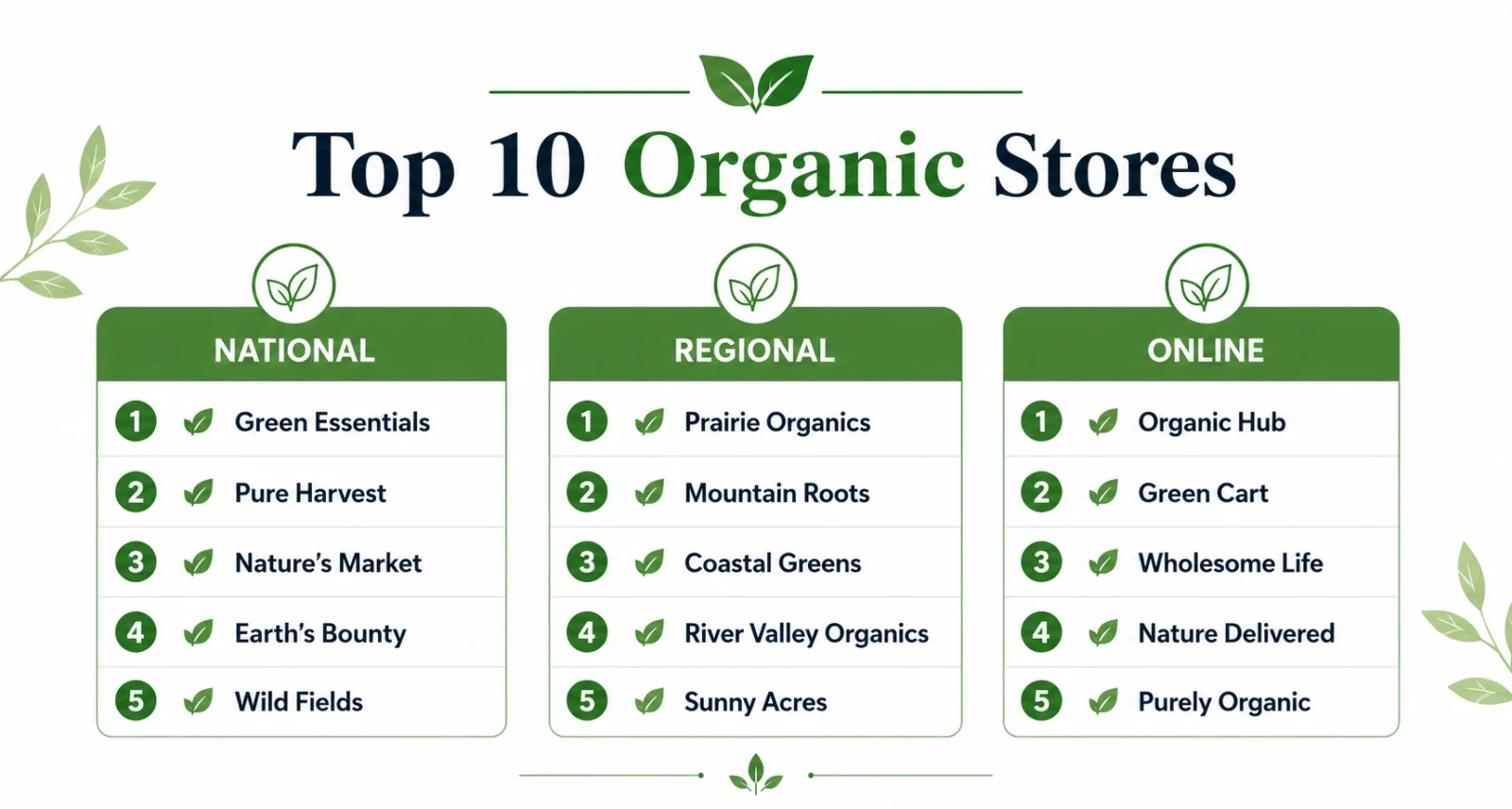
Here is the full lineup in one scannable table, with type, how organic each one really is, and where you can shop it.
| Store | Type | Organic Credibility | Price |
| Whole Foods Market | National | Highest, only certified organic chain | Mid to high |
| Natural Grocers | National | Very high, 100 percent organic produce | Value |
| Thrive Market | Online | High, thousands certified organic | Value plus fee |
| MOM’s Organic Market | Regional | Very high, only organic produce | Mid |
| Sprouts | National | Strong, not all organic | Value |
| Costco | National | Trustworthy where labeled | Low, bulk |
| Trader Joe’s | National | Good, weak transparency | Low |
| Azure Standard | Online | High, farmer-owned | Low, bulk |
| PCC Community Markets | Regional | Excellent co-op | Mid |
| Misfits Market | Online | Strong, organic produce | Low, discounted |
What USDA Certified Organic Really Means
Organic is the most strictly regulated food label in the US, overseen by the USDA National Organic Program. Farms must keep land free of prohibited substances for three years, and the rules ban synthetic pesticides, synthetic fertilizers, and GMOs. There are four label tiers, and knowing them is the key to shopping smart.
| Label | What It Means |
| 100 percent organic | Every ingredient is certified organic. May show the USDA seal |
| Organic | At least 95 percent organic ingredients. May show the USDA seal |
| Made with organic | At least 70 percent organic. Certified, but no USDA seal |
| Specific ingredients | Under 70 percent. Organic named only in the ingredient list |
The certifier’s name must appear on any packaged organic product, such as certified organic by Quality Assurance International. The USDA Organic seal is the clearest at-a-glance signal. You can read the official breakdown in the USDA guide to the organic label. Words like natural, eco-friendly, and clean, by contrast, have no legal organic meaning at all.
| Important Caution Store-brand organic is trustworthy if it carries the USDA seal, since certification is the same for every brand. The one caveat, per the watchdog Cornucopia Institute, is that private labels rarely disclose which farms supply them, so the organic status is real but the exact source may not be transparent. |
How to Shop Organic on a Budget
You do not need to buy everything organic. Each year the Environmental Working Group ranks produce by pesticide load, which lets you spend where it counts. Buy these organic, and save on the cleaner ones.
| Buy Organic (Dirty Dozen) | Save Money (Clean Fifteen) |
| Spinach, kale, collard greens | Pineapple, sweet corn |
| Strawberries, grapes | Avocado, papaya |
| Nectarines, peaches, cherries | Onion, frozen sweet peas |
| Apples, pears, blackberries | Asparagus, cabbage, cauliflower |
| Potatoes, blueberries | Watermelon, mango, banana, carrots |
You can see the full, updated lists on the EWG Dirty Dozen guide. A few smart-money tactics go a long way.
- Prioritize what you eat most. Spend on organic for the berries, greens, and apples that fill your cart every week.
- Buy the Dirty Dozen frozen. Frozen organic is often cheaper than fresh and just as nutritious.
- Go bulk on staples. Use Costco or Azure Standard for organic grains, beans, flour, and oils.
- Mind the shrinking gap. On many items the organic premium is now small, so when it is under about 10 percent, just buy organic.
| Health Disclaimer Do not let pesticide worry stop you from eating produce. Even EWG stresses the goal is to eat more fruits and vegetables, and a diet rich in conventional produce is far healthier than one low in produce. This article is general information, not medical or dietary advice. |
How Do You Verify a Store Is Truly Organic?
To verify a product is truly organic, look for the USDA Organic seal and the certifier’s name on the package. Then confirm the operation in the USDA Organic INTEGRITY Database, the official public list of every certified organic business. If a store or brand does not appear there, its organic claim is not certified. Treat words like natural and clean as marketing, since only USDA certification carries legal force.
A 2024 update called Strengthening Organic Enforcement, the biggest change to organic rules in decades, added tougher inspections and electronic import certificates, which makes the 2026 organic seal more fraud-resistant than ever. Tracking your grocery budget around these choices helps too, and our guide to the new Google Finance and its budgeting tools shows one easy way to keep an eye on spending.
The best organic food stores are the ones that earn the word, not just print it. Whole Foods leads for sheer selection and in-store integrity. Natural Grocers and MOM’s win on truly all-organic produce, and online shops like Thrive Market, Azure Standard, and Misfits Market bring certified organic to any doorstep.
The smartest move in 2026 is a mix: a trusted main store, a budget bulk source, and an online backup, with your organic dollars aimed at the foods that matter most. Check for the USDA seal, ignore the marketing fluff, and you will always know exactly what you are buying.
| Your Move Want more practical guides on food, money, and living well? Browse our Lifestyle section for clear, useful reads. |
Frequently Asked Questions
What are the best organic food stores in the US?
Whole Foods Market, Natural Grocers, and Thrive Market lead the list, followed by MOM’s Organic Market, Sprouts, Costco, Trader Joe’s, Azure Standard, PCC Community Markets, and Misfits Market. Whole Foods is the only national chain that is itself certified organic.
Which grocery store has the most organic products?
Whole Foods Market carries the most, with more than 44,500 organic products, and it is the only national grocer where the store itself is USDA certified organic. Natural Grocers and MOM’s sell only 100 percent organic produce.
Is store-brand organic actually organic?
Yes, if it carries the USDA Organic seal. Certification is identical regardless of brand, so labels like Whole Foods 365, Kirkland Organic, and Trader Joe’s organic are genuinely certified. The farms behind them, though, are not always disclosed.
What is the cheapest way to buy organic food?
Buy in bulk at Costco or Azure Standard, use discounted online produce from Misfits Market, and reserve organic spending for the EWG Dirty Dozen while buying the Clean Fifteen conventional. The organic price gap is also shrinking overall.
Does natural mean the same thing as organic?
No. Natural has no legal definition, and no agency regulates it, so a product labeled natural can still contain synthetic ingredients. Only USDA certified organic carries legal force, which is why the seal matters more than any marketing word.
Can I buy truly organic food online?
Yes. Thrive Market offers a curated certified organic pantry nationwide, Azure Standard delivers bulk organic staples to all 50 states, and Misfits Market ships discounted organic produce. Check for the USDA seal or a certified organic filter when ordering.