
A million miles from Earth, a golden mirror the size of a tennis court has spent 2026 quietly rewriting the textbooks. It found a black hole that somehow existed before its own galaxy, and the first chemical sniff of a visitor from another star system. The James Webb discoveries 2026 have forced astronomers to rethink some of their most basic assumptions about how the universe works. This guide walks through the biggest ones, one by one, in plain language. You will understand not just what Webb found, but why each discovery matters.
| Quick Answer In 2026, the James Webb Space Telescope made several landmark discoveries. It found a supermassive black hole in the galaxy Abell2744-QSO1 that appears to predate its host galaxy, possibly forming within the first second of the Big Bang. It captured the first mid-infrared chemical fingerprint of interstellar comet 3I/ATLAS, only the third known visitor from another star system. It produced one of the highest-resolution dark matter maps ever made, spotted a five-galaxy collision just 800 million years after the Big Bang, and revealed hidden newborn stars across nearby galaxies. Each finding challenges existing models of how the cosmos formed. |
Key Takeaways
- The James Webb discoveries 2026 include a black hole that seems older than its own galaxy.
- Webb captured the first infrared chemistry of interstellar comet 3I/ATLAS, a visitor from another star.
- It made one of the most detailed dark matter maps ever, revealing the cosmic web in new clarity.
- It found a five-galaxy pileup just 800 million years after the Big Bang.
- Together, these findings are pushing scientists to revise long-held cosmic theories.
First, What Makes Webb So Powerful?
Before the discoveries, one quick bit of context makes them all easier to appreciate. The James Webb Space Telescope is a joint NASA, ESA, and CSA mission. It launched in December 2021 and began science in July 2022. It sits about a million miles from Earth and sees the universe in infrared light, the part of the spectrum our eyes cannot detect.
That infrared vision is the key. It lets Webb peer through thick clouds of cosmic dust that block ordinary telescopes. It also lets the telescope see extremely distant, ancient light stretched into infrared as the universe expanded. In practice, that means Webb can look both through dust and backward in time. It sees more than 13 billion years back, closer to the Big Bang than any observatory before it.
| Worth Knowing Because light takes time to travel, looking far into space means looking into the past. When Webb studies a galaxy 13 billion light-years away, it sees that galaxy as it was 13 billion years ago, near the dawn of the universe. |
Discovery One: A Black Hole Older Than Its Galaxy
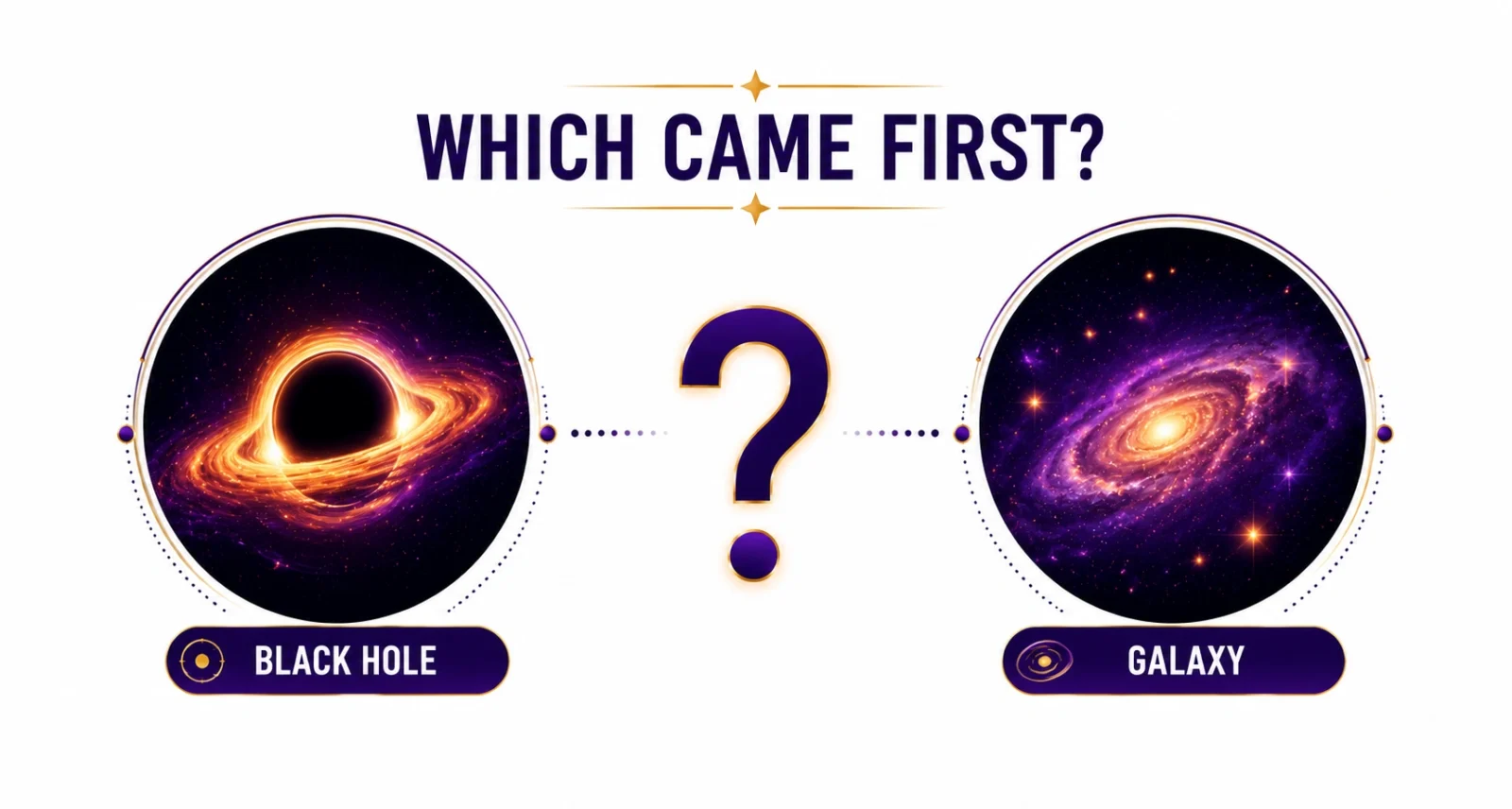
This is the discovery that made headlines worldwide, and for good reason. Scientists have long debated a cosmic chicken-and-egg question: which forms first, a galaxy or the giant black hole at its center? The usual assumption has been that the galaxy comes first, with black holes growing later from collapsing stars. Webb just found strong evidence for the opposite.
As NASA reported, researchers used Webb’s NIRSpec instrument to measure a black hole at the center of a tiny distant galaxy called Abell2744-QSO1. That galaxy existed just 700 million years after the Big Bang. The black hole weighs about 50 million times the mass of our Sun, and it appears to dominate its host galaxy rather than the other way around. The team concluded it likely predates the galaxy entirely, possibly forming within the first second of the Big Bang.
| The Standout One researcher called it a paradigm shift, a total revisiting of how scientists thought black holes form and grow. If black holes this big existed this early, they could not have grown the slow way, from collapsing stars. They must have been enormous from the very start. |
The findings were published in the journal Nature, giving them the weight of formal peer review. It is one of the clearest signs yet that the early universe was stranger, and more black-hole-dominated, than models predicted.
Discovery Two: The First Chemistry of an Interstellar Comet
In late 2025, astronomers spotted only the third known object ever to enter our Solar System from another star system. They named the interstellar comet 3I/ATLAS. In 2026, Webb did something no telescope had done with such a visitor before: it read its chemistry.
Using its NIRSpec instrument, Webb mapped the specific chemical contents of comet 3I/ATLAS as it moved away from the Sun. This captured the first mid-infrared chemical fingerprint of an interstellar object. The comet turned out to have a surprising chemical makeup. That raises a fascinating question: how common, or how unusual, are the conditions in our own Solar System compared to others across the galaxy?
| The Cool Part This is like receiving a package from another star system and getting to analyze what it is made of. Every interstellar visitor carries chemical clues about the distant system it came from, a rare direct sample of material formed around another star. |
Discovery Three: The Sharpest Dark Matter Map Yet
Dark matter is one of the great mysteries in science. It makes up most of the matter in the universe, yet it emits no light and cannot be seen directly. We only know it exists because of how its gravity bends light and holds galaxies together. In 2026, Webb helped map it in stunning new detail.
As UC Riverside reported, scientists used Webb data to produce one of the most detailed, high-resolution maps of dark matter distribution ever made. Published in Nature Astronomy, it reveals the cosmic web, dense regions of dark matter connected by thinner filaments, more clearly than ever. The Webb map contains about ten times more galaxies than ground-based maps of the same region. That is twice as many as an earlier Hubble map from 2007.
| Map Feature | What Webb Showed |
| Galaxies mapped | About 10 times more than ground-based maps |
| Compared to Hubble 2007 | Roughly twice as many galaxies, higher resolution |
| New structures | Previously unseen clumps of dark matter |
| Big picture | The cosmic web revealed in sharper focus |
Discovery Four: A Five-Galaxy Collision in the Early Universe
Galaxies grow by colliding and merging, but scientists did not expect to see this happening so soon after the Big Bang. In 2026, astronomers found evidence that they did.
As Texas A&M University reported, researchers used Webb to identify an ongoing merger of at least five galaxies. It is happening about 800 million years after the Big Bang. They also found evidence that the collision was spreading heavy elements out beyond the galaxies themselves. The discovery suggests galaxies were interacting and reshaping their surroundings far earlier than anyone had predicted.
| Worth Knowing Heavy elements, anything beyond hydrogen and helium, can only form inside stars. Finding them spread across space this early means stars had already lived and died in large numbers, seeding the young universe with the ingredients for future planets. |
Discovery Five: Hidden Newborn Stars Revealed
Not every Webb discovery rewrites cosmology. Some simply show us things we could never see before. Throughout 2026, Webb kept revealing the hidden process of star birth in extraordinary detail.
As Space.com reported, astronomers used Webb alongside Hubble to study nearly 9,000 young star clusters across four nearby galaxies, including Messier 51 and Messier 83. Webb’s infrared vision pierced thick clouds of gas and dust to reveal newborn stars still hidden inside their birth clouds. These are stars completely invisible to ordinary telescopes. The images trace how giant star clusters form, then blast away the gas around them, shaping the whole galaxy in the process.
Why the James Webb Discoveries 2026 Matter
Taken together, the James Webb discoveries 2026 share a common thread. Again and again, Webb is finding that the early universe was more advanced, more structured, and more surprising than existing models predicted. Black holes were bigger sooner. Galaxies collided earlier. Heavy elements spread faster.
Each of these findings forces scientists to refine their theories, and that is exactly how science is supposed to work. Webb is not just taking pretty pictures. It is delivering hard data that reshapes our understanding of where everything, including us, came from. And with years of mission life ahead, the biggest discoveries may still be coming.
| Good to Know Webb’s success has accelerated planning for its successor, the Habitable Worlds Observatory, a future NASA telescope designed to directly image Earth-like planets and search their atmospheres for signs of life. Current estimates put its launch in the late 2030s or 2040s. |
The James Webb discoveries 2026 add up to a remarkable year for astronomy. A black hole that broke the rules of formation. A chemical reading of a comet from another star. The sharpest dark matter map yet, an ancient galactic pileup, and countless hidden stars brought into view. Each one nudges our understanding of the universe a little further.
The common lesson is humility: the cosmos keeps proving more surprising than our best models. Webb is still going strong, and its successor is already in planning. The next few years of discovery may be even more extraordinary than this one. The golden mirror is still watching.
Frequently Asked Questions
What did the James Webb telescope discover in 2026?
In 2026, Webb discovered a black hole that appears older than its host galaxy. It also captured the first chemical fingerprint of interstellar comet 3I/ATLAS, made one of the most detailed dark matter maps ever, and found a five-galaxy collision just 800 million years after the Big Bang.
What is the black hole Webb found in 2026?
Webb measured a supermassive black hole in the distant galaxy Abell2744-QSO1, weighing about 50 million times the Sun. It appears to predate its host galaxy, possibly forming within the first second of the Big Bang. That challenges standard theories of how black holes form.
What is comet 3I/ATLAS?
3I/ATLAS is only the third known interstellar object ever detected entering our Solar System from another star. In 2026, Webb captured its first mid-infrared chemical fingerprint, revealing a surprising chemical makeup that offers clues about conditions around distant stars.
How does Webb see things other telescopes cannot?
Webb observes in infrared light, which passes through cosmic dust that blocks visible-light telescopes. Infrared also lets Webb detect ancient, distant light stretched by the expanding universe. That allows it to see more than 13 billion years into the past.
Did Webb find dark matter in 2026?
Webb helped create one of the highest-resolution dark matter maps ever made, published in Nature Astronomy. It did not see dark matter directly, since that is impossible. Instead, it mapped the distribution by tracing how its gravity shapes the visible universe.
Is the James Webb Space Telescope still working?
Yes. As of 2026, Webb is fully operational and observing continuously, with new results published regularly. It has years of mission life remaining, so more major discoveries are expected in the coming years.

