

You would be forgiven for missing it under the bigger headlines, but the ocean just quietly broke a major record. In June 2026, the world’s seas were hotter than in any June ever measured. These record ocean temperatures are not just a number for scientists to note. They shape the weather, the storms, and the summers the rest of us live through. And with a powerful El Niño now forming, experts warn the heat could climb even higher. Here is what happened, why it matters, and what may come next.
| The Short Answer In June 2026, the world’s oceans hit their warmest June on record. The global average sea surface temperature reached 20.98 degrees Celsius, beating the previous records set in 2023 and 2024, according to the European Union’s Copernicus Marine Service. Marine heatwaves affected around 82 percent of the ocean during the first half of the year. Scientists say a forming El Niño, combined with human-driven climate change, could push temperatures higher still, making more records likely in the months ahead. |
What Happened: The Oceans Broke a June Record
Let us start with the headline number. In June 2026, the global average sea surface temperature was 20.98 degrees Celsius, the highest ever recorded for the month. That edged past the previous June records from 2023 and 2024. The data comes from the European Union’s Copernicus Marine Service, as reported by CNN and others.
This was not a one-off spike. It capped six months of near-record ocean warmth across 2026. The heat was also widespread. Marine heatwaves, which are long stretches of unusually warm water, affected around 82 percent of the world’s oceans in the first half of the year. As NBC News noted, that is the second-largest extent on record, behind only 2024.
Where the Heat Was Worst
The warmth was not spread evenly. A few regions really stood out.
| Region | What Happened |
| Global ocean average | 20.98°C, the hottest June on record, beating 2023 and 2024 |
| Tropical Pacific | 27.26°C, its hottest June ever measured |
| Mediterranean Sea | 24.3°C, a new June record, with heatwaves hitting 98% of the basin |
| Parts of the Mediterranean | Up to 6°C above the long-term average |
| Parts of the North Sea | Up to 3°C above average |
Europe, meanwhile, has been sweltering through a record-breaking heatwave on land, and the surrounding seas mirrored it. When the water around a continent runs this hot, it makes the heat on land much harder to shake.
What Is El Niño, and Why Does It Matter Here?
You have probably heard the term El Niño, so here is the short version. El Niño is a natural climate pattern where parts of the Pacific Ocean turn unusually warm. That warmth releases extra heat into the atmosphere and shifts weather around the globe. It raises the odds of floods in some places, and droughts or wildfires in others.
One is forming right now, and it looks like it could be a strong one. In parts of the central and eastern Pacific, the sea is already about 1.24 degrees Celsius warmer than average. An El Niño usually takes about a year to fully play out. So its biggest effect on global temperatures tends to come near the end. In practice, that means 2026 is likely to be very hot, and 2027 could be even hotter.
Scientists at Copernicus were direct about it. Carlo Buontempo of the Copernicus Climate Change Service warned that “we are likely to see more temperature records fall in the coming months.” His colleague, lead oceanographer Simon Van Gennip, added that “we can expect that 2026 will be among the warmest ever recorded.” He pointed to both El Niño and continued greenhouse gas emissions.
Why Should You Care About Record Ocean Temperatures?
It is easy to picture the ocean as a faraway thing, but its temperature touches daily life more than you might expect. Here is why record ocean temperatures matter to everyone.
- The ocean is Earth’s thermostat. It soaks up roughly 90 percent of the extra heat trapped by greenhouse gases. When it warms, that is a sign the whole planet is heating fast.
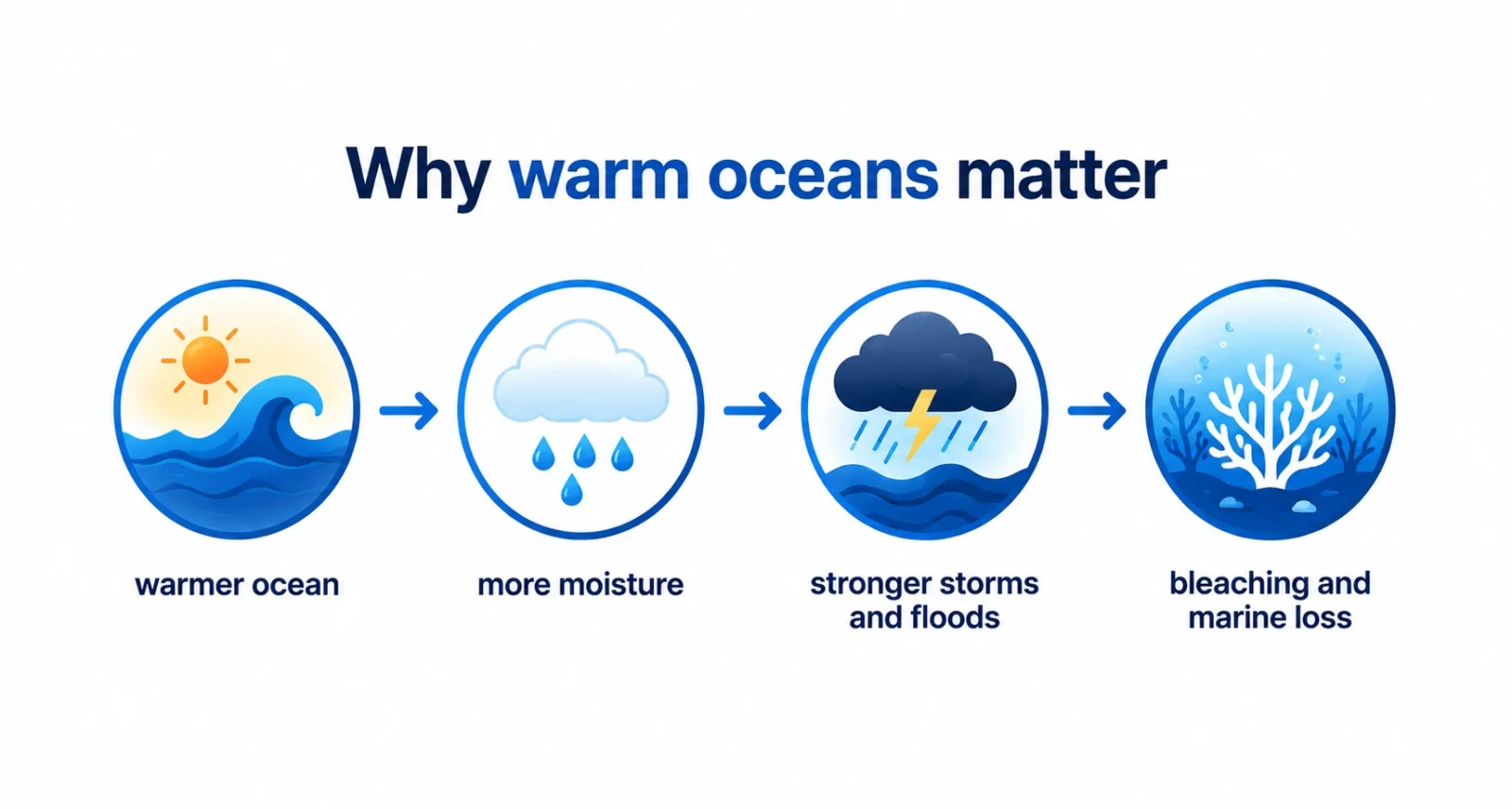
- Warmer seas mean wilder weather. Hot water puts more moisture into the air, which fuels heavier rain, stronger storms, and worse flooding.
- Hotter summers on land. A warm ocean is less able to cool the land nearby, so coastal regions bake for longer.
- Marine life suffers. Prolonged heat triggers coral bleaching and can kill off reefs, seagrass, and the creatures that depend on them.
A major United Nations scientific assessment last month went further, describing the world’s oceans as being in a deepening crisis, warming and rising faster than before. Our explainer on the secrets of the ocean looks at just how much we still do not understand about this vast system.
Just How Hot Is It, Really?
Numbers like 20.98 degrees can feel abstract, so here is some perspective. Before the industrial era, back around 1870, the average ocean temperature was roughly 19.6 degrees Celsius. Today it is just under 21. A difference of a degree or so may not sound like much, but warming the entire ocean by that amount takes a staggering amount of energy.
To make it concrete, scientists writing in The Conversation offered a startling comparison. In 2025, they estimated, the heat added to the oceans was roughly equal to 12 Hiroshima-scale bombs going off every single second. To find a natural climate comparable to today’s oceans, they note, you would have to look back around 120,000 years, to before the last ice age.
The record ocean temperatures of June 2026 are a clear signal, not a blip. The seas are quietly absorbing the planet’s extra heat. With a strong El Niño building, scientists expect more records to fall through 2026 and into 2027. For most of us, that shows up as hotter summers, heavier storms, and more unpredictable weather.
None of this is beyond understanding, and staying informed is a real first step. On the brighter side, the shift to cleaner energy keeps picking up speed. Ideas like floating solar panels show how technology is starting to respond to the challenge.
Frequently Asked Questions
How hot were the oceans in June 2026?
The global average sea surface temperature reached 20.98 degrees Celsius in June 2026, the warmest June on record. That beat the previous June highs set in 2023 and 2024, according to the European Union’s Copernicus Marine Service.
Why are the oceans so warm right now?
Two forces are stacking up. Long-term warming from greenhouse gas emissions has been steadily heating the seas for decades. On top of that, a newly forming El Niño is adding extra Pacific warmth. Together they pushed June to a record.
What is El Niño?
El Niño is a natural climate pattern in which parts of the Pacific Ocean become unusually warm. It releases heat into the atmosphere and shifts weather worldwide, raising the risk of floods, droughts, and wildfires in different regions.
Will 2026 be the hottest year on record?
It could be. Scientists at Copernicus expect 2026 to rank among the warmest years ever recorded, driven by El Niño and ongoing emissions. Because El Niño’s peak effect often lags, 2027 may end up even hotter.
Why do warm oceans matter for weather?
Warmer oceans put more moisture into the air, which fuels heavier rainfall, stronger storms, and flooding. They are also less able to cool nearby land, so warm seas can make heatwaves on land more intense and longer lasting.
Who measures ocean temperatures?
The figures here come from the European Union’s Copernicus Marine Service, run by Mercator Ocean International. It tracks sea surface temperatures and marine heatwaves worldwide using satellites and ocean data, and its records are widely cited by scientists.

