

Every so often, our solar system gets a visitor from somewhere far, far away. In 2025, one such traveler made headlines, and people are still asking: what is 3I/ATLAS? In short, it is a comet from another star system. It is only the third object we have ever caught passing through our cosmic neighborhood from interstellar space. It is fast, it is ancient, and it briefly gave scientists a once-in-a-lifetime chance to study material born around a distant star. Here is everything you need to know, from how it was found to whether it was ever a threat, explained simply.
| The Short Answer 3I/ATLAS is the third known interstellar object, a comet that came from outside our solar system. It was discovered on July 1, 2025 by the ATLAS survey telescope in Chile. It is the fastest comet ever recorded, and its icy makeup suggests it may be older than the Sun itself. It never posed any danger to Earth, passing hundreds of millions of miles away, and it is now heading back out of the solar system for good. Despite the online rumors, scientists agree it is a completely natural comet, not an alien craft. |
What Is 3I/ATLAS?
3I/ATLAS is an interstellar comet, which means it formed around another star and drifted into our solar system from deep space. It is only the third such object we have ever confirmed, after 1I/‘Oumuamua in 2017 and 2I/Borisov in 2019. Astronomers also gave it the formal name C/2025 N1. Like any comet, it has an icy core, called a nucleus. That core sits inside a glowing cloud of gas and dust, known as a coma, plus a tail. What makes it extraordinary is simply where it came from. According to NASA, its path proves it originated far beyond our Sun.
| Object | Discovered | Notes |
| 1I/‘Oumuamua | 2017 | First interstellar object, cigar-shaped, no visible tail |
| 2I/Borisov | 2019 | First confirmed interstellar comet |
| 3I/ATLAS | 2025 | Third, and the largest and fastest so far |
How Was 3I/ATLAS Discovered and Named?
The comet was first spotted on July 1, 2025 by a NASA-funded telescope in Río Hurtado, Chile. That telescope is part of the ATLAS network, which scans the sky for objects near Earth. Once astronomers checked the archives, they found it in earlier images going back to June 14, 2025.
The name looks like a code, but it is simple once you break it down. The “3” means it is the third interstellar object found, the “I” stands for interstellar, and “ATLAS” is the survey that discovered it. Put those together, and you get 3I/ATLAS.
How Do We Know It Came From Another Star?
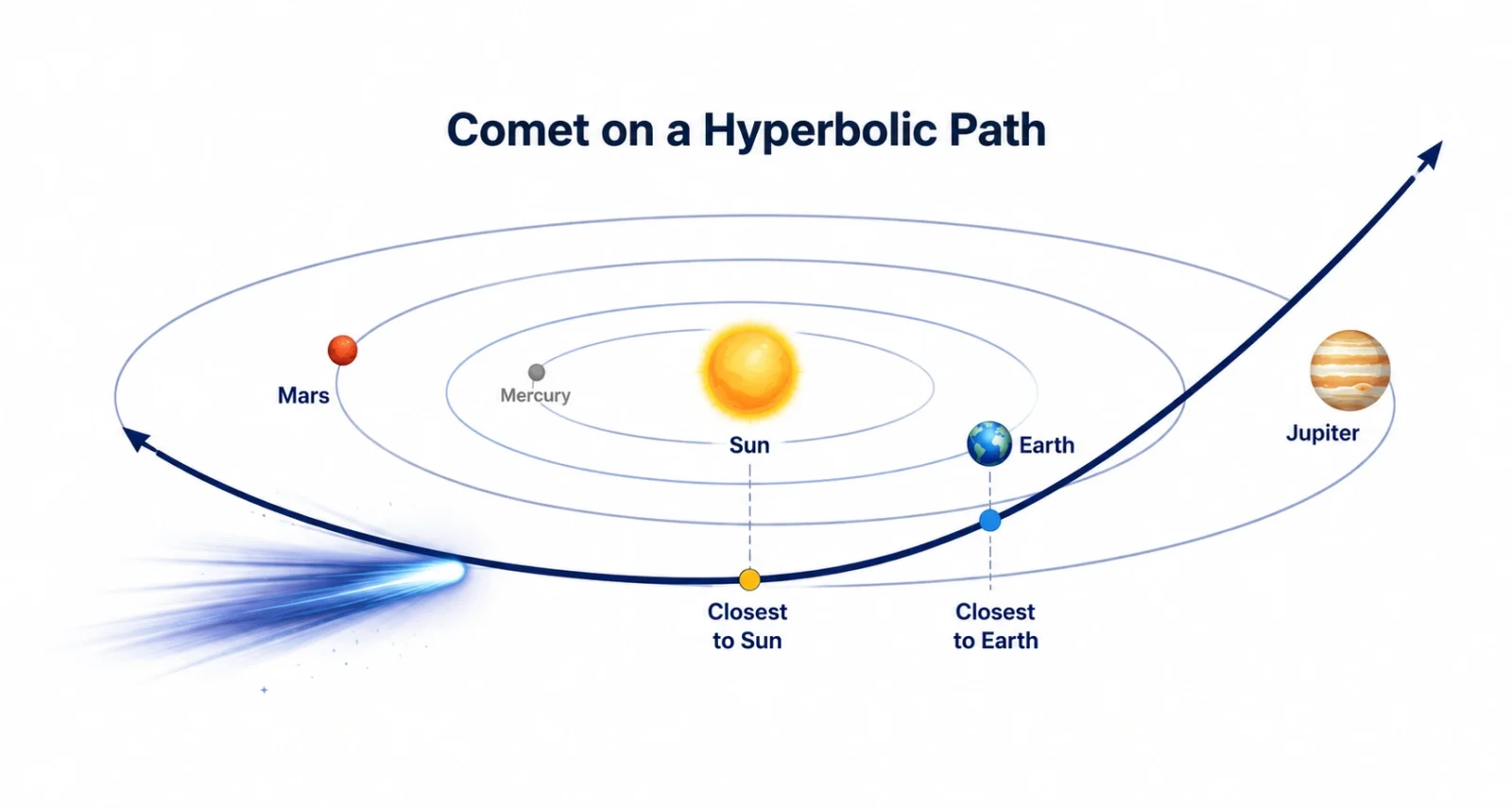
This is the clever part. Most comets loop around the Sun on closed, oval orbits. 3I/ATLAS did not. It arrived on a wide-open, hyperbolic path, and it was moving far too fast for the Sun’s gravity to hold onto it. It also never passed close enough to a planet to have been flung to such speeds. Trace its route backward, and it points clearly to interstellar space. That mix of blistering speed and an open orbit is the fingerprint of a true interstellar visitor.
3I/ATLAS by the Numbers
Here are the key facts at a glance.
| Feature | Detail |
| Type | Interstellar comet (also named C/2025 N1) |
| Discovered | July 1, 2025, by the ATLAS telescope in Chile |
| What it is | The third known interstellar object |
| Top speed | About 153,000 mph (246,000 km/h) near the Sun |
| Nucleus size | Roughly 0.4 to 5.6 km across |
| Closest to Earth | About 170 million miles, on December 19, 2025 |
| Age | Possibly 10 to 12 billion years, older than the Sun |
| Status | Leaving the solar system, never to return |
For more on the European observations, including the first time an interstellar comet was seen in X-ray light, the European Space Agency has a helpful summary.
What Makes 3I/ATLAS So Special?
Beyond being a rare visitor, 3I/ATLAS handed scientists a wealth of data. An armada of instruments tracked it, from Hubble and Webb to spacecraft near Mars and Jupiter. It even became the first interstellar comet ever seen in X-ray light.
The findings were remarkable. Using NASA’s James Webb telescope, researchers found a chemical mix unlike any comet from our own solar system. It carries unusually high levels of methane and a form of “heavy water.” That points to a birth in an extremely cold, distant region of the galaxy. Their conclusion, published in the journal Nature, is stunning. The comet may have formed 10 to 12 billion years ago, long before our Sun existed. Lead scientist Martin Cordiner described it as “an ancient object, probably pre-dating our Sun.” That could make it one of the oldest things ever seen in our solar system. We covered more of the observatory’s finds in our piece on what the James Webb telescope has discovered.
Is 3I/ATLAS an Alien Spacecraft?
With any strange object from deep space, the question comes up: could it be aliens? The idea gained attention when Harvard astronomer Avi Loeb pointed to the comet’s unusual methane levels and wondered aloud about its origins. It is a fun thought, but the scientific answer is clear.
NASA, the European Space Agency, and the vast majority of astronomers agree that 3I/ATLAS is a completely natural comet. It behaves exactly like one, with an icy nucleus, a coma, and a tail. A dedicated search for radio signals using the Allen Telescope Array found no technological signals at all. The unusual chemistry comes from natural processes as the comet’s ancient ice warmed near the Sun, not from anything artificial.
Where Is 3I/ATLAS Now?
3I/ATLAS is already on its way out. It made its closest pass by the Sun in late October 2025. The comet then swept nearest to Earth on December 19, 2025, a safe 170 million miles away. Beyond that, it crossed past Jupiter’s orbit in March 2026. It arrived at the same tremendous speed it will leave with, which is exactly why the Sun could not capture it. By the early 2030s, it will have left the planetary part of our solar system for good, drifting back into interstellar space, never to return. We got one brief look, and then it was gone.
3I/ATLAS was a genuine cosmic event. It was only the third interstellar object we have ever seen. This was a comet quite possibly older than our Sun, carrying secrets from another star system. The comet was never a danger, and it was never aliens. But it was something arguably more exciting: a rare chance to touch the wider galaxy for a few short months.
It is heading home now, back into the dark between the stars. Thanks to the telescopes that caught it, though, a little piece of its story stays with us.
Frequently Asked Questions
What is 3I/ATLAS?
3I/ATLAS is an interstellar comet, the third object ever confirmed to pass through our solar system from another star. Discovered in July 2025, it has an icy nucleus, a coma, and a tail, and it is also formally named C/2025 N1.
Is 3I/ATLAS dangerous to Earth?
No. 3I/ATLAS never came close to Earth. Its nearest approach was about 170 million miles away, well beyond the Moon and even beyond the Sun, so it posed no threat at any point.
Is 3I/ATLAS an alien spacecraft?
No. NASA, the ESA, and most astronomers agree it is a natural comet. It behaves like a normal comet, and a dedicated search found no radio or technological signals. Its unusual chemistry is explained by natural processes, not by anything artificial.
How fast is 3I/ATLAS?
Very fast. It reached about 153,000 mph (246,000 km/h) near the Sun, making it the fastest comet ever recorded. That extreme speed is one of the clues that it came from outside our solar system.
What were the other interstellar objects?
3I/ATLAS is the third. The first was 1I/‘Oumuamua, a cigar-shaped object found in 2017. The second was 2I/Borisov, discovered in 2019, which was the first confirmed interstellar comet. 3I/ATLAS is the largest and fastest of the three so far.
Where is 3I/ATLAS now?
It is leaving. After passing the Sun in late 2025 and crossing beyond Jupiter in March 2026, 3I/ATLAS is on an escape path out of the solar system. By the early 2030s it will be back in interstellar space, and it will never return.

