
Microsoft announced on July 20 that it will run AMD Helios racks inside Azure. The announcement itself reads like alphabet soup: MI455X, EPYC Venice, Pensando, ROCm, HDv2, HXv2. Strip the jargon away and one clear story remains. For the first time in years, Nvidia has a serious rival for the machines that run AI. The world’s second-largest cloud just placed an order. Here is what every piece means, why it matters, and the detail most coverage buries.
| The Short Answer AMD Helios is not a chip. It is a whole rack of computing equipment sold as one unit, combining AMD’s Instinct MI455X GPUs, EPYC Venice processors, Pensando networking, and ROCm software. Microsoft will deploy it across Azure to run AI inference, the stage where a trained model actually answers your questions. Microsoft joins Meta, OpenAI, and Oracle as Helios customers, and shipments start in the second half of 2026. Azure is also adding two new virtual machine families built on AMD chips, one for agentic AI pipelines and one for chip design work. The catch: none of it can be rented yet, and Microsoft has published no pricing, no regions, and no launch date. |
What Microsoft and AMD Actually Announced
Three separate commitments landed at once, and they are easy to confuse. Splitting them apart makes the whole announcement readable.
| The Commitment | What It Covers | Why It Matters |
| Helios racks on Azure | Full AMD rack systems deployed across Azure at scale | The headline. Azure gains a second serious AI platform |
| Two new Azure VM families | HDv2 and HXv2, both on 6th-gen EPYC Venice chips | Ordinary cloud customers get faster AMD-powered machines |
| Wider Pensando networking | AMD networking chips tied into Azure Boost across the fleet | Moves data faster between machines, which quietly limits AI speed |
The Microsoft announcement came from Scott Guthrie, who runs the company’s Cloud and AI division. His framing was that AI work has grown too varied for one type of hardware to serve it well. Azure is therefore building a mixed fleet on purpose. AMD published its own release the same morning, and its shares closed roughly five percent higher.
The Jargon, Decoded
Read this table once and the rest of the article, plus every other report on this deal, becomes straightforward.
| The Term | What It Actually Means |
| Helios | A complete rack of AI hardware sold as one integrated product |
| Instinct MI455X | AMD’s newest AI accelerator chip, the engine of the rack |
| EPYC Venice | AMD’s 6th-generation server processor, the general-purpose brain |
| Pensando | AMD networking silicon that moves data between machines |
| ROCm | AMD’s software layer, its answer to Nvidia’s CUDA |
| Inference | Running a trained AI model to produce answers |
| Rack-scale | Selling a whole cabinet as one designed unit, not loose parts |
| HPC | High-performance computing, meaning heavy scientific and engineering math |
What AMD Helios Is, and Why It Is Not a Chip
This is the point almost everyone gets wrong. Helios is not a faster graphics card. It is an entire cabinet of equipment, roughly the size of a large refrigerator. Inside sit 72 MI455X accelerators plus processors, networking, and cooling. AMD designs all of it together and ships it as one product.
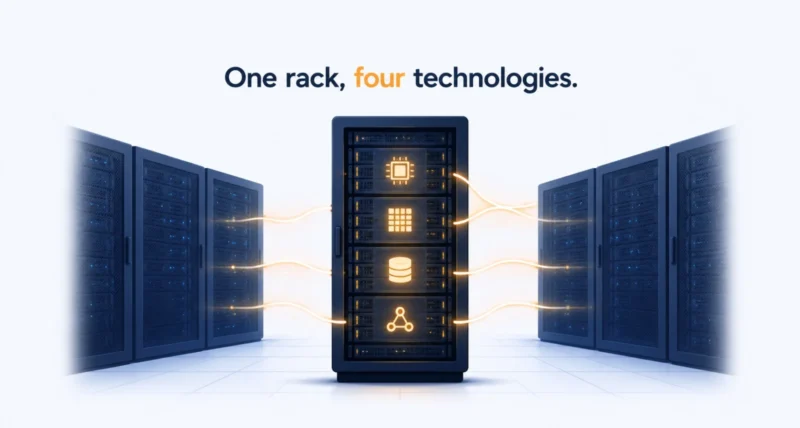
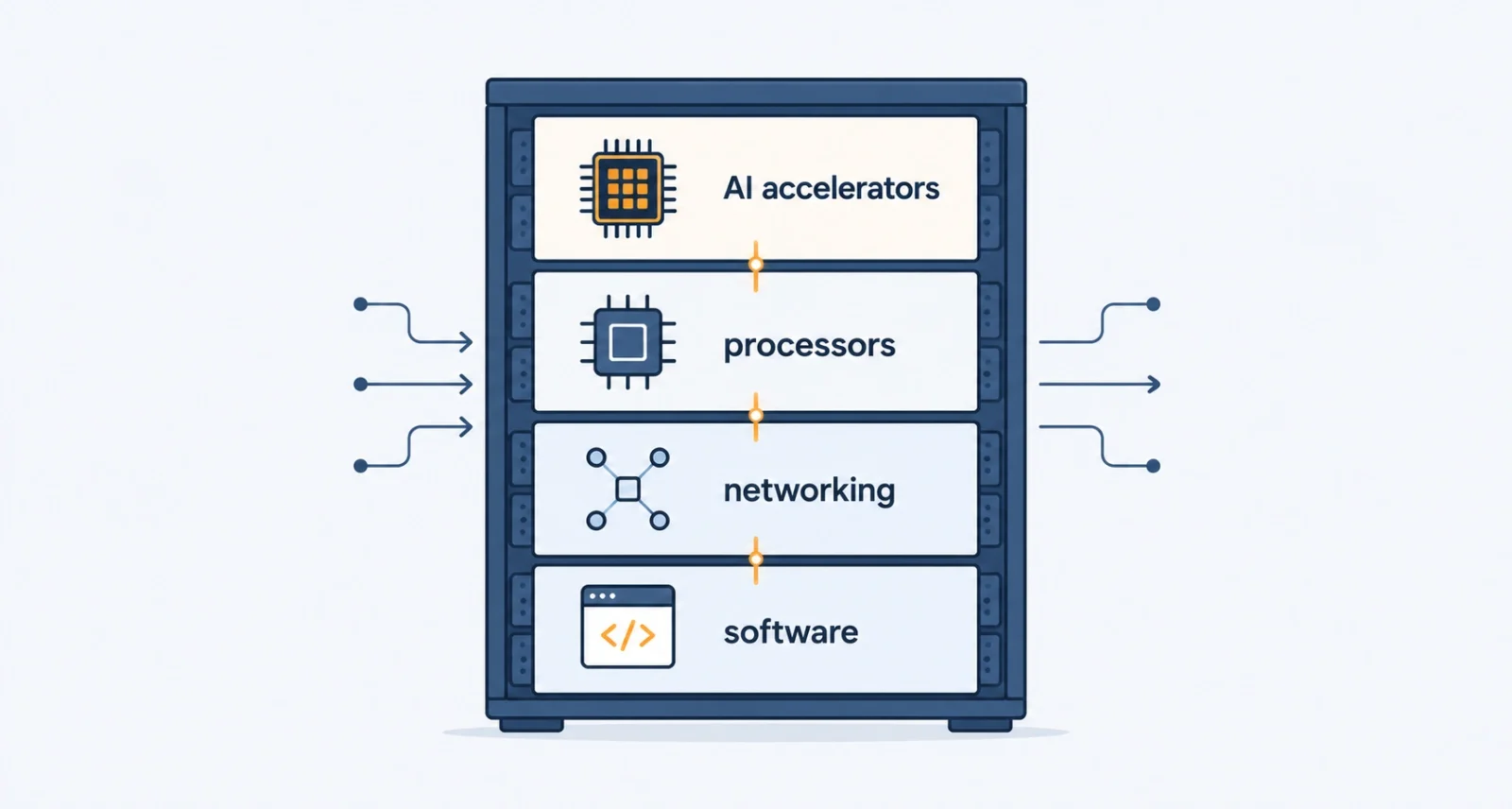
The name gives away the design. As CNBC reported after touring AMD’s development lab in Rockdale, Texas, the name comes straight from Greek myth. Helios was the sun god who crossed the sky drawn by four horses. The system pulls together exactly four things AMD builds in house.
| The Four Parts | The Job It Does |
| Instinct MI455X GPUs | Do the actual AI math, 72 of them per rack |
| EPYC Venice CPUs | Coordinate the work and handle everything the GPUs do not |
| Pensando networking | Keep all those chips talking without a traffic jam |
| ROCm software | Let developers write code that runs on the hardware |
Why sell it this way? Because a modern AI model does not fit on one chip. It spreads across dozens, and those chips spend much of their time waiting on each other. When one company designs the processors, the network, and the cooling together, less time gets wasted in transit. That shift matters commercially too. For most of the GPU era AMD sold components that someone else assembled, which meant competing on one part of the system. Selling the whole rack changes what it competes on.
The Three New Azure Machines, Decoded
Alongside the racks, Azure is adding three virtual machine families. Each targets a different job, and the naming tells you nothing, so here is the translation.
| The Machine | Built For | Who Would Rent It |
| ND MI455X v7 | Large-scale AI inference, running on Helios | Companies serving AI models to lots of users |
| Azure HDv2 | Agentic AI and data pipelines | Teams building AI agents and preparing training data |
| Azure HXv2 | Chip design, simulation, engineering analysis | Semiconductor and engineering firms running heavy math |
HXv2 has an unusually credible reference customer. AMD itself uses Azure HX machines to design future EPYC processors and Instinct accelerators. That makes a neat loop. AMD rents Microsoft’s cloud, running on AMD chips, to design the next AMD chips. The new version adds 800 gigabit InfiniBand networking, which matters for simulations that split one problem across many machines at once.
Why Inference Is the Real Story Here
Notice which word Microsoft used. Not training. Inference.
Training is the expensive one-time process of building a model. Inference happens every single time someone asks that model a question, and it never stops. As AI assistants and agents spread into everyday products, inference becomes the larger and steadier bill. It runs every hour of every day rather than in bursts.
That changes what buyers optimize for. Peak benchmark speed matters less than cost per answer. Forrest Norrod, who leads AMD’s data center business, told CNBC the company is focused on total cost of ownership and the “lowest cost per token”. Tokens are the small chunks of text an AI model reads and writes, so cost per token is simply the price of producing an answer. Competing on that number, rather than on raw speed, is a shrewder fight to pick.
| Quick Take Training an AI model is like writing a textbook. Inference is like answering every reader who asks a question about it, forever. The textbook gets written once. The questions never stop, and that is where the money now goes. |
What This Means for Nvidia
Honesty helps here, because the excitement around this deal outruns the numbers. Nvidia still holds more than 95 percent of the data center GPU market. AMD sits somewhere near 4 or 5 percent. One cloud deal does not undo that.
What has changed is the shape of the contest. As Tom’s Hardware notes, Helios puts AMD in direct competition with Nvidia’s own rack-scale systems rather than just its chips. Microsoft, Meta, OpenAI, and Oracle all signing up suggests the biggest AI buyers want a second supplier, if only for bargaining power.
The obstacle is software, not silicon. Nvidia’s deepest advantage is CUDA, the programming platform developers have built around for well over a decade. The libraries and working habits grew up alongside it. AMD’s ROCm has improved a great deal, and Microsoft committing to run frontier model inference on it counts as a real vote of confidence. Even so, running some production work well and matching CUDA everywhere remain different achievements. Analysts split on this point. Some at Futurum Group project AMD could eventually reach a fifth or a quarter of the market. Others at Counterpoint Research caution that matching hardware performance alone will not win customers.
The Part Most Coverage Skips
Read almost any report on this announcement and you would think you could go and rent a Helios machine this afternoon. You cannot.
None of the three new virtual machine families can be provisioned today. Microsoft published no pricing, no list of regions, and no general availability date. AMD says shipments begin in the second half of 2026, a window that stretches from July to December. For anyone actually planning infrastructure, this is a roadmap announcement rather than a product launch.
| The Catch Nobody Prints on the Box If you run workloads on Azure today, the practical takeaway is to start evaluating, not migrating. Anyone considering a move from existing AMD-based Azure machines will need real benchmarks on their own code before committing, because published peak figures rarely survive contact with a specific workload. Treat the announcement as a signal about direction, and revisit when pricing and regions appear. |
What to Watch Next
The next milestone arrives almost immediately. AMD holds its Advancing AI 2026 conference in San Francisco on July 22 and 23, where the company is expected to detail its roadmap. Analysts expect technical specifications and timing rather than fresh customer announcements, and any concrete availability window for the Azure machines would most likely surface there.
After that, three things are worth tracking. Watch for pricing and regional availability, because those determine whether Helios competes on cost or only on paper. Watch for independent benchmarks from customers running their own code, rather than vendor figures. And watch how quickly developer tooling matures, since software adoption, not hardware capability, decides whether this becomes a genuine second option or a niche one.
Strip out the product names and this deal says something simple. AI infrastructure has stopped being a market for chips and become a market for complete systems. Nvidia is no longer the only company selling one. Microsoft putting Helios into Azure gives that shift real weight, because hyperscalers do not adopt unproven platforms for their most demanding work.
Frequently Asked Questions
What is AMD Helios?
AMD Helios is a rack-scale AI system. That means a full cabinet of computing equipment that ships and installs as one designed unit rather than as separate parts. Each rack holds 72 Instinct MI455X accelerators alongside EPYC Venice processors, Pensando networking, and AMD’s ROCm software. It targets large-scale AI training and inference work.
What did Microsoft and AMD announce?
On July 20, 2026, the companies expanded their partnership across GPUs, CPUs, networking, and software. Microsoft will deploy Helios racks at scale on Azure for AI inference. It also adds two new virtual machine families running 6th-generation EPYC Venice processors, and widens its use of AMD Pensando networking chips alongside Azure Boost.
When can I use AMD Helios on Azure?
No date exists yet. AMD says Helios shipments to customers, Microsoft included, begin in the second half of 2026, which covers anything from July to December. Microsoft has released no pricing, no regional availability, and no launch date for the three new machine families. None can be provisioned yet.
Does this mean AMD is beating Nvidia?
No. Nvidia still holds more than 95 percent of the data center GPU market, leaving AMD with a low single-digit share. The significance is competitive rather than numerical. Helios lets AMD compete against Nvidia’s complete rack systems instead of only its chips, and major buyers clearly want a second supplier.
What is the difference between AI training and inference?
Training builds the model, an expensive process done relatively rarely. Inference runs the finished model to answer each request, which happens constantly once a product ships. Microsoft specified inference for its Helios deployment, reflecting how running AI services day to day now consumes more compute than building models does.
Why does ROCm matter in this deal?
ROCm is AMD’s software platform, equivalent to Nvidia’s CUDA. Hardware alone does not win customers, because developers need mature tools, libraries, and support for the code they already run. Microsoft agreeing to run frontier model inference on AMD hardware signals growing confidence in ROCm, though matching CUDA across all workloads remains unproven.

