
A company pledging money to a government science program is not usually interesting. This one is, for a reason that has nothing to do with the number.
The Microsoft Genesis Mission commitment comes with four research projects that are already running inside American national laboratories. One of them is teaching a nuclear reactor to run under remote control. Another is trying to spot the next outbreak before it starts. Here is what Microsoft announced, what the money actually buys, and which parts deserve your skepticism.
| The Short Answer On July 22, 2026, Microsoft committed $60 million to the Department of Energy’s Genesis Mission, a national effort to build AI into American scientific research. The money splits into $40 million of Azure computing credits over three years and $20 million of engineering support. Microsoft also launched SPARK, a program office acting as the single point of contact for labs wanting to work with it. The Genesis Mission itself is far larger, backed by more than $5 billion in federal commitments and spanning the DOE’s 17 national laboratories, with a stated goal of doubling the productivity of American research within a decade. |
What Is the Genesis Mission?
Start here, because the Microsoft announcement makes little sense without it.
The Genesis Mission is a United States government programme to embed AI directly into how scientific research gets done. An executive order created it in November 2025, and the White House leads it, with the Department of Energy at its center. It connects the DOE’s 17 national laboratories, their experimental facilities, and decades of accumulated scientific data into one platform.
Its stated goal is deliberately ambitious. The programme aims to double the productivity and impact of American research within ten years. On the same day as the Microsoft announcement, the White House announced more than $5 billion in federal commitments, and the DOE unveiled funding for hundreds of individual projects.
| Quick Take Think of it as trying to give every national lab the same AI tooling at once, rather than letting each one figure it out alone. The bet is that the bottleneck in modern science is no longer collecting data but making sense of it, and that AI is better placed to close that gap than more scientists working the same way. |
Microsoft Genesis Mission: Where the $60 Million Goes
The split matters more than the total, and it tells you what Microsoft thinks the actual problem is.
| The Commitment | What It Covers | Over What Period |
| $40 million in Azure credits | Computing and AI capacity for large-scale scientific workloads | Three years |
| $20 million in engineering services | Architecture, deployment, and adoption support from Microsoft teams | Not specified |
That second line is unusual. Most corporate pledges to public programmes are pure credit. That looks generous and often goes underused, because nobody at the receiving end has time to build with it. Committing a third of the package to human engineering support suggests Microsoft has watched that happen before.
What SPARK Actually Is
Alongside the money, Microsoft created a program office called SPARK, short for Scientific Partnership Advancing Research and Knowledge. Microsoft describes it as “the single front door” for labs that want to work with the company on Genesis Mission projects.
That sounds like corporate housekeeping. It is arguably the most practical part of the announcement. The usual failure mode in government and industry partnerships is not technology but coordination, with each lab negotiating separately and repeating the same conversations.
| SPARK Commitment | What It Means in Practice |
| Program management office | One intake point, set review cycles, a standing interface with the DOE |
| AI for Science Center of Excellence | A delivery team that takes projects from idea to working system |
| Azure credit optimization | Directing computing capacity toward projects that benefit most |
| Technical services management | Hands-on help for labs adopting the tools |
| Joint research and development | Shared challenge problems with agreed milestones and IP terms |
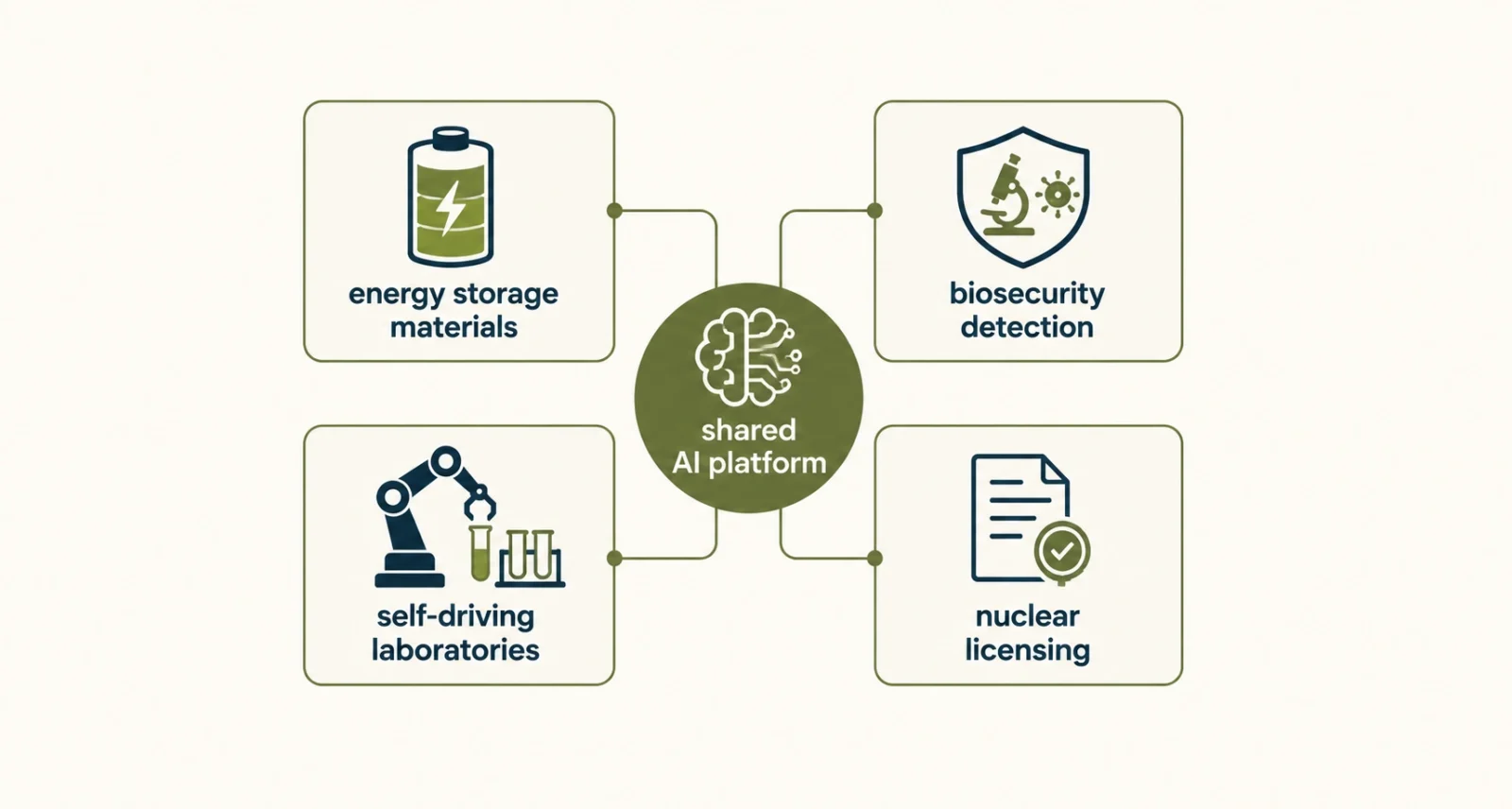
Four Projects Already Running
This is the part worth your attention. These are not proposals, they are collaborations already producing results, and each one has a public trail you can follow.
Batteries and Self-Driving Biology Labs
At the Pacific Northwest National Laboratory, researchers are using AI to speed up the search for new energy storage materials. Microsoft says analysis that once took years now takes weeks. The more striking half is biosystems design. There the software plugs into the lab’s automation equipment and runs biological experiments that design and adjust themselves in real time.
Spotting the Next Outbreak Sooner
At Lawrence Livermore National Laboratory, the work pairs AI with bioinformatics to identify emerging biological threats earlier. In practical terms, that means compressing the gap between a new pathogen appearing and anyone realizing it matters.
Laboratories That Run Their Own Experiments
At the Johns Hopkins University Applied Physics Laboratory, the goal is self-driving labs. Foundation models named MatterGen and MatterSim design candidate materials, and robotics run the experiments. Results feed back into the next round without a human in the loop for each step. The targets are structural materials and superconductors.
Cutting the Nuclear Paperwork Mountain
At Idaho National Laboratory, researchers are applying AI to nuclear licensing and permitting. The software automates the enormous engineering and safety documentation that new reactor projects require. The lab also demonstrated remote autonomous power control of a research reactor over secure cloud infrastructure.
| Worth Knowing The nuclear licensing project is the least glamorous and possibly the most consequential. New reactors in the United States are slowed far more by documentation and review cycles than by engineering. If AI genuinely shortens that process without weakening safety review, it affects the energy supply more directly than any new material discovered in a lab. |
The Technology Underneath
Two Microsoft products carry most of this. Microsoft announced both before the Genesis Mission commitment rather than for it.
Microsoft Discovery is the research platform, now generally available. It combines AI models, simulation, data and experimental workflows in one governed environment. It also supports autonomous lab orchestration, meaning software can direct physical laboratory equipment. A desktop version of the app is in preview. Underneath sits Microsoft’s FedRAMP-authorized cloud stack, including Azure, Microsoft Foundry, and security through Defender, Sentinel and Entra. That authorization is what allows any of this to touch government research.
The quantum piece is more speculative. Microsoft points to its Majorana-based topological qubits as a route toward modelling chemistry, materials and energy systems. Classical computers struggle with all three. Treat that as direction of travel rather than available capability, because practical quantum advantage in these areas has not arrived yet.
How Big Is $60 Million, Really?
Context is where most coverage of announcements like this falls down, so here is the honest scale.
| The Commitment | Amount | Source |
| Federal commitments to Genesis Mission | More than $5 billion | White House |
| National Science Foundation data infrastructure | $83 million | NSF |
| Microsoft | $60 million | Microsoft |
| $40 million in AI resources |
Two honest readings follow from that table. Microsoft’s contribution is the largest corporate commitment announced so far, which is a genuine distinction. It is also roughly one percent of the federal money, and small for a company of Microsoft’s size, which means the strategic value matters more than the sum.
| The Catch Nobody Prints on the Box Read this as commercial strategy as well as public good, because both are true at once. Embedding Azure, Microsoft Discovery and Microsoft security tooling into national laboratory workflows creates a dependency. That dependency outlasts a three-year credit package. That is not a scandal, it is how vendor relationships work, but a $60 million entry price into the infrastructure of American federal science is a bargain if it holds. Worth watching whether the labs retain the ability to move elsewhere later. |
What This Means for You
Most readers do not run a national laboratory, so the practical effects are indirect but real.
- Energy first. Faster nuclear licensing and better battery materials both feed into electricity supply and cost, which is the most direct line from this work to an ordinary household.
- Biosecurity next. Earlier detection of biological threats is the kind of capability nobody notices until it is needed, and then it matters enormously.
- Timelines are long. Scientific research does not convert into products quickly. Judge this over years, not quarters, and be wary of anyone promising otherwise.
- Watch the measurement. Doubling research productivity in a decade is a striking claim. Nobody has yet explained how they intend to measure it. That is the number to hold the programme against.
Strip away the announcement language and two things remain. A government programme is trying to change how national laboratories do science. One of the largest cloud companies has bought a substantial seat at that table for a modest sum. Both statements are true, and neither cancels the other.
Frequently Asked Questions
What is the Genesis Mission?
It is a United States government initiative to build AI into scientific research. An executive order created it in November 2025, and the White House leads it with the Department of Energy at its center. It connects the DOE’s 17 national laboratories, their facilities and their data into a shared platform, with a stated goal of doubling American research productivity within a decade.
How much did Microsoft commit to the Genesis Mission?
Microsoft committed $60 million. That splits into $40 million in Azure computing and AI credits over three years, plus $20 million in solution engineering services covering architecture, deployment and adoption support. The company also launched SPARK, a coordination hub and program office for Genesis Mission collaboration.
What does SPARK stand for?
SPARK stands for Scientific Partnership Advancing Research and Knowledge. It is Microsoft’s program office for the Genesis Mission. Five commitments sit under it: a program management office, an AI for Science Center of Excellence, optimization of Azure credits, management of technical services, and joint research and development with agreed milestones and IP terms.
Which national laboratories are working with Microsoft?
Microsoft named four collaborations at announcement. Pacific Northwest National Laboratory works on energy storage materials and automated biosystems design. Lawrence Livermore National Laboratory covers biosecurity detection. Johns Hopkins University Applied Physics Laboratory builds self-driving laboratories for materials discovery, and Idaho National Laboratory handles nuclear licensing and autonomous reactor operations.
Is Microsoft the only technology company involved?
No. Google committed $40 million in AI resources to the same programme. The National Science Foundation invested $83 million in supporting data infrastructure. Microsoft’s $60 million is the largest single corporate commitment announced so far, though all of it sits alongside more than $5 billion in federal commitments.
Will this actually double American research productivity?
Nobody knows, and the claim deserves scrutiny. It is the programme’s stated ten-year goal rather than a prediction anyone has demonstrated, and nobody has published a clear method for measuring research productivity at that scale. The concrete projects already running are stronger evidence of progress than the headline target.

