
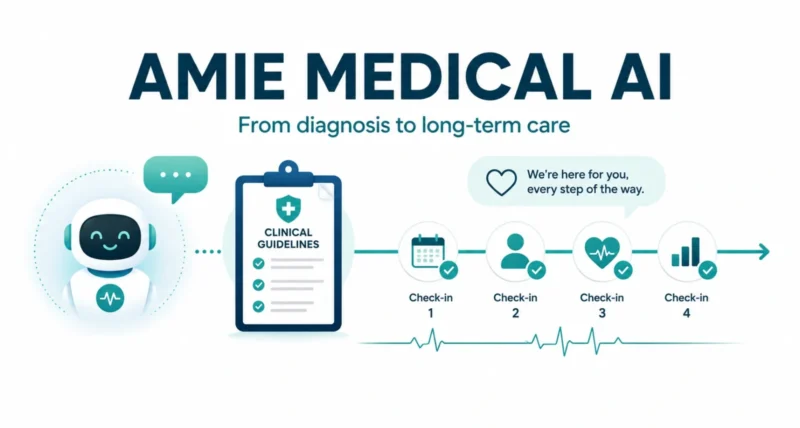
Getting a diagnosis is only step one. The hard part is what comes after: managing a condition for months or years, tracking symptoms, adjusting medications, and keeping up with changing guidelines. Now Google’s research AI has shown it can help with that harder part too. As Google announced, a new study in the journal Nature found its medical AI, AMIE, matched primary care doctors at managing health conditions. Here is what that means, explained simply.
| Quick Answer AMIE is Google’s research AI for medical conversations and reasoning. A new study in Nature extends it from diagnosing illness to managing conditions over time. In a blinded test against 21 primary care doctors, AMIE matched them on overall management reasoning and scored higher on treatment-plan precision and guideline adherence. It is a research system, not a product, and not a replacement for your doctor. |
| Please Note This article explains a research study. AMIE is not a medical product, is not available to the public, and should never be used to diagnose or treat anyone. Always see a qualified healthcare professional for medical advice. |
What Is AMIE
AMIE stands for Articulate Medical Intelligence Explorer. It is Google’s research AI built specifically for medical reasoning and conversations, the kind of back-and-forth a doctor has with a patient. Until now, researchers studied AMIE mainly for diagnosis, working out what might be wrong from a conversation.
This new research takes it a big step further: from diagnosing a condition to managing it over the long term. That shift matters, because for most patients, the years of care after a diagnosis are where the real work happens.
| Why It Matters Diagnosis is a single moment, but managing a chronic condition is a long journey of follow-ups and adjustments. An AI that can help with that ongoing work could ease pressure on overstretched doctors and give them more time with patients. |
Why Managing a Disease Is So Hard
Think about someone with a long-term condition like diabetes or high blood pressure. Their care is not one appointment, it is dozens, stretched over years.
- Symptoms change over time and have to be tracked carefully across many visits.
- Medications need fine-tuning, with doses adjusted as the patient responds.
- Guidelines keep updating, so the best treatment today may differ from last year’s.
Keeping all of this straight, for every patient, is demanding work. That is the challenge this version of AMIE aims to help with.
How AMIE Works, in Simple Terms
The clever part is that AMIE is not one single AI. It works as two specialists together, drawing on Gemini’s ability to read and hold huge amounts of information at once.
| The Two Parts | What It Does |
| Empathetic dialogue agent | Handles the real-time conversation with the patient, with a caring, clear tone |
| Management reasoning agent | Thinks deeply, cross-referencing hundreds of pages of clinical guidelines and drug information |
So one part talks with the patient, while the other does the heavy medical thinking in the background, checking treatment options against trusted, up-to-date clinical knowledge. Together they produce a careful management plan.
| The Cool Part AMIE can cross-reference hundreds of pages of medical guidelines and drug formularies in seconds, then explain its thinking in a warm, plain-language conversation. It pairs deep knowledge with a good bedside manner. |
What the Nature Study Found
This is the headline. The research was published in Nature, one of the most respected scientific journals in the world, which is a high bar for credibility.
In the study, specialist physicians ran a blinded comparison between AMIE and 21 primary care doctors, using trained patient actors. Blinded means the reviewers did not know which responses came from the AI. The results were striking.
- It matched the doctors on overall management reasoning, the core skill of figuring out how to care for a patient.
- It scored higher on plan preciseness, meaning its treatment plans were more exact.
- It scored higher on guideline alignment, meaning it followed established clinical best practices more closely.
| Worth Knowing Matching real doctors in a blinded, expert-judged study is a serious result, not a marketing claim. Publication in Nature means the work passed rigorous review by independent scientists. |
What This Does Not Mean
It is just as important to be clear about the limits. This is promising research, not a finished tool, and a few caveats matter a lot here.
- It is not a product. AMIE remains a research system you cannot download or use.
- It used patient actors, not real patients. The study ran as a controlled test, not live medical care.
- It is not a replacement for your doctor. The goal is to support clinicians, not replace the human relationship at the heart of care.
Google frames it as a way AI could someday support medical care and give physicians more time with patients, rather than take the doctor out of the equation.
What Comes Next for AMIE
The research is moving carefully toward the real world. Google says it is exploring how AMIE could work in actual clinical settings, and it has launched a nationwide study to test AI in real virtual care. You can read the underlying paper in Nature for the full detail.
That step-by-step, evidence-first approach is the right one for medicine, where being careful matters far more than being fast.
AMIE matching doctors at disease management is a genuine milestone for medical AI, and the careful, peer-reviewed way Google is testing it is just as notable as the result. The promise is real: AI that helps manage the long, complex journey of care, giving doctors more time for patients. The caution is real too: this is research, not a tool, and your doctor stays at the center of your care. You can read the announcement on the Google blog.
Frequently Asked Questions
What Is AMIE
AMIE, the Articulate Medical Intelligence Explorer, is Google’s research AI for medical reasoning and patient-style conversations. New research extends it from diagnosis to managing conditions over time.
Can I Use AMIE
No. AMIE is a research system, not a public product. It is not available to use and should never be used to diagnose or treat any health condition.
What Did the Nature Study Show
In a blinded study against 21 primary care doctors using patient actors, AMIE matched them on overall management reasoning and scored higher on plan precision and guideline adherence.
Does This Mean AI Will Replace Doctors
No. Google frames AMIE as a way to support doctors and free up their time, not replace them. The human relationship remains central to care.
How Does AMIE Work
It uses two Gemini-powered AI agents: one handles the patient conversation with an empathetic tone, and the other does deep reasoning against clinical guidelines and drug information.
Why Is Publication in Nature Important
Nature is a top peer-reviewed scientific journal, so independent experts reviewed the research before publication, a strong signal of credibility.

