
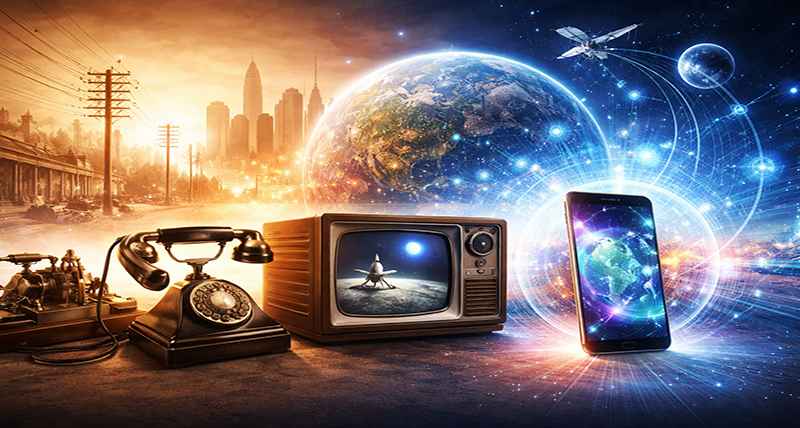
Communication technology is the backbone of modern civilization. Every major shift in society, from global trade to digital media, has been driven by innovations that allowed information to travel faster and reach more people.
Today, a message can move across continents in seconds. Instant communication feels normal, yet this ability is the result of nearly two centuries of technological progress. The journey from the telegraph to the internet reshaped how humans exchange knowledge, conduct business, share news, and connect with one another.
Understanding the history of communication technology helps explain how the modern digital world developed and why communication networks remain one of the most important infrastructures of the global economy.
The Telegraph: The First Electronic Communication Revolution
Before the nineteenth century, long distance communication depended on physical travel. Letters moved through ships, horses, or trains, often taking days or even weeks to reach their destination.
The invention of the telegraph changed this reality completely.
During the 1830s and 1840s, telegraph systems allowed messages to travel through electrical signals sent along wires. Operators used Morse code, a system of dots and dashes, to convert written language into electrical pulses that could be transmitted across long distances.
For the first time in human history, information could travel faster than people or transportation.
Telegraph networks rapidly expanded across the United States and the United Kingdom before spreading throughout Europe and Canada. By the late nineteenth century, transatlantic telegraph cables connected North America and Europe, enabling international communication in minutes instead of weeks.
The telegraph revolutionized journalism, finance, and government communication. News agencies could report global events almost instantly, financial markets could share price information across cities, and governments could coordinate policies more efficiently.
This technology marked the beginning of the modern communication age.
The Telephone: Voice Communication Across Distance
While the telegraph allowed coded messages to travel through wires, the next major breakthrough enabled something even more powerful, which is the human voice.
The telephone introduced direct voice communication over electrical networks. Instead of sending Morse code, users could speak naturally and hear responses in real time.
Telephone networks expanded rapidly during the late nineteenth and early twentieth centuries across countries, including the United States, Canada, and the United Kingdom. Businesses quickly adopted telephone systems to coordinate operations, while households began using them for everyday communication.
Telephone exchanges and switching systems were developed to manage the growing number of calls. These systems allowed large networks of users to connect efficiently.
By the mid-twentieth century, international telephone lines connected major cities around the world, further strengthening the global communication infrastructure.
The telephone transformed business operations, emergency services, and personal relationships by making real-time conversation possible across great distances.
Radio Communication: Wireless Information Sharing
The early twentieth century introduced another revolutionary shift in communication technology.
Wireless transmission.
Radio communication allowed signals to travel through electromagnetic waves instead of physical wires. Messages and audio could now be broadcast across large geographic regions.
Radio quickly became one of the most influential communication technologies of the twentieth century.
Governments used radio broadcasts to communicate with citizens, especially during emergencies and major political events. News organizations delivered real-time updates to listeners, while entertainment programs such as music and storytelling attracted millions of audiences.
Radio also played a crucial role during major global events by quickly disseminating information to the public.
Wireless communication technology later laid the foundation for modern mobile networks, satellite systems, and wireless internet technologies.
Television: The Era of Visual Communication
Television added a powerful new dimension to communication by combining sound with moving images.
During the mid-twentieth century, television broadcasting expanded rapidly in countries such as the United States, Canada, and the United Kingdom, as well as across Europe.
Television allowed audiences to witness global events visually as they happened. Political speeches, international sports events, cultural moments, and breaking news could be experienced by millions of viewers simultaneously.
This technology reshaped journalism, advertising, entertainment, and political communication.
Visual storytelling became a powerful medium for sharing information and influencing public opinion.
Television also accelerated the development of satellite communication systems, enabling international broadcasting across continents.
Satellite Communication: Global Connectivity
The launch of communication satellites marked another major milestone in the history of communication technology.
Satellites made it possible for signals to travel across vast distances without relying entirely on cables or ground infrastructure.
Satellite communication enabled international television broadcasting and improved global telephone services. It also made communication possible in remote regions where traditional networks were difficult to build.
Navigation systems, weather forecasting, international broadcasting, and early data networks all benefited from satellite technology.
For the first time in history, communication networks could operate on a truly global scale.
The Rise of the Internet
The most transformative development in communication technology arrived with the internet.
Originally developed as a research network, the Internet connected computers so they could exchange digital information through standardized communication protocols.
Unlike earlier communication systems that focused mainly on voice or broadcasting, the internet allowed multiple forms of digital interaction, including email, websites, file sharing, and digital messaging.
The introduction of the World Wide Web in the early 1990s made the internet accessible to the general public. Websites enabled individuals, companies, universities, and governments to publish information globally.
Internet adoption expanded rapidly across technologically advanced nations, including the United States, the United Kingdom, Canada, Iceland, and Austria.
Businesses began building digital platforms, educational institutions launched online resources, and global communication became faster and more accessible than ever before.
The internet created a decentralized network where billions of devices could exchange information instantly.
Mobile Communication and the Smartphone Era
Mobile communication introduced the next stage in the evolution of global connectivity.
People were no longer tied to fixed locations, such as offices or homes, in order to communicate.
Mobile phones allowed users to make calls while traveling, but the true transformation arrived with smartphones.
Smartphones combined voice communication, internet access, messaging, photography, and multimedia sharing into a single device. High-speed mobile networks such as 4G and 5G enabled fast data transmission that supports video calls, social media, streaming services, and cloud communication.
Today, smartphones serve as the primary communication device for billions of people worldwide.
Mobile technology has connected global communities, enabled digital businesses, and created new forms of social interaction.
Communication Technology in the Age of Artificial Intelligence
Communication systems are now entering a new phase driven by artificial intelligence.
Artificial intelligence technologies help analyze, organize, and deliver information across digital networks more efficiently. Search engines, digital assistants, messaging platforms, and productivity tools increasingly rely on AI to improve communication experiences.
AI-powered translation tools allow users to communicate across languages instantly. Intelligent search systems help users find relevant information faster. Automated content systems help businesses deliver personalized communication at scale.
Artificial intelligence is becoming an integrated layer within modern communication infrastructure.
As AI technology advances, communication will become more intelligent, adaptive, and personalized.
The Global Impact of Communication Technology
The evolution of communication technology has transformed nearly every aspect of society.
Businesses can coordinate international operations in real time. Financial markets operate with instant global data exchange. News organizations can report events within minutes of their occurrence.
Education has expanded through digital platforms that allow students to access learning resources from anywhere in the world.
Governments use communication networks to quickly share policies, public announcements, and emergency alerts with large populations.
Families and communities separated by great distances can stay connected through messaging applications, video calls, and social networks.
Modern economies and global cultures depend heavily on the communication technologies developed over the past two centuries.
The Future of Communication Technology
The future of communication technology will focus on speed, intelligence, and global accessibility.
Next-generation internet infrastructure, advanced satellite networks, and artificial intelligence-powered communication systems are expected to redefine how information moves across the world.
Emerging technologies such as immersive digital environments, virtual collaboration systems, and intelligent communication platforms may transform how people interact online.
The evolution that began with simple telegraph signals has now grown into a complex digital ecosystem connecting billions of people.
Communication technology continues to shape how societies exchange knowledge, build relationships, and operate within the global information economy.
The journey from telegraph wires to the internet reflects one of the most important technological transformations in human history.

