
Almost everything written about AI and jobs is a prediction. This is not. Google has published data on what 15 million real conversations with its AI tools were actually about, and the picture it paints is calmer than the forecasts.
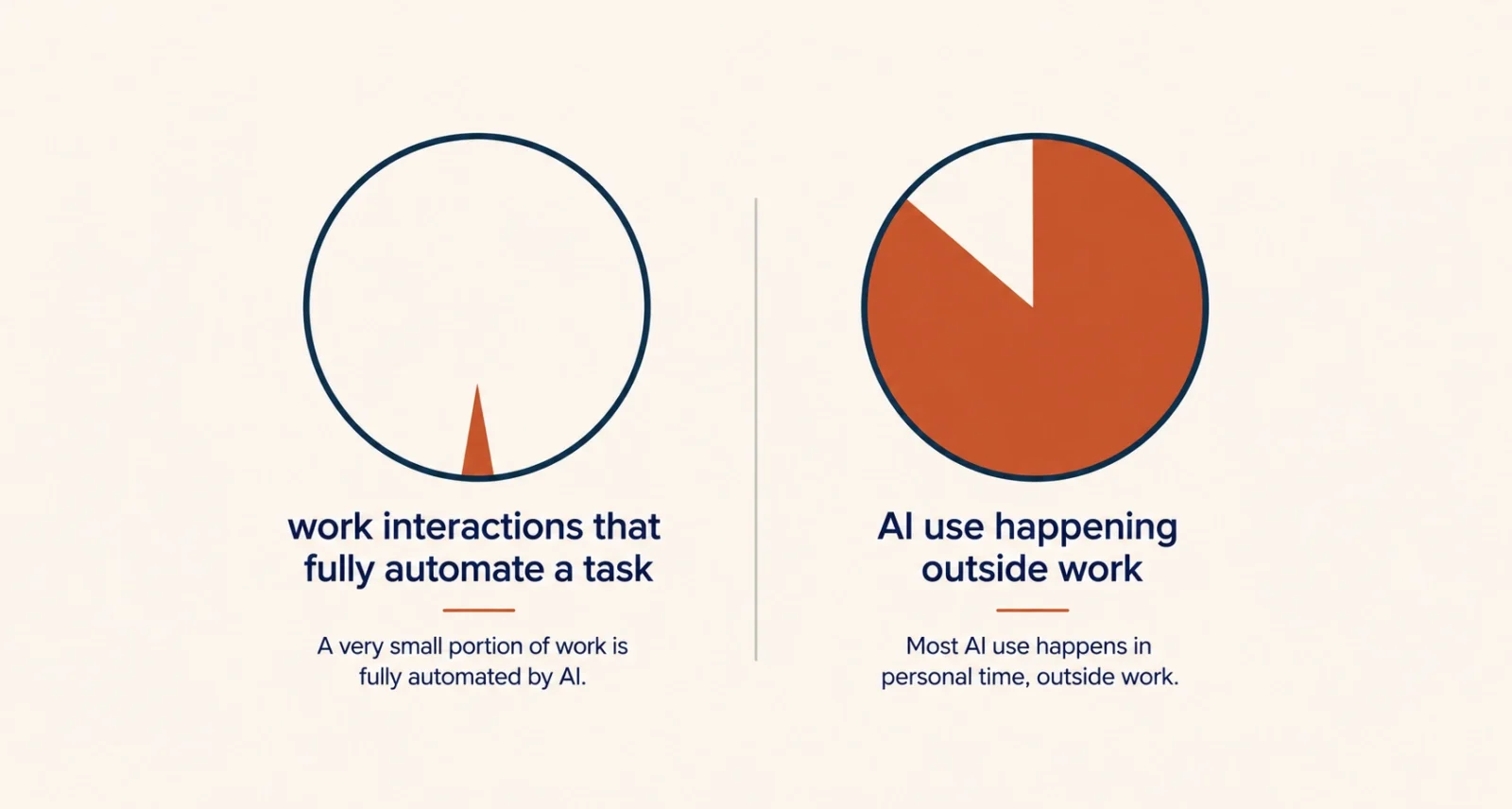
The Google ATLAS report is the largest study yet of how people genuinely use AI. Two numbers do most of the work in it. Fewer than one in ten work interactions fully automate a task, and more than 86 percent of all AI use happens outside work entirely. Here is every finding, what it means for you, and where the study is weakest.
| The Short Answer ATLAS stands for Activity, Task, Landscape, and Adoption Study. Google built it from 15 million de-identified conversations across the Gemini app, AI Mode, and the Gemini API, covering more than 150 countries, 140 languages, 800 occupations, and 4,000 tasks. The headline findings: AI use at work is wide but thin, reaching 68 percent of occupations yet only around 21 percent of tasks within a typical job. Under 10 percent of work interactions fully automate anything. Most usage is collaborative. And the large majority of AI use happens at home rather than at work. |
What the Google ATLAS Report Actually Is
Before the findings, a quick sense of the scale, because it explains why this study carries more weight than the survey research it replaces.
Most claims about AI adoption come from asking people what they think they do. ATLAS looks at what they actually did, using de-identified records of real conversations. Google’s announcement describes it as an ongoing study rather than a one-off, with this first version marked v1.0.
| What ATLAS Covers | The Scale |
| Conversations analyzed | 15 million, de-identified and aggregated |
| Products included | Gemini app, AI Mode, and the Gemini API |
| Monthly users of those products | More than 1 billion |
| Countries and territories | More than 150, covering 99 percent of world population |
| Languages | 140 |
| Occupations and tasks | 800 occupations, 4,000 tasks |
The Five Findings, One at a Time
Google published five headline observations. Taken together they tell a coherent story, so read them in order rather than skipping to the one that sounds most dramatic.
Finding 1: AI use at work is broad but shallow
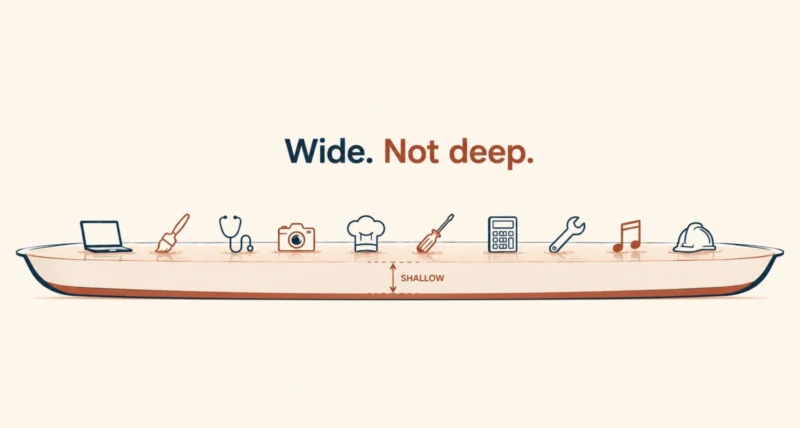
Adoption reaches every industry sector and 68 percent of all occupations. Those occupations together account for 90 percent of total United States employment. That sounds like saturation. The second half of the finding matters more. Within a typical job, people use AI for only about 21 percent of their tasks. Almost everyone has touched it. Almost nobody runs their whole role through it.
Finding 2: Almost nothing is fully automated
This is the number that contradicts most headlines you have read. Fewer than 10 percent of work interactions fully automate a task. The vast majority are collaborative: brainstorming, strategy, looking things up, and learning. Google also found something notable about the kind of work involved. Non-routine cognitive tasks, meaning things like creative design and hypothesis testing, appear in AI conversations far more often than in the economy at large, at 65 percent against 35 percent.
Finding 3: Mechanics are using it, not just office workers
The assumption that AI is a knowledge-work tool does not survive the data. Workers in manual and technical trades use conversational AI as a live problem-solving partner. That includes automotive technicians and industrial mechanics handling diagnostics and troubleshooting. When these workers use AI, they are twice as likely to use it multimodally, meaning with images or video. Real examples include interpreting complex test results, debugging electrical wiring, and inspecting machinery for wear.
Finding 4: Most AI use happens at home
More than 86 percent of interactions in the study occur outside work. People use AI for productive household activity such as researching purchases and working out how to use an appliance. They also use it heavily for high-friction admin, specifically navigating government services like taxes, licensing, and fines. Google notes that none of this shows up in standard economic statistics, so the measurable economy is missing most of what AI currently does.
Finding 5: Adoption follows national wealth, mostly
Usage appears in more than 150 countries representing 99 percent of the world population. English accounts for only around a third of conversations. People also do not abandon their own languages for complex tasks. On a per-person basis, though, usage closely tracks a country’s relative wealth, which points to a persisting digital divide. The exceptions are interesting: some middle-income countries in South America and the Middle East adopt at rates matching richer nations.
What This Means for Your Work
Data is only useful if it changes something. Four practical readings follow from the findings above.
- Stop asking whether AI will replace your job. Ask instead which fifth of your tasks it already fits. That question the data actually supports, and you can answer it this week rather than in ten years.
- If you work in a trade, you are not outside this. The mechanics in the study are using photos and video to get help with real diagnostics, which is the most under-reported finding in the whole report.
- Use it for the admin you hate. Tax forms, license applications, appliance manuals and fine notices are exactly where the study found the most friction removed. None of it requires any special skill.
- Treat collaboration as the skill worth building. Under a tenth of interactions automate anything outright. The people getting value work alongside these tools rather than handing tasks over wholesale.
How It Compares With Anthropic’s Data
Google is not the first AI company to publish this kind of study, and the comparison is genuinely useful.
Anthropic has run its Economic Index since December 2024, using anonymized Claude conversations classified against a United States government job database. Its findings looked different. Usage concentrated heavily in software development and technical writing, with computer and mathematical work making up a large share of conversations.
| Worth Knowing Do not read that difference as a contradiction. The two studies measure different products with different user bases, and Claude has always skewed toward developers while Gemini reaches a far broader consumer audience. What is striking is that both, using different methods on different data, land on the same core conclusion. AI is being used across a wide range of occupations, for a modest share of tasks within each, and mostly as an assistant rather than a replacement. |
How Much Should You Trust It?
Two things deserve saying plainly, and they pull in opposite directions.
The obvious caveat first. This is Google measuring Google products and publishing the result itself, with no external peer review. A company with a commercial interest in AI adoption reporting on AI adoption is not a neutral arrangement, however careful the methodology.
Against that, the report acknowledges contributions from Dame Diane Coyle of Cambridge and Dr David Autor of MIT. Autor in particular is among the most cited labor economists working on technology and employment, and neither name is one you attach lightly to weak work. That does not make ATLAS peer-reviewed research, but it is a meaningful signal.
| What ATLAS Leaves Out | Why It Matters |
| Google Workspace and Translate | Billions of interactions excluded from the totals |
| AI Overviews in Search | The most widely encountered AI feature is absent |
| Gemini Enterprise and Cloud | Business usage is largely missing |
| Agentic coding and world models | The frontier capabilities are not represented |
| Every other company’s AI tools | No OpenAI, Anthropic, Meta or Microsoft data |
That last row is the one to keep in mind. ATLAS describes how people use Google’s AI, not how people use AI. The distinction sounds pedantic and is not.
How Google Built ATLAS
The method matters if you plan to cite the numbers, and the privacy handling is more thorough than most corporate research.
Google DeepMind built a tool called OCTO, short for Observation Clustering and Taxonomy Organisation, which turns huge volumes of unstructured conversation text into organized categories. On privacy, Google lists several layers. It scrubbed personally identifiable information and automatically removed possible references to sensitive information. It also severed all links between the study data and underlying user logs, summarized the text, then aggregated those summaries into groups covering multiple users.
Want the detail rather than the summary? The full ATLAS v1.0 report is published openly, and the wider AI and Economy Research Program sets out where the work goes next.
The most valuable thing in this report is not a prediction, it is a correction. AI has spread further than most people assume and gone less deep than most headlines claim. The largest share of what it currently does happens in kitchens and living rooms rather than offices.
Frequently Asked Questions
What is the Google ATLAS report?
ATLAS stands for Activity, Task, Landscape, and Adoption Study. It is Google’s large-scale study of how people actually use its AI tools, built from 15 million de-identified conversations across the Gemini app, AI Mode, and the Gemini API. Version 1.0 was published on July 23, 2026, and covers more than 150 countries, 140 languages, 800 occupations, and 4,000 tasks.
Does the report say AI is taking jobs?
No, and the data points the other way. Fewer than 10 percent of workplace AI interactions fully automate a task. The overwhelming majority are collaborative, covering things like brainstorming, strategy, information retrieval and learning. Within a typical job, AI is used for only around 21 percent of tasks, which describes assistance rather than replacement.
How much AI use happens outside work?
More than 86 percent of the interactions studied. People use AI at home for productive household tasks such as researching purchases and figuring out appliances, and heavily for high-friction admin like taxes, licensing and fines. Google notes this activity does not appear in standard economic measurements, so official statistics currently miss most AI use.
Is AI only used by office workers?
No. The study found workers in manual and technical trades, including automotive technicians and industrial mechanics, using conversational AI for real-time diagnostics and troubleshooting. Notably, these workers are twice as likely to use AI multimodally with images or video, for tasks like reading test results, debugging wiring and inspecting machinery.
Which languages and countries does it cover?
Usage appears in more than 150 countries and territories, representing 99 percent of the world population, across 140 languages. English accounts for only about a third of global AI conversations, and the study found people do not systematically switch away from their native language for complex tasks. Per-person adoption broadly tracks national wealth.
What are the limitations of the ATLAS report?
Three main ones. It covers only Google products, so no data from OpenAI, Anthropic or others. It excludes several major Google surfaces including Workspace, Translate, AI Overviews and enterprise Gemini. And Google published it about its own products without external peer review, though economists from Cambridge and MIT are acknowledged as contributors.

