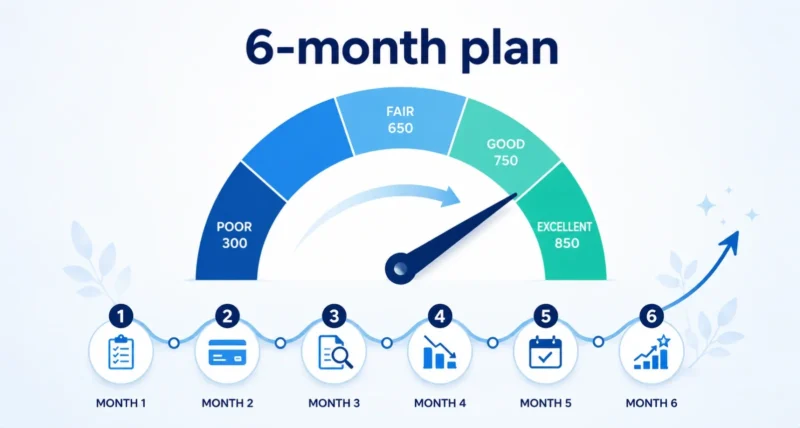
A better credit score is not luck. It is a handful of habits, applied in the right order. If you have been searching for how to improve credit score advice and found only vague tips, this guide is the fix. It is a month-by-month plan for the next six months, with one clear mission per month. Follow it in order, because the early months set up the wins in the later ones.
Quick context before we start. This plan focuses on the US system, where FICO and VantageScore are the main scoring models, though the habits help in most countries. And a six-month window is realistic: utilization changes can show up within a billing cycle or two, while payment-history gains build steadily over months. No one can promise an exact point jump, but the direction is firmly in your control.
First, Know What Actually Moves Your Score
Every step in this plan targets a real scoring factor, so it helps to see the machine before you work on it. According to myFICO, the FICO score, used by most top US lenders, weighs five things.
| Factor | Weight | What It Means |
| Payment history | About 35% | Whether you pay every bill on time |
| Amounts owed | About 30% | How much of your available credit you use |
| Length of history | About 15% | How old your accounts are, on average |
| Credit mix | About 10% | The variety of credit types you manage |
| New credit | About 10% | Recent applications and new accounts |
Notice the math. Payment history and amounts owed together drive roughly 65 percent of your score. That is why this plan spends its first months exactly there, and why the flashy tricks you see online matter far less than these two basics.
Month One: Get the Full Picture and Set Your Safety Net
Mission: know exactly where you stand, fix what is wrong, and make missed payments impossible.
- Pull all three credit reports. Get them free from com, the official US source for reports from Equifax, Experian, and TransUnion. Checking your own reports never hurts your score.
- Hunt for errors. Look for accounts you do not recognize, wrong balances, and payments marked late that you made on time. Errors are common and can quietly drag a score down.
- Dispute anything inaccurate. File disputes directly with the credit bureaus. The Consumer Financial Protection Bureau explains the process, and bureaus generally must investigate within about 30 days.
- Turn on autopay for at least the minimum on every account. Payment history is the biggest factor, and a single payment reported 30 days late can do serious damage. Autopay makes that mistake mechanically impossible.
Month Two: Attack Your Credit Utilization
Mission: shrink the share of your credit limits you are using, because it is the fastest lever you have.
Utilization is simply your card balances divided by your card limits. Experian’s guidance is to stay below 30 percent overall, and notes that people with the highest scores tend to sit under 10 percent. Unlike late payments, utilization has no memory. Bring it down and your score can react within a cycle or two.
- List every card’s balance, limit, and utilization percentage.
- Pay down the card with the highest percentage first, since one nearly maxed card can hurt even when your overall number looks fine.
- Time your payments before the statement closing date. Issuers usually report the balance on that date, so paying a few days earlier lowers the number the bureaus actually see.
| Good to Know Paying in full every month and still seeing high utilization? That is the statement-date timing at work. You are not doing anything wrong. Just shift your payment earlier in the cycle. |

Month Three: Raise Limits and Add Positive History
Mission: improve your utilization math from the other side, and get credit for bills you already pay.
- Ask your card issuers for a credit limit increase. A higher limit lowers your utilization instantly without paying an extra dollar. Ask whether the request uses a soft or hard credit check first, since some issuers differ.
- Add everyday bills to your file. Tools like Experian Boost can count eligible rent, utility, phone, and streaming payments toward your Experian-based scores. Newer models like VantageScore 4.0, now allowed in US mortgage lending, also consider this kind of data.
- Keep every dollar of the freed-up limit unspent. The point of a higher limit is a lower ratio, not more room to borrow.
Month Four: Clean Up Old Problems
Mission: stop past mistakes from bleeding into your future.
- Bring any past-due accounts current. The damage from a late account stops compounding once it is current, and every on-time month afterward slowly rebuilds your record.
- Ask for goodwill adjustments. If you have a single late payment on an otherwise clean account, write to the lender, explain what happened, and politely request its removal. Lenders are not required to agree, but it costs nothing to ask.
- Do not close old cards. Closing a card shrinks your available credit and can eventually shorten your average account age, both of which work against you. Keep old cards open with a small occasional purchase, unless a fee makes one not worth it.
Month Five: Build New History, Carefully
Mission: strengthen a thin file without tripping the new-credit penalty.
- Consider a secured card or credit-builder loan if your file is thin. Both are designed for building history, and both report your on-time payments to the bureaus.
- Ask a trusted family member about authorized-user status. Being added to a long-standing, well-managed card can add its positive history to your file. Their habits will reflect on you, so choose carefully.
- Space out applications. Each application typically triggers a hard inquiry, which usually costs only a few points and fades within months. Several in a short window, though, compound and look risky. One new account in this plan is plenty.
Month Six: Measure, Protect, and Keep Going
Mission: confirm your progress and lock in the habits.
- Re-pull your reports and compare them to Month One. Confirm disputes were resolved, balances dropped, and everything reports as current.
- Track your score for free. Most banks and card apps now show a free score. Watch the trend, not the daily wobble, since scores naturally bounce a little.
- Keep the machine running. Autopay stays on, utilization stays low, and old cards stay open. Your score keeps improving on the same habits long after month six.
| Worth Knowing Results differ by starting point. Someone recovering from high balances often sees faster movement than someone repairing serious late marks, which fade gradually. Six months of these habits improves nearly every file, but nobody can honestly promise a specific number. |
How to Improve Credit Score Habits, and the Traps That Undo Them
Building the right habits is half the job. Avoiding the classic traps is the other half.
- Carrying a balance to help your score. A myth. Carrying a balance only costs you interest. Pay in full whenever you can.
- Closing old cards for tidiness. It cuts your available credit immediately and can hurt your history length later.
- Maxing one card while others sit empty. Scoring models look at each card as well as the total, so one maxed card still stings.
- Applying for several cards at once. Stacked hard inquiries in a short period compound and signal risk.
- Ignoring your reports. Errors and fraud can sit unnoticed for years. A free check a few times a year is cheap insurance.
One more quiet helper: money pressure causes most missed payments, so anything that eases your cash flow protects your score too. Trimming subscriptions helps, and if you want to add income instead, our guide to the best side hustles for 2026 covers realistic options. A free tracker like the new Google Finance can help you watch the whole picture in one place.
Improving your credit is not about tricks. It is a sequence: see your file clearly, make late payments impossible, push utilization down, add positive history, clean up the past, and then protect the progress. Each month in this plan hands momentum to the next.
Start with Month One this week. Pulling your free reports takes less than an hour, and it is the single step that makes every other step smarter. Six months from now, the you who started today will be glad you did.
Frequently Asked Questions
How fast can you improve your credit score?
It depends on your starting point. Utilization improvements can show up within one or two billing cycles, while rebuilding after late payments takes longer, since payment history builds month by month. Six months of consistent habits is a realistic window for visible progress, though no specific point gain can be promised.
What is the fastest way to raise a credit score?
For most people, the fastest lever is lowering credit utilization, since it has no memory and updates as issuers report new balances. Paying down high-percentage cards and paying before the statement closing date are the two quickest moves.
Does checking my own credit score lower it?
No. Checking your own score or reports is a soft inquiry and never affects your score. Only hard inquiries, which happen when a lender processes your application for credit, can shave off a few points temporarily.
Should I close old credit cards I no longer use?
Usually not. Closing a card removes its limit from your utilization math immediately and can shorten your average account age over time. Keeping old cards open with an occasional small purchase generally helps, unless an annual fee makes the card a bad deal.
How long do late payments stay on a credit report?
Late payments can generally remain on US credit reports for up to seven years. Their impact fades with time, especially as you stack new on-time payments on top, which is why the plan focuses on making future lates impossible.
Do rent and utility payments count toward my credit score?
Increasingly, yes. Opt-in tools like Experian Boost can add eligible rent, utility, and phone payments to your Experian file, and newer models like VantageScore 4.0, now permitted in US mortgage lending, can consider this data. Coverage varies by scoring model and lender.