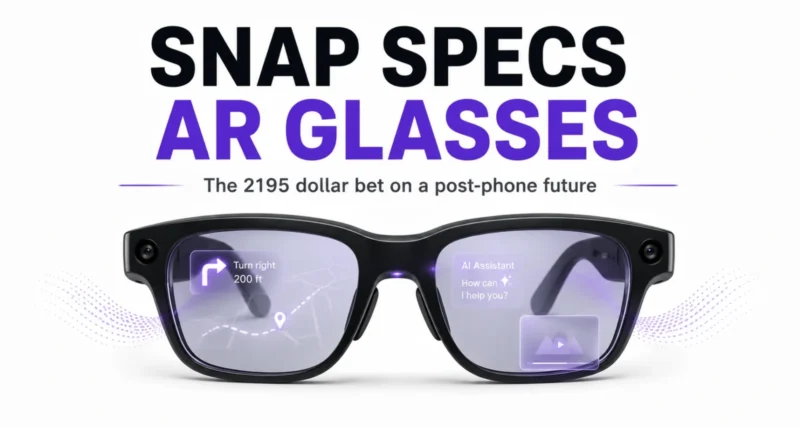
Snap just asked the world to pay over two thousand dollars to stop looking at a screen. Its new Specs AR glasses promise a computer you wear on your face, one that paints directions on the street and lets an AI see what you see. Investors blinked and the stock dropped nearly 10 percent. So are these the future of computing, or an expensive gamble? Here is everything worth knowing.
| Quick Answer Snap’s new AR glasses, called Specs, were unveiled on June 16, 2026, priced at $2,195 with a $200 refundable deposit. They are standalone augmented reality glasses with a see-through display, AI that can see what you see, and up to four hours of use. They ship this fall in the US, UK, and France. CEO Evan Spiegel calls them a post-smartphone bet, while some investors are skeptical. |
What Are Snap’s Specs
Specs are Snap’s first augmented reality glasses built for the general public, not just developers. Unlike camera-only smart glasses, they place digital content directly into your view through see-through lenses, so you can use apps, get directions, or watch a movie while still seeing the real world.
Snap pitches them as a new kind of computer. Rather than pulling your eyes down to a phone, the Snap AR glasses aim to keep you present while information appears around you. The company unveiled them at the Augmented World Expo and opened pre-orders the same day.
| Quick Take Think of Specs as a wearable screen plus an AI assistant that shares your point of view. Instead of typing a question into a phone, you look at something and the glasses help, with directions, translations, or guidance layered onto the real world. |
Snap Specs Features and Specifications
Snap packed a lot into a glasses-sized frame. Here are the key numbers at a glance.
| Feature | Detail |
| Price | $2,195, with a $200 refundable deposit |
| Release | Fall 2026 in the US, UK, and France |
| Design | Standalone, no phone or tether needed |
| Weight | 132 grams (47mm) or 136 grams (52mm) |
| Display | See-through, 51-degree field of view, 16 million colors |
| Processors | Two Snapdragon chips, one for vision, one for apps |
| Battery | Up to 4 hours of mixed use, 20 hours with the case |
| Latency | 7 milliseconds motion-to-photon |
The display is the headline. Snap says it feels like a 24-inch monitor for work, or a 115-inch cinema screen for movies. The lenses even tint automatically, using the same electrochromic tech found in Boeing 787 windows.
What Can You Actually Do With Them
Hardware aside, the real test is whether the glasses are useful day to day. Snap leans on a few clear examples.
- See directions in the street. Navigation arrows appear on the road in front of you, not on a phone you keep checking.
- Get AI help in the moment. Because the AI can see what you see, it can guide you through a task or answer questions about what is in front of you.
- Turn any room into a workspace. Cast a screen, open a whiteboard, or stream content while staying aware of people around you.
- Play and learn with Lenses. Developers have built hundreds of AR Lenses, from interactive drum lessons to tools that make invisible forces visible.
| The Cool Part Snap built privacy in from the start. An LED lights up when the glasses are recording, they ask before accessing sensitive data, and much of the processing happens on the device itself rather than in the cloud. |
Why the $2,195 Price Is Such a Big Deal
The price is the part everyone is talking about. At $2,195, the Snap AR glasses cost more than 15 times the original $130 Spectacles from 2016, which never caught on. This is clearly aimed at early adopters and developers, not the average shopper.
Snap’s bet is that people are tired of staring at phones. As Spiegel put it, nearly 20 years after the iPhone, people are ready to think about computing differently. Whether that is worth two thousand dollars today is the open question.
The Catch: Investors Are Not Sold
The launch landed with a thud on Wall Street. Snap shares fell almost 10 percent on the day, as investors weighed the steep price of the Snap AR glasses against years of heavy spending on the project.
Activist investor Irenic Capital Management has pushed Snap to spin off or separately fund the glasses unit, noting the company has already spent more than $3.5 billion on it. Spiegel pushed back, saying his job is long-term success rather than short-term profit. It is a genuine clash between a big vision and the patience to pay for it.
| Why It Matters This is bigger than one gadget. Snap, Meta, Apple, and Google are all racing to decide what comes after the smartphone. If face-worn computers really are next, the company that gets there first could shape the next decade of tech. If not, it is a very expensive detour. |
Should You Buy a Pair
For most people, the honest answer is not yet. At this price, with four hours of battery and a fall release, Specs are a first-generation product for enthusiasts and developers. Here is a simple way to decide.
- Consider it if you are a developer, AR creator, or early adopter who wants to build or experiment on the platform.
- Wait if you want a mainstream gadget, since prices usually fall and battery life improves with later versions.
- Watch for real-world reviews this fall, which will show how the display, comfort, and AI hold up in daily use.
If you follow how AI is moving into everyday devices, this is one of the clearest signs yet of where things are heading. Our other coverage of AI tools and gadgets digs into the wider shift.
Snap’s AR glasses are a bold swing at life after the smartphone, and the technology genuinely impresses. A see-through display, on-board AI, and a standalone design in a 132-gram frame is no small feat. The catch is the $2,195 price and a nervous market that wants results now. For most of us, Specs are a fascinating preview rather than a purchase, but they make one thing clear. The race to put a computer on your face has truly begun.
Sources and Further Reading
Snap’s official Specs announcement (primary source, full specifications)
Reuters on Spiegel defending the bet (independent business reporting)
CNBC’s launch coverage (independent reporting)
Frequently Asked Questions
What Are Snap’s AR Glasses Called
They are called Specs. They are Snap’s first augmented reality glasses aimed at the general public rather than just developers.
How Much Do Snap’s Specs Cost
Specs cost $2,195, with a $200 refundable deposit to pre-order. That is more than 15 times the price of Snap’s original 2016 Spectacles.
When Do Snap’s Specs Release
They are expected to ship in fall 2026, starting in the United States, the United Kingdom, and France.
What Makes Specs Different From Smart Glasses
Specs have a see-through display that overlays digital content on the real world, plus AI that can see what you see. Many smart glasses only have a camera and audio.
How Long Does the Battery Last
Snap says up to four hours of mixed use, with the charging case adding enough for around 20 hours total.
Are Snap’s AR Glasses Worth It
For developers and early adopters, possibly. For most people, it is worth waiting for cheaper, longer-lasting future versions and real-world reviews.