
We have known for decades that a giant space rock ended the age of the dinosaurs. We did not know what kind of rock it was. Now we do. A new study has identified the asteroid that killed the dinosaurs as an exceptionally rare type of object. It is so unusual that the researchers call it an oddball. The discovery does not change what happened 66 million years ago. It sharpens the story of how it happened, and it makes the dinosaurs look even unluckier than we thought.
| The Short Answer Scientists have identified the asteroid that killed the dinosaurs as a CO chondrite, one of the rarest and most primitive classes of space rock. A team from the University of British Columbia, Paris, Brussels, and Vienna measured nickel isotopes trapped in the thin clay layer the impact left behind, then matched that chemical fingerprint against known meteorites. Carbonaceous chondrites account for only about 5 percent of meteorites found on Earth, and the CO class is a small slice of that already small group. The result matters because CO chondrites carry very little sulfur. That points to the fine dust blasted into the sky, rather than sulfur from the rock itself, as the main killer. The work appears in the journal Science Advances. |
What Scientists Just Discovered
Researchers from the University of British Columbia, Paris, Brussels, and Vienna have pinned down the class of the object that struck Earth 66 million years ago. Their answer is a CO chondrite, a rare and primitive kind of meteorite. The findings appear in Science Advances, in a paper led by Georgy Makhatadze on the origin of the impactor.
That impact created the Chicxulub crater, now buried beneath Mexico’s Yucatán Peninsula. It wiped out roughly 75 percent of species on Earth, including every non-avian dinosaur. Scientists already suspected a carbonaceous asteroid from the outer solar system. This study narrows the field to one specific and very unusual family.
One caution worth keeping in mind: the team describes this as the probable impactor, not a closed case. The evidence points strongly at CO chondrites, though science of this kind gets refined as new samples arrive.
What a CO Chondrite Actually Is
Start with the name, because plenty of coverage has already got it wrong. CO does not stand for carbon monoxide. The letters are a standard shorthand in meteorite science.
| The Letter | What It Means |
| C | Carbonaceous, meaning the rock is rich in carbon compounds |
| O | Ornans, the French town where the first meteorite of this type fell |
So a CO chondrite is a carbonaceous chondrite of the Ornans class. Chondrites are the oldest rocks we know of. They formed at the birth of the solar system and never melted, so they preserve original material from more than 4.5 billion years ago. As Dr. Philippe Claeys of the research team put it, these are nothing like the typical meteorites sitting in museum collections.
They are also genuinely rare. Carbonaceous chondrites make up only about 5 percent of all meteorites sampled on Earth. CO chondrites are a small fraction of that 5 percent. Being hit by one is a little like being struck by lightning thrown from the far side of the solar system.
How Scientists Identified the Asteroid That Killed the Dinosaurs
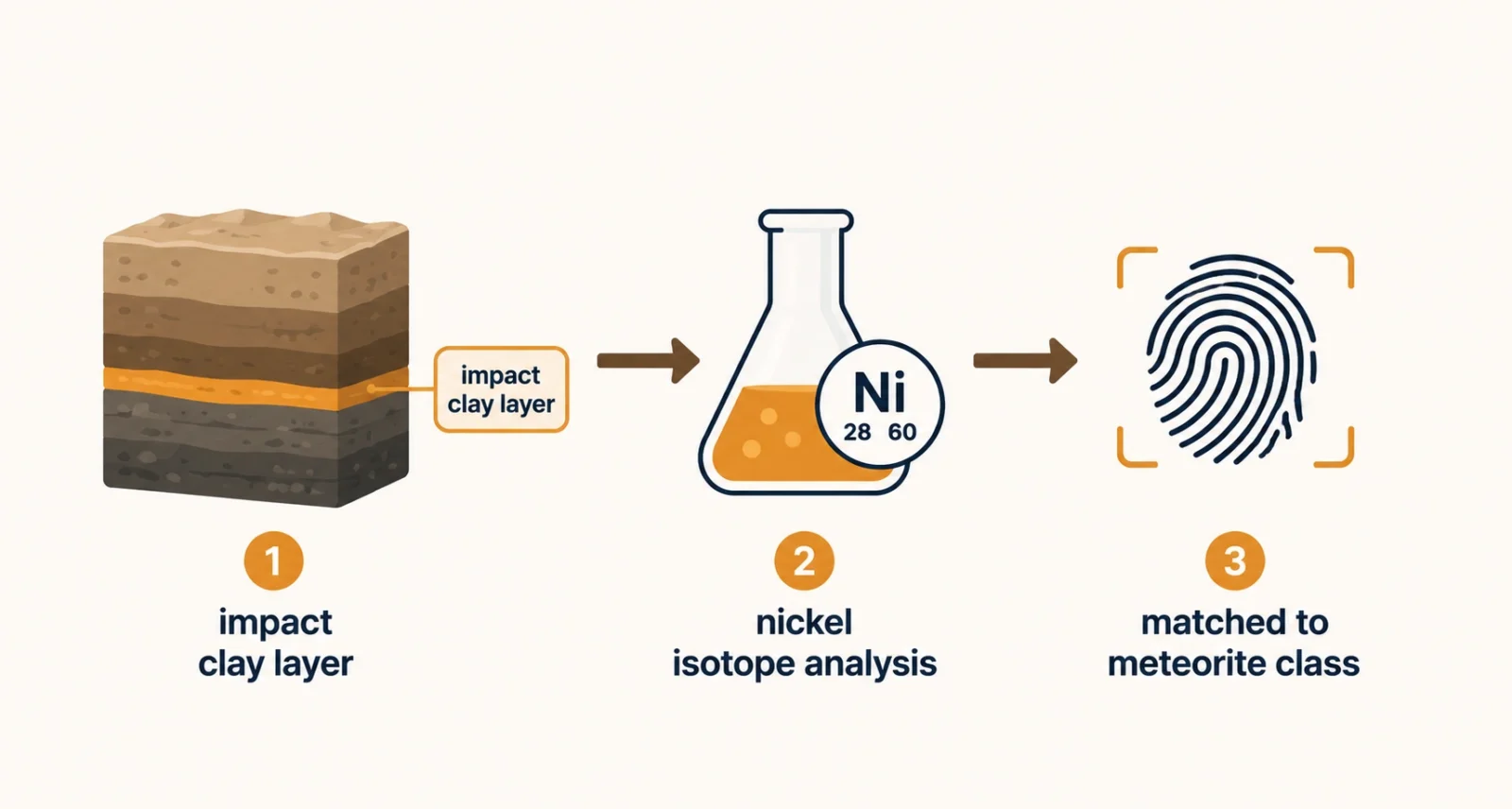
The detective work here is the impressive part. The meteorite vaporized on impact, so almost nothing of it survives. What remains is a whisper of its chemistry, scattered worldwide in a thin band of clay that marks the boundary between two geological eras.
Here is how the team read that whisper.
- Collect the boundary clay. The researchers sampled the impact layer at classic sites in Denmark, Spain, and Italy, where the band survives in good condition.
- Measure the nickel isotopes. Nickel comes in slightly different atomic versions, and their ratios act as a chemical fingerprint of where a rock formed.
- Separate the signal from the noise. Only a minute trace of the projectile survives in that clay, so the team had to isolate it from ordinary Earth material.
- Match it to known meteorites. They compared the fingerprint against a set of carbonaceous meteorites until one class fit: the Ornans group.
Nickel is a smart choice for this. It survives the violence of an impact, it comes from the projectile rather than the crust, and its isotope ratios differ measurably between meteorite families. That combination turns a layer of ancient mud into a forensic sample.
Why This Changes the Extinction Story
Here is the part with real scientific weight. CO chondrites are unusually poor in volatile elements. They hold far less carbon, zinc, water, and especially sulfur than other meteorite classes.
Sulfur matters because of a long-running debate about how the impact actually killed so much life. One idea is that sulfur blasted into the upper atmosphere formed aerosols, blocking sunlight and plunging the planet into a long, dark, freezing winter. If the incoming rock carried little sulfur, that particular source looks weaker.
The research team points to the fine debris thrown into the atmosphere as the primary factor instead. Dust, not the rock’s own sulfur, did the worst of the damage. As ScienceDaily notes in its coverage, Claeys is careful to say this does not overturn the theory of what caused the extinction. It refines the mechanism, which is how most real science moves forward.
| Worth Knowing This does not remove sulfur from the story altogether. The rocks the asteroid landed on were themselves rich in sulfur-bearing minerals, and scientists have long argued that vaporizing them released enormous quantities into the sky. What the new work shifts is the source. The sulfur most likely came from the ground it hit rather than the rock that hit it. |
The Asteroid That Killed the Dinosaurs, by the Numbers
The scale is hard to picture, so here it is in one place.
| Detail | The Figure |
| When it hit | About 66 million years ago |
| Size | Roughly 10 to 15 kilometers, or about six to nine miles wide |
| Speed | Around 64,000 km/h, roughly 40,000 mph |
| Crater left behind | Chicxulub, about 200 km across |
| Where | Buried beneath the Yucatán Peninsula in Mexico |
| Species lost | Around 75 percent, including all non-avian dinosaurs |
| Meteorite class | CO chondrite, the Ornans group |
| How rare | Carbonaceous chondrites are about 5 percent of meteorites found |
Why the Dinosaurs Were So Unlucky
Step back and the scale of the coincidence is startling. Of all the objects that could have crossed Earth’s path, the one that did belonged to a family we almost never see. Claeys said the strike by such a rare and distant projectile underscores “how unlucky the dinosaurs were.”
There is a pleasing symmetry to it too. The rock that ended one world was itself a leftover from the building of the solar system, unchanged since before Earth existed. It carried a 4.5-billion-year-old record of our origins, and it delivered a mass extinction. Life on this planet, including ours, took the shape it did partly because of which rock happened to be passing.
The asteroid that killed the dinosaurs finally has a name tag. It was a CO chondrite, a rare visitor from the early solar system. Its unusual chemistry shifts the blame for the extinction toward dust rather than its own sulfur. The story of that terrible day is not being rewritten. It is coming into focus.
Frequently Asked Questions
What killed the dinosaurs?
An asteroid roughly 10 to 15 kilometers wide struck Earth about 66 million years ago, forming the Chicxulub crater in what is now Mexico. The impact and its aftermath wiped out around 75 percent of species, including all non-avian dinosaurs. Birds are the surviving branch of the dinosaur family tree.
What kind of asteroid killed the dinosaurs?
New research identifies it as a CO chondrite, a carbonaceous chondrite of the Ornans class. That is one of the rarest and most primitive classes of space rock known. Researchers reached the conclusion by analyzing nickel isotopes in the clay layer the impact left worldwide, and they describe it as the probable impactor.
Does CO chondrite mean carbon monoxide?
No, and this is a common mix-up in news coverage. In meteorite science the C stands for carbonaceous, meaning carbon-rich. The O stands for Ornans, the town in France where the first meteorite of this class fell. Meteorite groups are routinely named after the place their first example fell.
How did scientists work out the meteorite class?
They measured nickel isotopes in the thin clay layer that marks the impact, sampled at sites in Denmark, Spain, and Italy. Nickel isotope ratios act as a fingerprint of where a rock formed. The team separated that faint signal from ordinary Earth material, then matched it against known carbonaceous meteorites.
Does this change what we know about the extinction?
It refines the mechanism rather than rewriting the event. Because CO chondrites contain little sulfur, sulfur from the asteroid itself looks less likely to be the main driver of the global winter that followed. The researchers point instead to fine debris thrown into the atmosphere as the primary factor.
Where is the Chicxulub crater?
It lies buried beneath the Yucatán Peninsula in Mexico, partly under land and partly under the Gulf. The crater measures roughly 200 kilometers across. You cannot see it from the surface, since millions of years of sediment cover it. It shows up clearly in gravity and magnetic surveys.

