
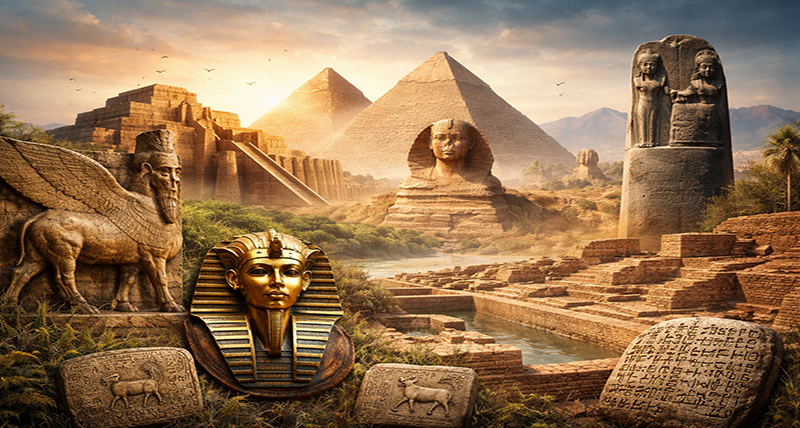
Human civilization did not emerge overnight. It rose slowly along fertile riverbanks, where agriculture replaced hunting, cities replaced tribes, and written language replaced oral memory. Among the earliest and most influential of these ancient civilizations were Egypt, Mesopotamia, and the Indus Valley Civilization.
These societies did not simply build cities. They built systems. Governance, law, trade, engineering, religion, and knowledge frameworks that continue to influence the modern world.
Ancient Egypt The Civilization of the Nile
Location: Northeastern Africa
Time Period: c. 3100 BCE to 30 BCE
Primary River: Nile River
Geography and Stability
Ancient Egypt flourished along the Nile River. The river’s predictable flooding cycle created fertile soil, enabling consistent agricultural production. This stability allowed Egypt to develop into one of the longest lasting civilizations in history.
Political Structure
Egypt operated under a centralized monarchy led by a pharaoh, considered both king and divine representative. Notable rulers included Tutankhamun and Cleopatra. Governance was highly organized, supported by scribes, priests, and administrators.
Architecture and Engineering
The Great Pyramid of Giza remains one of the Seven Wonders of the Ancient World. Egyptian engineering demonstrated advanced mathematics, logistics, and labor organization.
Writing System
Hieroglyphics, a complex writing system combining symbols and phonetics, enabled record keeping, religious texts, and historical documentation. The deciphering of hieroglyphics became possible through the discovery of the Rosetta Stone centuries later.
Religious Beliefs
Egyptian religion was deeply tied to the afterlife. Mummification and elaborate tomb construction reflected a belief in immortality and divine judgment.
Key Contributions
- Monumental stone architecture
- Calendar systems
- Medical practices
- Advanced irrigation techniques
- Hieroglyphic writing
Mesopotamia The Cradle of Ancient Civilizations
Location: Between the Tigris and Euphrates Rivers in modern day Iraq
Time Period: c. 3500 BCE to 539 BCE
Major Civilizations: Sumerians, Akkadians, Babylonians, Assyrians
The term Mesopotamia means land between rivers. Unlike Egypt’s predictable Nile, the Tigris and Euphrates were less stable, leading to complex irrigation systems and competitive city states.
Urban Innovation
The city of Ur and other Sumerian settlements are considered among the first true cities. Monumental structures called ziggurats dominated city centers.
Writing System
Cuneiform writing, inscribed on clay tablets, is among the earliest known writing systems. It was used for trade records, literature, and legal codes.
Law and Governance
One of the earliest written legal codes was the Code of Hammurabi, established by Hammurabi. It formalized laws based on social hierarchy and justice principles.
Technological Contributions
Mesopotamians introduced
- The wheel
- Early forms of mathematics using a base 60 system
- Astronomical observations
- Complex trade networks
Literature
The Epic of Gilgamesh is considered one of the earliest known works of literature, exploring themes of mortality and heroism.
The Indus Valley Civilization Urban Planning Mastery
Location: Modern day Pakistan and northwest India
Time Period: c. 2600 BCE to 1900 BCE
Major Cities: Harappa, Mohenjo daro
The Indus Valley Civilization was one of the world’s largest early urban cultures, yet remains among the most mysterious.
Advanced Urban Planning
Cities like Mohenjo-daro were built on grid layouts with sophisticated drainage systems, far ahead of many contemporary civilizations.
Trade Networks
Evidence suggests trade connections with Mesopotamia. Standardized weights and seals indicate an organized economic system.
Script and Seals
The Indus script remains undeciphered, limiting our understanding of governance and religion.
Social Structure
Unlike Egypt and Mesopotamia, there is little evidence of grand palaces or large scale royal tombs, suggesting a possibly more decentralized power structure.
Key Contributions
- Urban sanitation systems
- Standardized brick construction
- Organized trade metrics
- Early metallurgy
Comparative Overview
| Feature | Egypt | Mesopotamia | Indus Valley |
| River System | Nile | Tigris and Euphrates | Indus |
| Political Structure | Centralized monarchy | City states and empires | Possibly decentralized |
| Writing System | Hieroglyphics | Cuneiform | Undeciphered script |
| Architecture | Pyramids and temples | Ziggurats | Grid planned cities |
| Legal System | Pharaoh centered | Codified laws | Unknown |
Why These Ancient Civilizations Still Matter
Modern governance, law codes, urban planning, mathematics, astronomy, architecture, and written communication trace intellectual roots back to these early societies.
National legal systems echo Hammurabi’s codification.
Calendar systems and astronomy reflect Mesopotamian calculations.
Urban infrastructure owes much to Indus drainage engineering.
Monumental architecture and centralized governance mirror Egyptian models.
These civilizations represent humanity’s transition from survival to structure, from scattered settlements to organized societies.
Conclusion
Ancient Egypt, Mesopotamia, and the Indus Valley were not isolated experiments in human development. They were the foundational blueprints of civilization itself.
They transformed agriculture into economy, belief into structured religion, power into governance, and memory into written history.
Every city, law, written word, and engineered structure today carries a distant echo of these early societies.
Understanding them is not about studying the past. It is about recognizing the origins of the present.
Ancient civilizations such as Egypt, Mesopotamia, and the Indus Valley represent the foundations of early human history. These early river valley civilizations developed during the Bronze Age and shaped the origins of organized society.
Egypt is known for monumental structures like the Great Pyramid of Giza and its hieroglyphic writing system. Mesopotamia, often called the cradle of civilization, introduced cuneiform writing and one of the earliest legal systems, the Code of Hammurabi. The Indus Valley Civilization, with major cities like Mohenjo-daro, demonstrated advanced urban planning and trade systems.
Together, these Bronze Age societies laid the foundations of governance, architecture, law, writing, and social organization that continue to influence the modern world.
Frequently Searched Questions –
- Which is the oldest civilization among Egypt, Mesopotamia, and the Indus Valley
Mesopotamian Sumerian settlements date slightly earlier than unified Egypt and the mature Indus phase. - Why did the Indus Valley Civilization decline
Scholars suggest climate change, shifting river systems, or economic disruption. - What makes Mesopotamia the Cradle of Civilization
It introduced early urbanization, writing systems, legal codes, and organized governance. - Why were rivers important to ancient civilizations
They provided fertile land, water supply, trade routes, and transportation.

