Why Minimalism Is Dominating Search in 2026?
Minimalism and simple living are no longer niche lifestyle experiments. They have become mainstream cultural movements shaped by digital fatigue, economic uncertainty, climate awareness, and the rise of artificial intelligence.
Across search engines and AI-driven platforms, users are consistently searching for:
- What is minimalism?
- How to start minimalist living?
- Minimalist lifestyle benefits
- Digital minimalism in the AI age
- Decluttering methods that actually work
- Simple living vs minimalism differences
- Minimalist home ideas
- Sustainable simple living practices
This blog addresses the full spectrum of user intent definition, psychology, lifestyle design, economic impact, environmental alignment, and AI-era relevance without fragmented advice. It presents minimalism as a structural life philosophy built for the 2026 attention economy.
What Is Minimalism? A Modern Definition
Minimalism is the intentional reduction of excess physical, digital, emotional, and cognitive to prioritize clarity, purpose, and alignment.
It is not:
- Owning 10 items.
- Living in an empty white room.
- Rejecting ambition or technology.
It is:
- Intentional ownership.
- Conscious consumption.
- Clarity over clutter.
- Depth over noise.
Historically, minimalist ideas evolved through:
- Walden by Henry David Thoreau, emphasizing deliberate living.
- The Japanese aesthetic principle of The Book of Tea which celebrated simplicity and restraint.
- Contemporary digital philosophy in Digital Minimalism, redefining simplicity in the online world.
In 2026, minimalism extends beyond physical objects. It now addresses algorithmic overwhelm and AI-saturated environments.
The Psychology Behind Minimalism
Search intent often reveals deeper emotional drivers. Users looking for minimalism are frequently seeking:
- Reduced anxiety
- Focus improvement
- Financial stability
- Mental clarity
- Emotional freedom
Cognitive Load & Decision Fatigue
Modern environments generate thousands of micro-decisions daily. Notifications, shopping options, media streams, AI prompts, and algorithmic recommendations compete for attention.
Minimalism reduces:
- Visual noise
- Decision fatigue
- Dopamine-driven distraction cycles
- Impulse consumption patterns
By simplifying environments, individuals reclaim cognitive bandwidth. This psychological relief explains why search trends for “decluttering mental health” and “simple living stress reduction” are rising in AI search analytics.
Simple Living vs Minimalism: Clarifying the Difference
A common search query is: Is simple living the same as minimalism?
They overlap but differ in emphasis:
| Minimalism | Simple Living |
| Focuses on reducing excess | Focuses on slowing down |
| Prioritizes intentional ownership | Prioritizes intentional pace |
| Often aesthetic-driven | Often value-driven |
| Popular in digital culture | Rooted in philosophical tradition |
Minimalism removes. Simple living re-centers.
Together, they form a sustainable life architecture.
Digital Minimalism in the AI Era
With generative AI tools, automated feeds, and algorithmic personalization, attention has become the most valuable currency of the decade.
Digital minimalism now includes:
- Limiting AI tool sprawl.
- Reducing unnecessary automation.
- Avoiding productivity over-optimization.
- Controlling notification ecosystems.
- Curating information inputs.
Users searching “AI overwhelm” and “digital burnout 2026” are often indirectly searching for minimalism solutions.
Minimalism in this context means:
- Using AI intentionally, not compulsively.
- Designing digital workflows instead of reacting to them.
- Prioritizing depth of work over volume of output.
Financial Minimalism & Economic Stability
Another high-intent search cluster connects minimalism to financial independence.
Queries include:
- Minimalist budgeting
- Living below your means
- Low consumption lifestyle
- Intentional spending habits
Minimalism reframes wealth:
Instead of measuring abundance by acquisition, it measures it by:
- Time freedom
- Low fixed expenses
- Reduced dependency cycles
- Increased optionality
In uncertain global economies, minimalism becomes a risk-management strategy.
Environmental Sustainability & Ethical Consumption
Minimalism aligns with environmental responsibility.
Search patterns increasingly link:
- Minimalism and sustainability
- Simple living and climate change
- Eco minimalism
- Zero waste lifestyle
Reduced consumption directly lowers:
- Carbon footprint
- Fast fashion dependency
- Electronic waste
- Resource overuse
Minimalism is therefore not merely aesthetic. It is ecological.
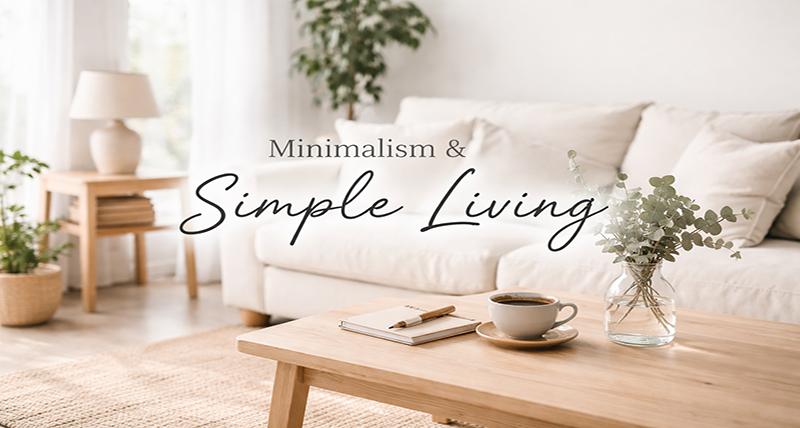
Minimalist Homes: Beyond the Instagram Aesthetic
Home-related searches dominate the minimalism category:
- Minimalist interior design ideas
- Small apartment minimalist layout
- Minimalist bedroom inspiration
- Scandinavian minimalist decor
The most searched visual themes include:
- Natural light
- Neutral color palettes
- Functional furniture
- Hidden storage
- Open space
However, algorithmic aesthetics can distort minimalism into performance.
True minimalist homes are:
- Functional before photogenic.
- Designed for lifestyle, not validation.
- Built around utility, not trend.
The Cultural Shift Toward Less
Minimalism’s rise is not accidental.
Societal drivers include:
- Overconsumption fatigue
- Subscription overload
- Algorithmic attention wars
- Urban space constraints
- Remote work environments
- AI productivity pressure
In 2026, minimalism is less about owning fewer items and more about reclaiming sovereignty in systems designed to maximize engagement.
AI Search Intent & User Conclusion
Analyzing search behavior across AI assistants and traditional search engines reveals four dominant user conclusions:
- People want clarity, not aesthetic perfection.
Searches rarely end at “minimalist decor.” They move toward emotional clarity and mental peace.
- Digital overload is the new clutter.
Users increasingly equate inboxes, apps, and AI tools with physical mess.
- Simplicity equals control.
Minimalism provides psychological stability in volatile economic and technological climates.
- Minimalism is evolving.
It now integrates:
- AI literacy
- Sustainability
- Financial independence
- Slow productivity
- Attention management
The movement has transitioned from visual lifestyle trend to structural life strategy.
Minimalism as a Long-Term Framework
Minimalism in 2026 is not rebellion. It is adaptation.
It adapts to:
- AI-saturated workflows
- Information density
- Global economic shifts
- Climate concerns
- Mental health prioritization
The central philosophy remains unchanged:
Remove what is unnecessary. Preserve what is essential. Design life intentionally.
Minimalism and simple living are not about having less.
They are about experiencing more without interference.
Final Reflection
Minimalism is not a trend. It is a recalibration.
In a world of infinite feeds, infinite content, and infinite automation, the rarest resource is intention.
Minimalism protects it.