
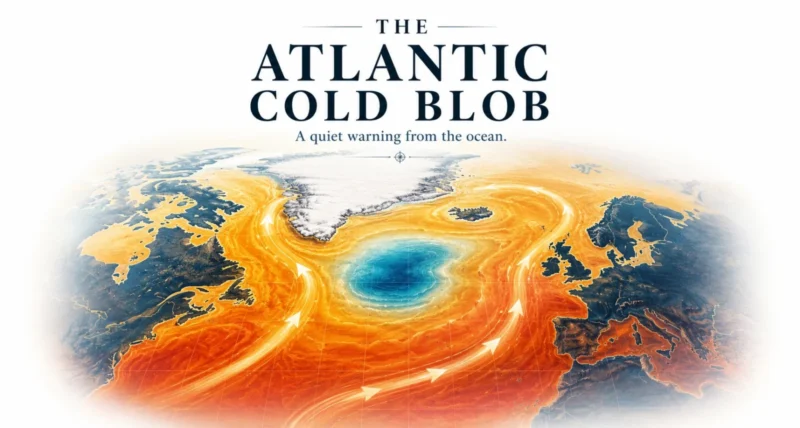
Almost everywhere on Earth, the oceans are heating up. But there is one strange patch in the North Atlantic, just south of Greenland, that has been doing the opposite: getting colder. Scientists call it the cold blob, and a new study suggests it may be a warning sign about one of the planet’s most important ocean systems. As meteorologists have explained, this peculiar cold spot could be telling us something important. Here is what it means, in plain language, and what it does and does not tell us.
| The Short Version A patch of the North Atlantic has cooled by about 1 degree Celsius since 1900, even as the rest of the ocean warms. A June 2026 study concludes this cold blob is caused by the slowing of a giant ocean current called the AMOC, which carries warm water north and keeps Europe mild. Scientists see it as a warning sign that the current is weakening and could be nearing a tipping point. Importantly, the study does not say a collapse is about to happen, the timing remains very uncertain. |
What Is the Cold Blob
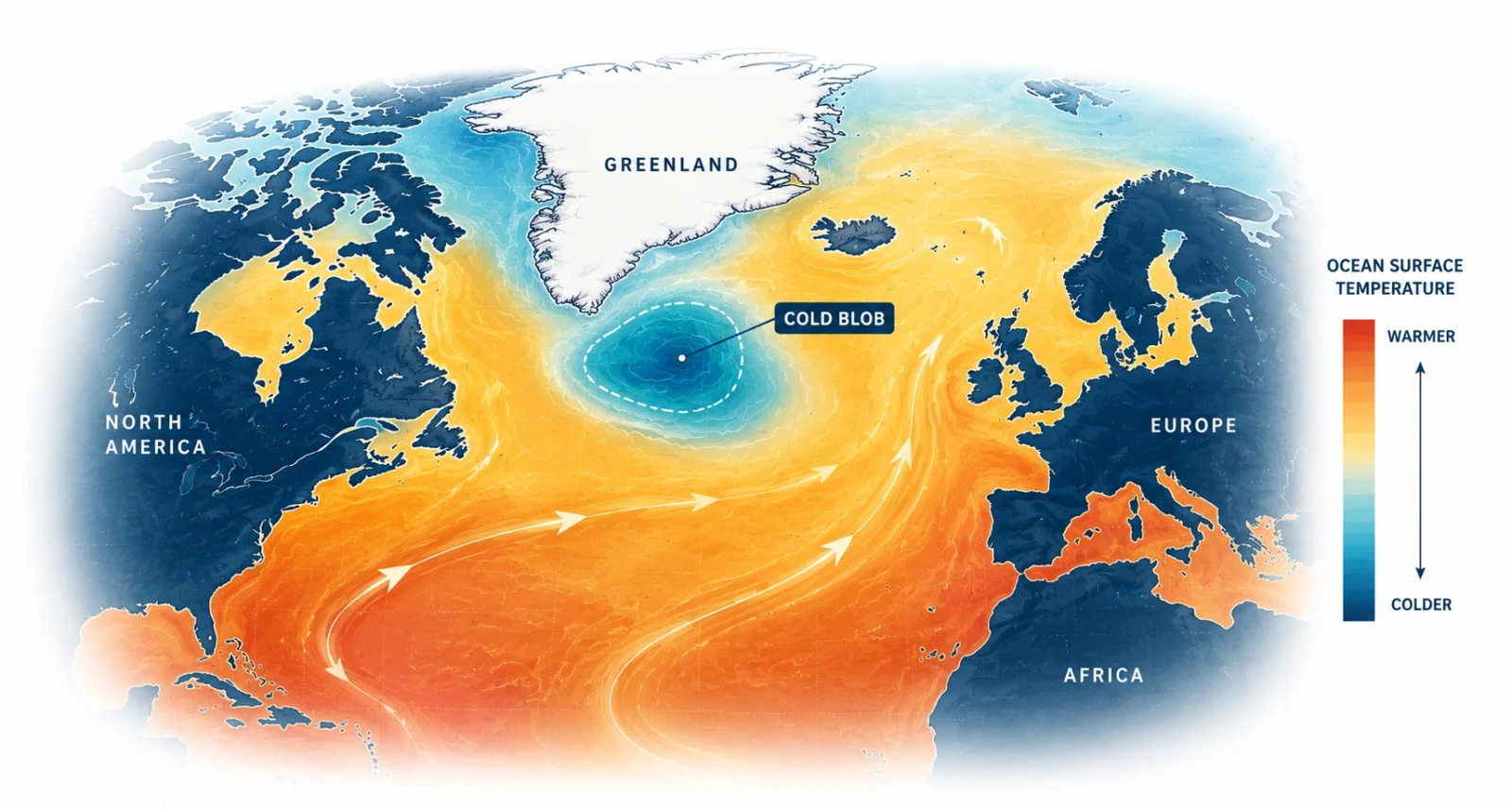
Picture a world map showing ocean temperatures. Almost the whole sea glows in warm colors as the planet heats up. But in the North Atlantic, southeast of Greenland, there is one stubborn cool patch that refuses to warm up. Scientists call that patch the cold blob, sometimes the warming hole.
It is not a small wobble, either. This area has cooled by roughly 1 degree Celsius, about 1.8 degrees Fahrenheit, since around 1900. On a warming planet, a region that is cooling stands out, and scientists have spent years trying to work out why.
Meet the AMOC: The Ocean’s Conveyor Belt
To understand the warning, you need to meet the system behind it. The Atlantic Meridional Overturning Circulation, or AMOC, is a vast system of ocean currents. The simplest way to picture it is as a giant conveyor belt of water.
Here is how it works. The belt carries warm water from the tropics northward across the Atlantic. As that water reaches the cold north, it cools, becomes denser, and sinks. Then it flows back south along the deep ocean, and the loop begins again. This constant churn moves an enormous amount of heat around the planet.
| Why It Matters to You That warm water heats the air above it, and westerly winds carry that warmth onto land. This is a big reason Europe enjoys relatively mild weather for how far north it lies. The AMOC quietly shapes temperatures and rainfall across Europe, North Africa, and parts of North America. |
How the Cold Blob and the AMOC Are Connected
Here is the key link. If that conveyor belt slows down, it delivers less warm water to the North Atlantic. Less incoming heat means that patch of ocean cools, which is exactly what we see in the cold blob.
For years, scientists debated whether the cold blob came from the ocean losing heat to the air above (through changing winds and clouds) or from this slowing current. The new study, published June 16, 2026, in the journal Geophysical Research Letters, concludes it is the current. The researchers found that surface heat loss alone cannot explain the cooling, pointing instead to a weakening AMOC. It is some of the strongest evidence yet linking the two.
| In Short The cold blob acts like a fingerprint. Its presence and growth suggest the Atlantic’s great conveyor belt is slowing down, and that is the part that has scientists paying close attention. |
Why Scientists Call It a Warning Sign
A slowing current is concerning because the AMOC is what scientists call a tipping point system. That means it can weaken gradually for a while, then potentially cross a threshold and change abruptly, rather than smoothly. Some research suggests the AMOC may already be the weakest it has been in around 1,000 years.
The mood among some researchers has shifted. Stefan Rahmstorf of Germany’s Potsdam Institute, a leading voice on this topic, put it bluntly in 2026. For thirty years, he treated an AMOC tipping point as a high-impact but low-probability risk. Recently, I’ve changed my mind, he wrote, signalling that he now takes the risk more seriously than before.
What Could Happen If the AMOC Weakened Further
If the current kept slowing or eventually shut down, scientists outline several possible consequences. These are potential impacts of a major weakening, not predictions of next year.
| Possible Impact | What It Could Mean |
| Colder Europe | Disruptive cooling and more extreme temperatures across northwest Europe, despite global warming |
| Higher US seas | Faster sea-level rise along the US East Coast as water piles up |
| Shifted rainfall | Changes to rain patterns that could affect farming and food supply |
| More extremes | A greater swing between cold and hot extremes in affected regions |
| Heads Up Yes, this is the real science behind the movie idea of a sudden deep freeze. But reality is slower and more complex than Hollywood. A real AMOC slowdown would unfold over years to decades, not in a single dramatic week. |
The Important Caveat: This Is Not a Doomsday Clock
This part matters as much as the warning itself. The study is a serious signal, but it does not say an AMOC collapse is about to happen, and responsible scientists are careful here.
- The timing is very uncertain. Estimates for when a tipping point could be reached range widely, from within decades to much further off, or not at all if emissions fall.
- The data is thin. The AMOC has only been directly monitored since 2004, which is a short record for spotting long-term trends with confidence.
- Scientists still debate it. Some researchers note a cold blob can also form from atmospheric changes, so caution is warranted even as evidence builds.
In other words: this is a genuine warning sign worth taking seriously, not a countdown to a fixed date. The honest scientific position is concern plus uncertainty, both at once.
The cold blob is a small patch of ocean with a big story to tell. It is most likely a fingerprint of the Atlantic’s great conveyor belt slowing down, and that is a warning worth heeding. At the same time, it is not a doomsday clock: the timing is uncertain and scientists are still piecing the picture together. The sensible response is the same one that applies to climate change broadly, take it seriously, follow the science, and support cutting the emissions driving it. For more, see the reporting from KING5 and other outlets covering the study.
Frequently Asked Questions
What Is the Atlantic Cold Blob
The cold blob is a patch of the North Atlantic Ocean, south of Greenland, that has cooled by about 1 degree Celsius since 1900. Meanwhile, the rest of the world’s oceans keep warming around it. Some scientists also call it the warming hole.
What Is the AMOC
The AMOC, or Atlantic Meridional Overturning Circulation, is a large system of ocean currents that works like a conveyor belt, carrying warm water from the tropics northward and helping keep Europe’s climate mild.
Why Is the Cold Blob a Warning Sign
A new 2026 study concludes the cold blob is caused by the AMOC slowing down. Because the AMOC has a tipping point, scientists read a sustained slowdown as an early warning that this important current is weakening.
Is the AMOC About to Collapse
No, the study does not say a collapse is imminent. The timing is highly uncertain, the data record is short, and scientists stress concern alongside caution rather than predicting a specific date.
How Would an AMOC Slowdown Affect Me
Depending on where you live, possible long-term effects include cooler and more extreme weather in northwest Europe, faster sea-level rise on the US East Coast, and shifts in rainfall that could affect agriculture.
Is This Like the Movie The Day After Tomorrow
It is loosely the same idea, a weakening Atlantic current, but far slower and less dramatic. A real slowdown would happen over years to decades, not overnight, and the movie greatly exaggerates the speed and severity.

