
Few places on Earth capture the imagination like the Bermuda Triangle. For decades, people have blamed this stretch of ocean for swallowing ships and planes without a trace. The stories sparked wild theories about aliens, sea monsters, and lost civilizations. But how much of the Bermuda Triangle mystery is real, and how much is just a good story? Scientists have studied the region for years, and their conclusions might surprise you. Here is a clear look at the real Bermuda Triangle, from what it is to the famous cases and the top theories. Then we tackle the question everyone asks: did science finally crack it?
| The Short Answer Here is the honest answer up front. Most scientists say there is no real mystery to solve. The Bermuda Triangle sees no more disappearances than any other busy stretch of ocean its size, and the incidents that did happen are explained by ordinary causes: sudden storms, strong currents, human error, and plain bad luck. Much of the legend was built on exaggerated or inaccurate stories. So in a scientific sense, yes, the mystery is essentially solved. But no single dramatic cause explains every case, which is part of why the legend still thrives. |
What and Where Is the Bermuda Triangle?
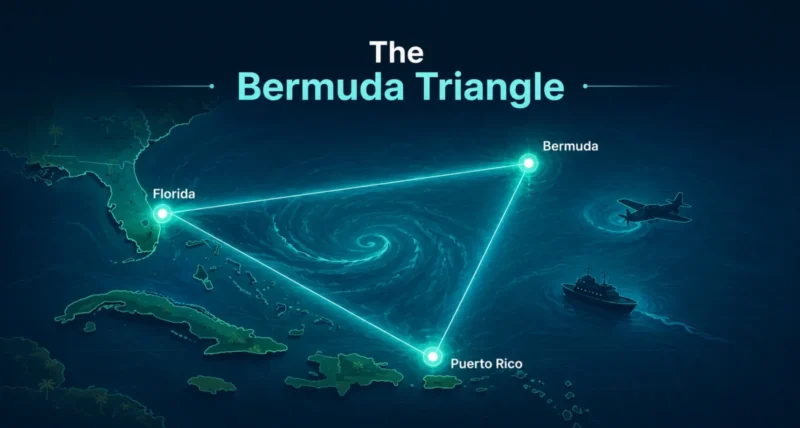
The Bermuda Triangle, also called the Devil’s Triangle, is a loosely defined patch of the North Atlantic Ocean. Mapmakers usually draw its three corners between Miami in Florida, the island of Bermuda, and San Juan in Puerto Rico. That covers roughly 500,000 square miles of open sea. Here is a surprising twist: there is no official version of it. The US Board on Geographic Names does not even recognize the Bermuda Triangle as a real place. Its exact borders shift depending on who is telling the story. The name is fairly modern, too. Writer Vincent Gaddis coined the phrase in a 1964 magazine article. Author Charles Berlitz then turned it into a worldwide sensation with his 1974 bestseller.
The Disappearances That Started It All
The legend rests on a handful of dramatic cases, especially two involving the US military. In 1918, the USS Cyclops, a Navy supply ship carrying more than 300 men, vanished on its way from Brazil to Baltimore. Searchers never found any wreckage, and no one ever established a clear cause. It remains one of the worst non-combat losses of life in US Navy history.
The most famous case came in 1945 with Flight 19. Five Navy torpedo bombers took off from Florida on a routine training flight. Their compasses reportedly failed, the crew grew disoriented, and no one ever saw the planes again. A rescue aircraft sent to find them also disappeared. Here are some of the incidents most often linked to the Triangle.
| Incident | Year | What Happened |
| USS Cyclops | 1918 | Navy ship with 300+ crew vanished with no wreckage found |
| Flight 19 | 1945 | Five Navy bombers lost on a training flight; a rescue plane vanished too |
| Star Tiger | 1948 | Passenger plane disappeared on approach to Bermuda |
| Douglas DC-3 | 1948 | Airliner vanished near Florida with all aboard |
| Marine Sulphur Queen | 1963 | Tanker lost at sea with its entire crew |
The Theories: From Science to Science Fiction
Over the years, people have offered every kind of explanation imaginable, and they fall into two camps. On the scientific side, researchers point to natural forces that are genuinely dangerous at sea. On the fanciful side, writers have blamed everything from aliens to the lost city of Atlantis. Here is a quick tour of the main ideas.
| Theory | The Idea | What Experts Say |
| Violent weather | Sudden storms and waterspouts can sink vessels fast | The most likely cause, per NOAA |
| The Gulf Stream | A powerful current sweeps away any wreckage | Well supported; explains missing debris |
| Rogue waves | Giant, unexpected waves swamp ships | Plausible and documented at sea |
| Methane gas | Seabed gas eruptions lower the water density | A hypothesis, unproven for the Triangle |
| Compass errors | Magnetic quirks confuse navigation | Real but minor, and known to sailors |
| Aliens and Atlantis | Supernatural forces cause the vanishings | No evidence; rejected by scientists |
The scientific explanations share a common theme. This part of the ocean can turn deadly fast, and the evidence often sinks or drifts away before anyone can study it.

So, Is the Bermuda Triangle Mystery Solved?
This is the question that matters, and the evidence points to a clear answer. When researchers actually checked the famous cases, the mystery started to fall apart. Author Larry Kusche spent years investigating the original reports for his aptly titled 1975 book, The Bermuda Triangle Mystery: Solved. He found that writers had exaggerated many stories and misplaced others far outside the Triangle. Several supposed disappearances were not mysterious at all. In one case, a plane said to have vanished had actually crashed in front of hundreds of witnesses. Sloppy reporting inflated the numbers too. A ship going missing made the news, while its safe return often did not.
Then there are the statistics. According to NOAA, the US ocean agency, there is no evidence that disappearances happen more often in the Bermuda Triangle than in any other busy, well-traveled part of the ocean. A 2013 study did not even rank it among the world’s most dangerous waters. Both the US Coast Guard and the insurance giant Lloyd’s of London reached the same view decades ago. Astronomer Carl Sagan put it simply. Ships and planes seem to vanish there mainly because it is such a busy route. Things that go down in water tend to disappear. As Britannica notes, the area’s fearsome reputation is largely unearned.
So, is it solved? In the way that matters, yes. There is no single supernatural force at work, and each real incident has an ordinary explanation, even if we cannot always pin down exactly which one. The one honest caveat, as History.com points out, is that no single theory explains every case, because there was never a single cause to begin with.
Why the Legend Refuses to Die
If the science is so clear, why do we still talk about the Bermuda Triangle? Part of the answer is human nature. A tidy explanation like bad weather is far less thrilling than aliens or a portal to another dimension. Movies, books, and documentaries have kept the spooky version alive for generations. There is also the ocean itself. The Atlantic is vast and deep, and wreckage can disappear quickly, which makes an ordinary accident feel eerie and unexplained. If you enjoy this kind of puzzle, our look at the secrets of the ocean shows just how much of the sea we still have not explored.
The Bermuda Triangle mystery shows how a legend takes hold. A few dramatic stories, some exaggeration, and our love of the unknown keep it alive for decades. The real explanation is not aliens or Atlantis. It is weather, currents, human error, and a very busy patch of ocean.
That may be less exciting than the myth, but it is a fascinating story in its own right. If you crave another great puzzle, our piece on 3I/ATLAS, a visitor from beyond our solar system, is a good place to go next.
Frequently Asked Questions
Where is the Bermuda Triangle?
The Bermuda Triangle is a loosely defined region of the North Atlantic Ocean. Its corners sit between Miami in Florida, the island of Bermuda, and San Juan in Puerto Rico, covering about 500,000 square miles.
Is the Bermuda Triangle dangerous?
Not unusually. Agencies like NOAA and the US Coast Guard say it has no more incidents than any other busy stretch of ocean its size. Modern ships, aircraft, and weather forecasting make passing through it routine and safe.
What happened to Flight 19?
Flight 19 was a group of five US Navy bombers lost during a training flight in 1945. Their compasses reportedly failed and the crew became disoriented before running low on fuel. A rescue plane sent to find them also disappeared, which fueled the legend.
Has the Bermuda Triangle mystery been solved?
In a scientific sense, yes. Investigations found that ordinary causes explain the incidents, like storms, currents, and human error. Writers had also exaggerated many of the stories. There is no single supernatural cause, though different incidents had different explanations.
Do ships and planes still travel through the Bermuda Triangle?
Yes, constantly. The region is one of the most heavily traveled shipping and flight paths in the world, and vessels cross it safely every day. Its dangerous reputation does not match the modern reality.
Why is it called the Bermuda Triangle?
The name comes from the roughly triangular shape formed by its three corners near Bermuda, Florida, and Puerto Rico. Writer Vincent Gaddis coined the phrase in a 1964 magazine article, and it stuck.

