
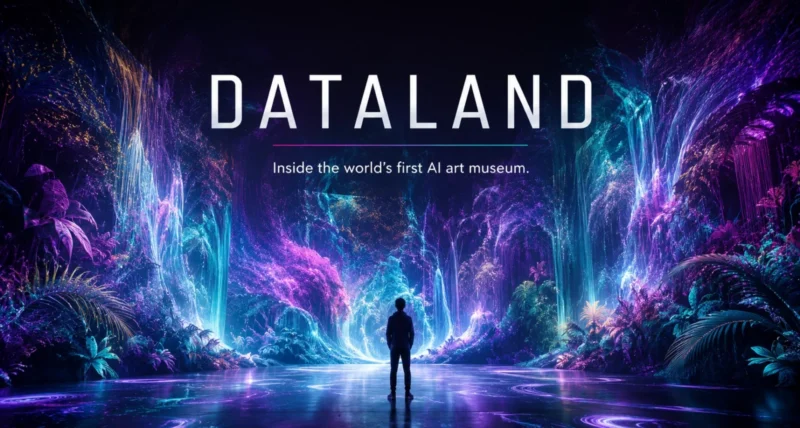
What happens when you hand an artist a neural network instead of a paintbrush? The answer opens its doors this week. On June 20, 2026, Dataland opens in Los Angeles, billed as the world’s first museum of AI arts. It is the result of a decade-long collaboration between Google and media artist Refik Anadol. As Google announced, it is a place where data becomes paint and the art reshapes itself in real time. Here is what it is, how it works, and how you can experience it.
| The Quick Answer Dataland is the world’s first AI art museum, opening June 20, 2026, at The Grand LA. Created by artist Refik Anadol and powered by Google Cloud, the 25,000-square-foot space turns environmental data into giant, living digital artworks that react to visitors in real time. Its first exhibition, Machine Dreams: Rainforest, runs on an AI trained on the natural world. Google Arts & Culture is also funding a new residency to support four AI artists. |
What Is Dataland
Dataland is a brand new museum dedicated entirely to art made with artificial intelligence, the first of its kind in the world. It sits inside The Grand LA, a Frank Gehry-designed development in downtown Los Angeles. The space spans 25,000 square feet of immersive galleries.
The big idea is simple but striking: instead of paint on canvas, the artists here use data as their medium. AI models take environmental data, like the patterns of a rainforest, and transform it into vast, shifting digital landscapes that surround you. The art is never static. It generates and evolves moment to moment.
| The Big Picture This is a real, physical museum you can walk into, not a website or an app. Think of it as stepping inside a living painting that is being created by AI in real time, all around you. |
Who Is Behind It
Dataland is the vision of Refik Anadol, a media artist famous for turning data into massive, mesmerizing visual installations. The museum is the culmination of a partnership with Google that goes back a full decade.
Anadol first joined Google’s Artists and Machine Intelligence program back in 2016. That was long before AI art became a mainstream talking point. Since then, the pair have collaborated on projects that hinted at this moment. Here is the journey that led to Dataland:
| Year | Milestone |
| 2016 | Refik Anadol joins Google’s Artists and Machine Intelligence cohort |
| 2018 | Projection-mapping the LA Philharmonic’s archives onto architecture |
| 2020 | Visualizing Google Quantum AI data as art |
| 2025 | Machine Dreams: Biophilia installation at Google’s campus |
| 2026 | Dataland opens to the public |

What You Will Actually See: Machine Dreams Rainforest
The museum’s opening exhibition is called Machine Dreams: Rainforest. It runs on something called the Large Nature Model, an AI trained on a huge dataset of the natural world. The result is a digital rainforest in an astonishing 1.2 billion pixels of ever-changing imagery.
But this is not just something you look at. Dataland is designed to be what Google calls an omni-sensory experience, meaning it engages more than your eyes. The space responds to the people inside it.
- It reacts to you: the artwork senses human presence and even emotion, shifting as you move through the gallery.
- Sound that responds: AI generates soundscapes in real time to match what is on the walls.
- Even a sense of smell: the experience augments scents algorithmically, adding another layer to the immersion.
| The Cool Part Walk into the same gallery twice and it will never look exactly the same. Because the art is generated live and responds to the crowd, every visit is genuinely one of a kind. |
How Google’s Technology Powers It
Turning raw environmental data into 1.2 billion living pixels takes serious computing muscle. That is where Google Cloud comes in, running the whole experience behind the scenes. Here is the tech, in plain terms.
| The Technology | What It Does |
| Large Nature Model | The AI, trained on nature data, that generates the imagery |
| Google Cloud | The computing power running it all, from ticketing to the gallery walls |
| Gemini and AI models | GANs, diffusion models, and Gemini bring the galleries to life |
| Carbon-free compute | Runs on 87% carbon-free renewable energy for sustainability |
| Worth Knowing Google highlights that all of this runs on infrastructure powered by 87% carbon-free energy. For an exhibition about nature and the environment, running it sustainably is part of the point. |
A Boost for New Artists: The Dataland Residency
The museum is not just about showing finished art. Alongside the opening, Google Arts & Culture is funding a new program called the Dataland AI Artist Residency, designed to help the next wave of digital artists learn these tools.
Here is what the residency offers:
- Who: four selected artists.
- How long: a six-month incubator program.
- Grant: 25,000 dollars for each artist.
- Support: mentorship from Refik Anadol Studio plus access to advanced Google Cloud tools and machine learning models.
- Payoff: their work goes on display on Dataland’s global stage and the Google Arts & Culture website later this year.
How to Visit Dataland
| Detail | Info |
| What | Dataland, the world’s first AI art museum |
| Where | The Grand LA, downtown Los Angeles |
| Opens | June 20, 2026 |
| First exhibition | Machine Dreams: Rainforest |
| Size | 25,000 square feet, omni-sensory galleries |
| Quick Tip If you are in or visiting Los Angeles, Dataland is a one-of-a-kind experience worth planning around. Check the official Dataland website for tickets, hours, and the latest exhibition details before you go. |
Why Dataland Matters
Beyond the spectacle, Dataland marks where creativity is heading. It treats AI not as a gimmick or a replacement for artists, but as a genuine new medium, a fresh kind of paintbrush in human hands. The decade-long collaboration behind it suggests a serious artistic movement, not a passing trend.
It also raises the big, fascinating questions of our moment. Where does the human artist end and the machine begin? Can a museum feel alive? Dataland does not just ask these questions, it lets you walk around inside them.
Dataland turns a big idea, that AI can be an artist’s medium, into a place you can actually stand inside. With living digital landscapes, real-time reactions to the crowd, and a residency to nurture new talent, it stands as one of the most ambitious fusions of technology and art yet. Whether you visit in person or just follow along, it is a glimpse of a creative future taking shape right now. You can read more on the official Google blog.
Frequently Asked Questions
What Is Dataland
Dataland is the world’s first museum dedicated to AI art, opening June 20, 2026, in Los Angeles. Created by artist Refik Anadol and powered by Google Cloud, it turns environmental data into giant, living digital artworks that respond to visitors.
Where Is Dataland Located
Dataland is located in The Grand LA, a Frank Gehry-designed development in downtown Los Angeles. It spans 25,000 square feet of immersive gallery space.
When Does Dataland Open
Dataland opens to the public on June 20, 2026.
What Is the First Exhibition
The opening exhibition is Machine Dreams: Rainforest, powered by the Large Nature Model, an AI trained on the natural world. It renders a digital rainforest in 1.2 billion pixels that shifts in response to visitors in real time.
How Is Google Involved
Google is the technology and creative collaborator. Google Cloud powers the real-time AI experience, Gemini and other AI models help generate the art, and Google Arts & Culture funds the new artist residency.
What Is the Dataland AI Artist Residency
It is a six-month program funded by Google Arts & Culture. It gives four artists 25,000 dollar grants each, mentorship from Refik Anadol Studio, and access to Google Cloud tools to create new AI artwork.
Is Dataland Environmentally Friendly
Google says the experience runs on computing infrastructure powered by 87% carbon-free renewable energy, an intentional choice for an exhibition centered on nature and the environment.

