
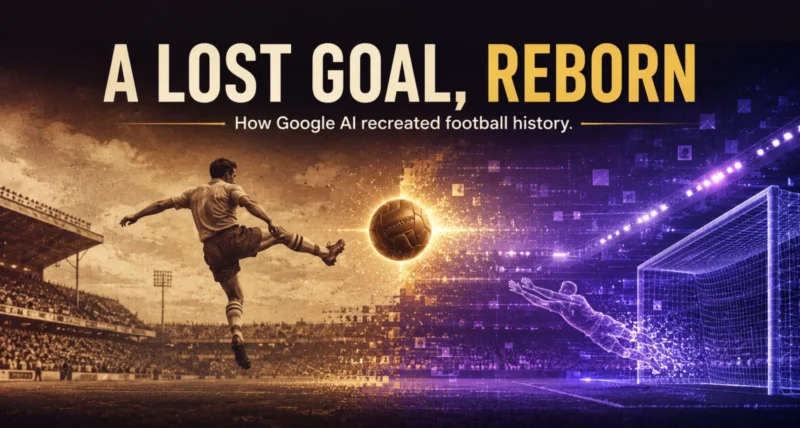
Some of the greatest moments in sports were never caught on camera. One of them belonged to Pele, the Brazilian footballer many consider the greatest of all time. Back in 1959, he scored a goal so beautiful it became a legend. Yet not a single frame of it survives. Now, using cutting-edge artificial intelligence, Google DeepMind has brought that lost moment back to life. Here is the story of how they did it, and why it matters right now.
| The Short Version Google DeepMind has used AI to recreate a famous 1959 goal by Pele that was never filmed, known as the Gol da Rua Javari. Working with Pele’s family, historians, and his official estate, teams used Google’s frontier AI models, Gemini Omni and Veo 3, to rebuild the lost footage. It was filmed on the original pitch with authentic kit and a vintage ball. The recreation is headed to the Pele Museum and arrives during the first World Cup since his passing. |
The Goal That History Forgot
To understand why this matters, picture the moment. On August 2, 1959, Pele produced what many call the most beautiful goal of his career. He flicked the ball over defenders’ heads three times in a row, a move known as a sombrero. He never let it touch the ground once, then finished. It was the kind of magic that defined him.
The play became known as the Gol da Rua Javari, named after the street where the stadium stood. There was just one problem. No camera recorded the 1959 match. So the goal lived on only through the memories of those lucky enough to witness it, and the stories they passed down. For over six decades, one of football’s greatest moments existed purely as legend, with no video to prove it.
| Quick Take Think about how much sport we capture today, every angle, every replay, in crystal-clear video. In 1959, that simply did not exist. So one of the finest goals ever scored, by arguably the sport’s greatest player, was never seen again after the final whistle. Until now. |
How Google DeepMind Rebuilt the Moment
This is where modern technology steps in. Google DeepMind, Google’s artificial intelligence lab, took on the challenge of recreating the goal as faithfully as possible. Crucially, this was not a case of a computer inventing something from nothing. It was a careful act of historical reconstruction, built on real evidence.
The team worked alongside the people who knew the moment best. The project brought together a wide group of experts and loved ones to make sure every detail rang true.
| Who Helped Rebuild the Goal | Their Role |
| Pele’s family | Shared personal memories and gave their blessing to the project |
| Historians | Provided accurate context about the era and the match |
| Sports journalists | Contributed records and accounts of how the goal unfolded |
| Football legends | Helped capture how Pele actually moved and played |
| Pele Brand | The official managers of Pele’s estate, full partners in the work |
To bridge the gap between old fragments and a moving picture, the team also went back to the source. The team filmed the scene on the original pitch, using authentic period uniforms and a vintage ball. This kept the recreation feeling real and grounded, rather than like a cartoon.
The AI Behind the Magic, Explained Simply
So what actually did the heavy lifting? Google used two of its most advanced AI systems, called frontier models because they sit at the very edge of what AI can do. Here is what each one brought to the table, in plain terms.
| AI Model | What It Did |
| Gemini Omni | Google’s advanced AI that can understand and work across many types of information at once, helping make sense of the historical fragments |
| Veo 3 | Google’s AI video generation model, used to turn those fragments into smooth, moving imagery of the goal |
In simple terms, the AI gathered scattered pieces of history: written accounts, memories, photos, and the freshly filmed footage. It then wove them into a flowing video of a goal that no camera ever captured. The result is a blend of real filming and AI reconstruction, grounded in fact rather than guesswork.
| Why It Matters This is a different way to think about AI. Instead of replacing human creativity or making things up, the technology is being used to preserve and honor history. It fills a gap that would otherwise have been lost forever, turning fading memories into something a new generation can actually watch. |
Why This Matters Right Now
The timing is deliberate and deeply emotional. Pele passed away in December 2022, which means the 2026 World Cup is the first ever held without him. The 2026 tournament is co-hosted across North America, including the United States. Fans around the world feel his absence keenly.
By bringing this lost goal back to life now, Google and Pele’s estate have created a fitting tribute. It lets a new generation of fans witness a piece of his genius. Many are discovering him for the first time, seeing something they could otherwise only read about. The project is rooted in education and cultural preservation. It will find a permanent home at the Pele Museum later this year.
| 1959 | the year of the lost goal, finally rebuilt more than 65 years later |
| Good to Know Pele is widely regarded as one of the greatest footballers in history, a three-time World Cup winner. For readers in the US, where the sport is known as soccer, he was also a pioneer who helped popularize the game in America in the 1970s. That global legacy is exactly what this project aims to protect. |
The Bigger Picture: AI as a Time Machine
This Pele project is a powerful example of a growing idea: using AI not just to look forward, but to look back and rescue history that would otherwise fade away. The same kinds of tools that generate new videos can also rebuild lost ones. They can restore damaged recordings, or bring historical events to life for students.
It points to a striking future. A faded photograph, an old radio commentary, or a witness’s memory could be enough to reconstruct a moment in vivid detail. Handled with care and respect, as Google did here through close partnership with Pele’s family, that prospect is genuinely exciting. It opens new doors for museums, educators, and sports fans alike. The full behind-the-scenes story is set to appear on Google’s official YouTube channel soon.
The story of Pele’s lost goal is a beautiful reminder. Used thoughtfully, technology can do more than push us forward. It can also help us reclaim what we thought was gone. Google teamed up with Pele’s family and used its most advanced AI. Together, they turned a 67-year-old legend into something people can finally see. It stands as both a tribute to a sporting icon and a glimpse of how AI can preserve our shared history. The world is gathering for a World Cup without him. That feels like a fitting way to keep his magic alive. You may also like our coverage of the latest Google and AI updates.
Frequently Asked Questions
What Did Google DeepMind Recreate?
Google DeepMind used AI to recreate a famous 1959 goal by football legend Pele that was never captured on film. Known as the Gol da Rua Javari, the goal saw Pele flick the ball over defenders three times in a row. It never touched the ground. The reconstruction was unveiled at the Cannes Lions festival in 2026.
What Is the Gol da Rua Javari?
The Gol da Rua Javari is the name of a goal Pele scored on August 2, 1959. Many consider it the most beautiful of his career. It is named after the street where the stadium was located. Because the match was not filmed, the goal survived only through eyewitness accounts until Google recreated it with AI.
What AI Did Google Use to Recreate the Goal?
Google used two frontier AI models. The first is Gemini Omni, which helps understand and combine many types of information. The second is Veo 3, Google’s AI video generation model that turns inputs into moving imagery. Together they transformed historical fragments and newly filmed footage into a video of the lost goal.
Was the Goal Fully Generated by AI?
No, it was a careful reconstruction, not pure invention. The team filmed the scene on the original pitch with authentic period uniforms and a vintage ball. The work also drew on input from historians, sports journalists, football legends, and Pele’s family. AI was used to weave these real elements into the final moving imagery.
Why Did Google Recreate a Pele Goal Now?
The recreation arrives during the 2026 World Cup, the first ever held since Pele’s death in December 2022. Google created the project in partnership with his official estate. It is a tribute meant to inspire a new generation of fans and preserve a piece of football history that was at risk of being forgotten.
Where Can I See the Recreated Pele Goal?
Google has said the full behind-the-scenes story will be available on its official YouTube channel soon. The recreation itself is also headed to the Pele Museum later this year. There, it will join an effort rooted in education and cultural preservation.

