
In 1948, an elderly woman lay blind and penniless in a Pennsylvania sanitarium. She had no children of her own. Yet every year, her room overflowed with cards and flowers from strangers. None of them knew the frail patient receiving these gifts was the very woman who had given the world Mother’s Day. She had also spent her entire fortune trying to destroy it. Her name was Anna Jarvis, and her story is one of the strangest, most bittersweet tales in the history of our holidays.
This is the true story of how Mother’s Day was born from a daughter’s grief, how it swept across America in just six years, and how its founder came to wage a furious, ruinous war against the very celebration she created. Pour a cup of tea. It is quite a tale.
| The Short Version Anna Jarvis held the first Mother’s Day on May 10, 1908, to honor her late mother. President Woodrow Wilson made it a national holiday in 1914. Within a decade, Jarvis turned against the florists, card-makers, and candy companies she felt had corrupted it, even getting arrested in protest, and died in 1948 having tried to abolish the holiday entirely. |
A Mother’s Prayer: Where It All Began
To understand Mother’s Day, you have to start not with Anna, but with her mother, Ann Reeves Jarvis, a remarkable woman in her own right.
Living in the hills of West Virginia in the mid-1800s, Ann Reeves Jarvis knew a mother’s grief intimately. Of her many children, only four survived to adulthood. Disease swept through Appalachian communities. So around 1858 she founded what she called Mothers’ Day Work Clubs. These were groups of women who worked to improve sanitation, inspect milk, and fight the infections killing local children.
When the Civil War tore the country apart, those clubs did something radical. They stayed neutral, caring for wounded soldiers on both sides. After the war, Ann organized a Mothers’ Friendship Day to bring former enemies, Union and Confederate families, back together in peace. She believed in the quiet, civic power of mothers to heal a broken world.
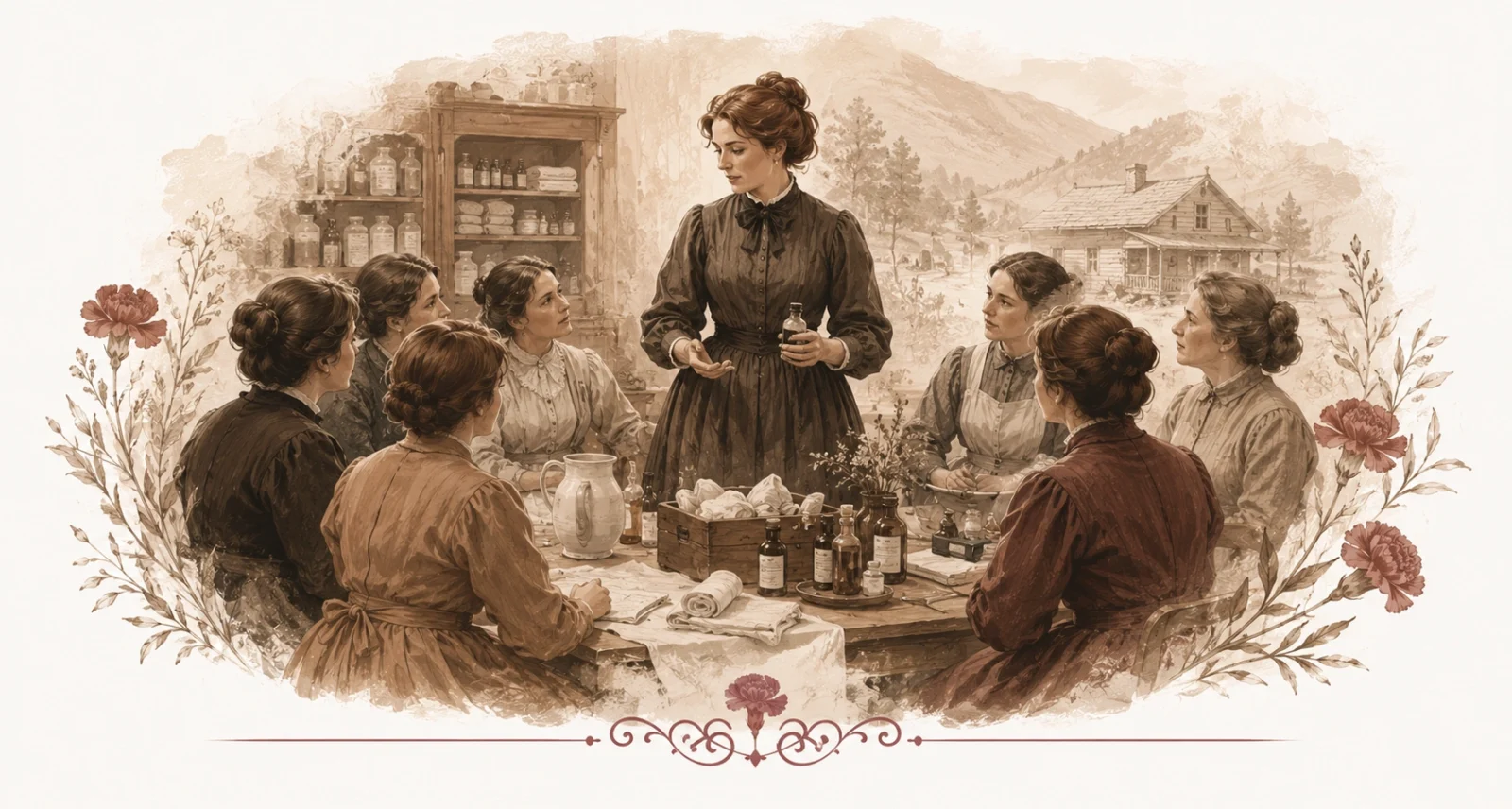
Then came the moment that planted the seed. Teaching a Sunday school lesson, Ann Reeves Jarvis closed with a prayer her daughter never forgot. It was a wish that someone would one day found a memorial day for mothers, honoring the matchless service they give to humanity. Young Anna heard it. She remembered it. And she would spend the rest of her life answering it.
| I hope and pray that someone, sometime, will found a memorial mothers day commemorating her for the matchless service she renders to humanity in every field of life. Ann Reeves Jarvis, in a Sunday school prayer that inspired her daughter |
From Grief to a Movement
Ann Reeves Jarvis died on May 9, 1905. Her daughter Anna, then in her early forties, unmarried and working for an insurance company in Philadelphia, was shattered. In her grief, she found her purpose: she would make her mother’s prayer come true.
Three years later, on May 10, 1908, the first official Mother’s Day took place. Fittingly, it happened in two places at once. In Grafton, West Virginia, a service was held at Andrews Methodist Episcopal Church, where Ann Reeves Jarvis had taught Sunday school for 25 years. Anna did not attend in person. Instead, she sent 500 white carnations, her mother’s favorite flower, one for each person there.
Why white carnations? Anna loved that the flower’s petals do not fall away as it dies. Instead they curl inward, as if hugging its own heart. To her, that was a mother’s love made visible. That same day, Anna herself addressed a vast crowd, reported at around 15,000 people, at a Philadelphia auditorium owned by her supporter John Wanamaker.
| One Tiny Apostrophe, One Big Meaning Anna insisted on the spelling Mother’s Day, singular possessive, not Mothers’ Day. The point was personal: a day for each family to honor its own mother, not a vague celebration of all mothers everywhere. As her leading biographer puts it, that small apostrophe was the entire point of the holiday. |
Six Years to a National Holiday
What happened next was astonishing. Anna Jarvis turned out to be a one-woman publicity machine. She wrote thousands of letters to governors, congressmen, newspaper editors, and powerful businessmen, tirelessly campaigning for an official day. Wealthy backers like John Wanamaker and the food magnate H. J. Heinz lent their support.
The idea caught fire. West Virginia became the first state to officially recognize Mother’s Day in 1910. By 1911, every state in the union was marking it. (Congress had earlier laughed off the idea, with one politician joking they would next need a Mother-in-law’s Day.)
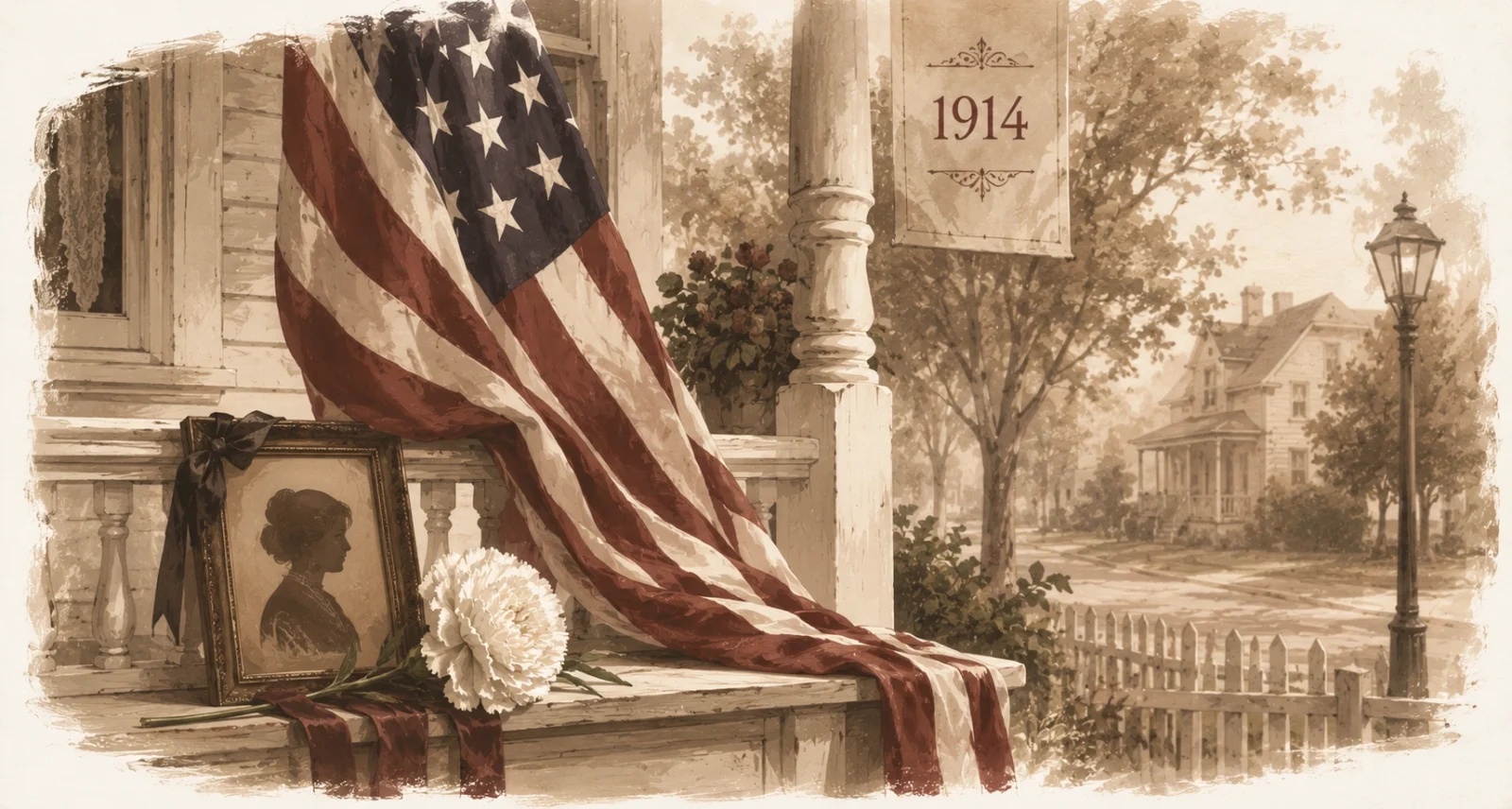
Then came the crowning moment. On May 9, 1914, President Woodrow Wilson signed a proclamation making the second Sunday in May an official national holiday. He called for Americans to fly the flag as a public expression of our love and reverence for the mothers of our country. In just six years, a grieving daughter had turned her mother’s quiet prayer into a holiday for an entire nation.
The Holiday Spins Out of Her Hands
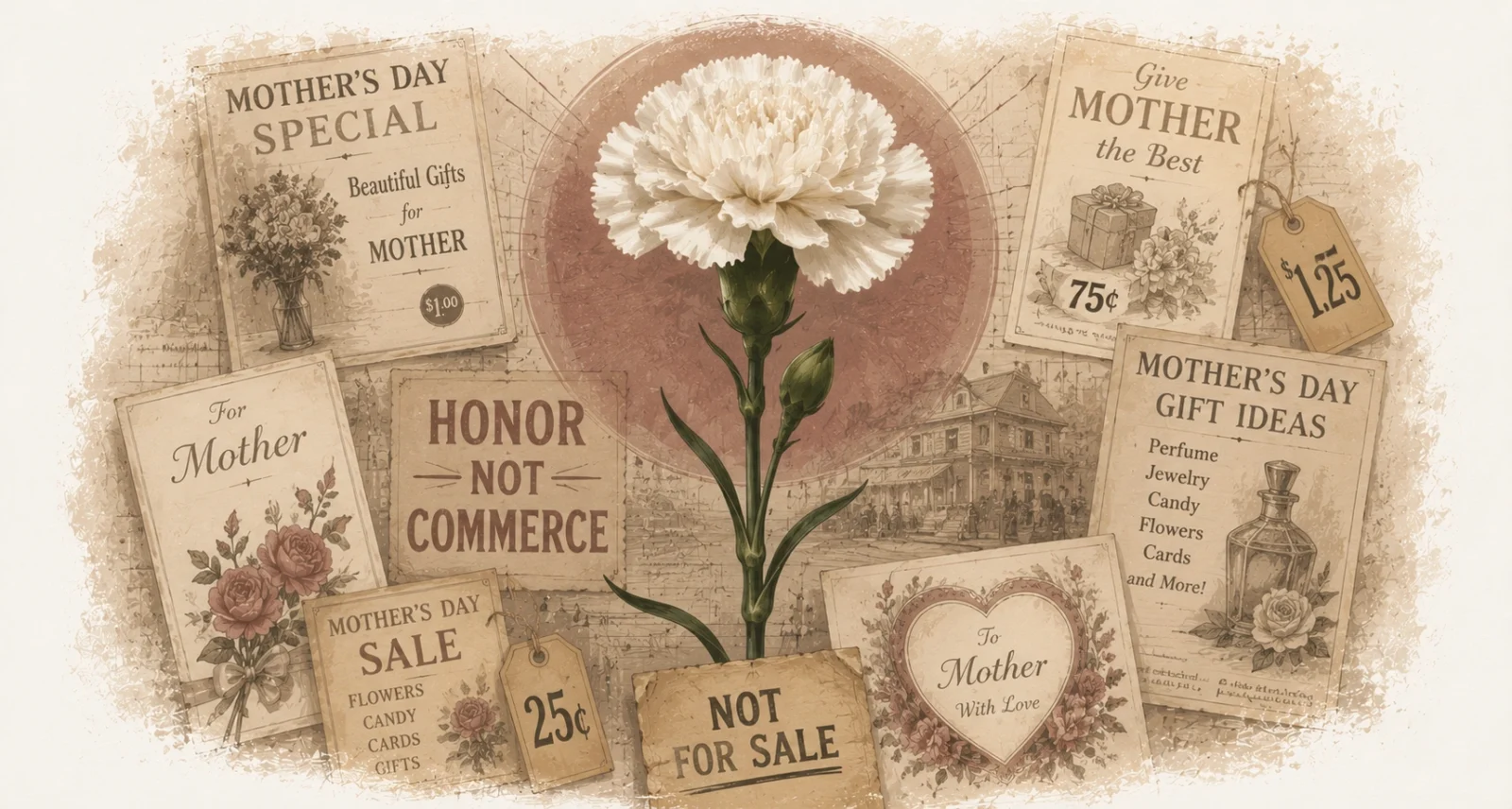
Almost immediately, the trouble began. The moment Mother’s Day became official, businesses saw an opportunity. Florists, who had been useful allies, now raised the price of white carnations every May. When supplies ran short, they invented a new rule. Red or pink carnations were for living mothers, white for those who had passed, a clever way to sell more flowers. Greeting-card companies printed cards by the millions. Candy-makers ran special promotions.
To most people, this was harmless. To Anna Jarvis, it was a betrayal. She had imagined a holy day of genuine sentiment: a heartfelt visit, a handwritten letter, a private moment between a child and a mother. What she saw instead was profit dressed up as love. And she was not the kind of woman to stay quiet about it.
| A day of sentiment, not profit. The principle Anna Jarvis believed Mother’s Day had abandoned |
She came to see the holiday as her own creation, almost her property, and she was determined to defend it. She especially loathed the printed greeting card, viewing it as a lazy shortcut. Why send a mass-produced card, she argued, when you could write your mother a real letter in your own hand?
| A Famous Quote, Handled Honestly You will often see this line attributed to Anna Jarvis: that a printed card means nothing except that you are too lazy to write to the woman who has done more for you than anyone in the world. It perfectly captures her views. But historians who have searched her archives cannot find it in her papers, so treat it as a quote often attributed to her rather than a verified one. What is firmly documented is her blistering description of commercializers as charlatans, bandits, pirates, racketeers, kidnappers and other termites. |
The Founder Declares War
What followed was extraordinary. Anna Jarvis spent the rest of her life, and most of her sizable inheritance, fighting the holiday’s commercial side with everything she had.
She incorporated an organization to control the day, and trademarked phrases tied to it. Lawsuits followed against groups using the Mother’s Day name. She even had simple white-carnation buttons made and gave them away free, a deliberate alternative to the florists’ inflated bouquets.
Her protests grew bolder and stranger:
- In 1923, she stormed a confectioners’ convention to denounce the candy industry’s use of the holiday.
- In 1925, she crashed a convention of the American War Mothers, who were selling carnations to raise money, and was arrested for disturbing the peace.
- She attacked a sitting First Lady, Eleanor Roosevelt, for using Mother’s Day to raise funds for charities fighting infant and maternal mortality, ironically, the exact cause Anna’s own mother had devoted her life to.
- She fought a postage stamp, objecting to a 1934 Mother’s Day stamp until the words Mother’s Day were removed from its design.
One famous, often-told story claims she once ordered a Mother’s Day Salad at a tea room, then dumped it on the floor and walked out in disgust at the commercial gimmick. Whether or not every detail is exact, it captures her fury perfectly. By 1943, she was circulating a petition to rescind Mother’s Day altogether, hoping to erase the very holiday she had spent her youth creating.
A Lonely, Bitter End
The war cost Anna Jarvis everything. She never married, never had children, and never earned a cent from the holiday celebrated by millions. Instead, the inheritance went into her campaigns, year after year, until the money was gone.
By the early 1940s, she was impoverished and nearly blind. Friends formed a committee to care for her, and she entered the Marshall Square Sanitarium in West Chester, Pennsylvania. There she remained until her death on November 24, 1948, at the age of 84. By some accounts, she told a visitor she was sorry she had ever started Mother’s Day. Her grave lies beside the mother whose memory had started it all.
| A Poignant Legend, Not a Proven Fact A story often repeated is that the floral and greeting-card industries, the very businesses Anna fought, secretly paid her sanitarium bills. It is a haunting irony, but it should be treated as a legend rather than established history. No company, document, or named donor has ever confirmed it, and the leading scholarly accounts state only that she died penniless. A beautiful story, but an unverified one. |
Mother’s Day Around the World
Here is something many people do not realize. The Mother’s Day that Anna Jarvis built is mostly an American creation. Much of the world celebrates motherhood on entirely different days, for entirely different reasons.
| Place / Tradition | When and Why |
| United States and 80+ countries | Second Sunday of May, following Jarvis’s holiday (Canada, Australia, India, and more) |
| United Kingdom and Ireland | Mothering Sunday, the fourth Sunday of Lent, with medieval Christian roots quite separate from Jarvis |
| Arab world | March 21, the spring equinox, introduced in Egypt in 1956 |
| Mexico | Fixed on May 10 every year |
| Norway | Second Sunday of February |
| France and Sweden | Last Sunday of May |
Long before any of this, ancient peoples held spring festivals for mother goddesses, the Greeks for Rhea, the Romans for Cybele. But these honored deities, not actual mothers. They are not the direct ancestors of the holiday we know. The modern, family-centered Mother’s Day really does trace back to one determined woman in West Virginia.
The Final Irony: What Mother’s Day Looks Like Today
If Anna Jarvis could see Mother’s Day now, she would likely be horrified, and heartbroken.
Mother’s Day is now one of the biggest shopping events of the year. In 2026, Americans are projected to spend a record amount on it, around 38 billion dollars, according to the National Retail Federation, or roughly 284 dollars per person. The biggest categories include jewelry, special outings, and, of course, flowers and greeting cards: the very things she spent her life fighting.
| Myth Check: Did Hallmark Invent Mother’s Day? No. This is one of the most common myths about the holiday. Mother’s Day was created by a real woman, Anna Jarvis, out of love for her mother, and she actually despised the greeting-card industry. The companies did not invent the day; they commercialized one that already existed. |
And yet there is something Anna might have taken comfort in. Beneath all the spending, the heart of the day is still what she wanted: a moment to stop and honor the woman who raised you. The card and the flowers are easy. The thing she truly asked for, genuine, personal gratitude, is still free, and still available to every one of us.
The history of Mother’s Day is really a story about love, grief, and what happens when something deeply personal becomes wildly popular. Anna Jarvis gave the world a day to honor mothers. Then she watched in dismay as it grew into something she no longer recognized, and died believing she had failed.
But maybe she did not. Every time someone writes their mother a real letter, makes a heartfelt call, or simply says a proper thank you, Anna Jarvis gets her wish after all. That, not the price tag, was always the point.
Frequently Asked Questions
Who Invented Mother’s Day
Anna Jarvis, a woman from Grafton, West Virginia, created the modern Mother’s Day to honor her late mother, Ann Reeves Jarvis. She held the first observance in 1908 and campaigned until it became a US national holiday in 1914.
Why Did Anna Jarvis Hate Mother’s Day Later
Anna believed florists, card companies, and candy-makers had corrupted her holiday for profit. She wanted a day of heartfelt, personal sentiment, not commercial gift-giving. So she spent her later life and fortune fighting that commercialization.
When Did Mother’s Day Become a National Holiday
President Woodrow Wilson signed a proclamation on May 9, 1914, establishing the second Sunday in May as a national Mother’s Day in the United States.
Why Are White Carnations Linked to Mother’s Day
White carnations were the favorite flower of Anna Jarvis’s mother. Anna chose them as the holiday’s emblem because their petals curl inward as they fade. She felt this symbolized a mother’s enduring love.
Did Anna Jarvis Have Children
No. Anna Jarvis never married and never had children. She said she understood motherhood through the eyes of a devoted daughter, honoring her own mother’s memory.
Is It Mother’s Day or Mothers’ Day
Anna Jarvis insisted on Mother’s Day, with the apostrophe before the s. She wanted each family to honor its own individual mother, rather than mothers in general.
Did Florists Really Pay Anna Jarvis’s Medical Bills
This is a popular story but an unverified one. It is often said the floral and card industries quietly covered her sanitarium costs. But no record confirms it, and historians treat it as a legend rather than fact.

