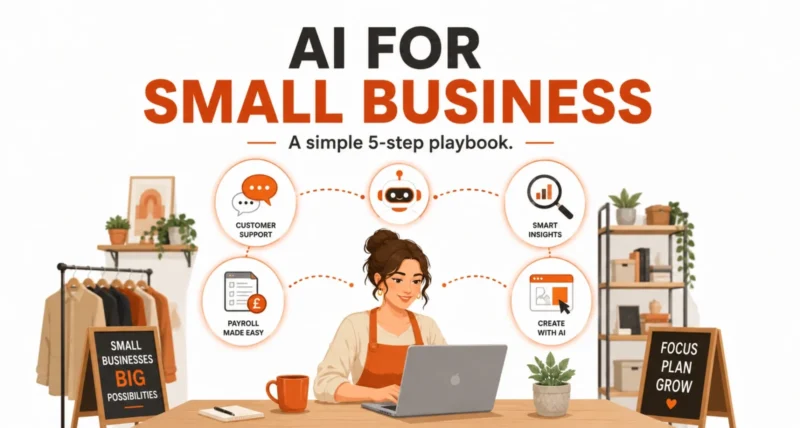
AI can feel like it is built for tech giants with huge budgets. It is not. Across the UK, ordinary small and midsize businesses are quietly using it to win back time, cut the boring work, and serve customers better. As Google Cloud shared at its London Summit, the results are real and measurable. This is a plain-English playbook: five practical steps to put AI to work in your own business, each one shown by a real UK company already doing it.
Why bother? The numbers from UK small businesses already using AI:
| 71% | of UK AI adopters surveyed say it saves them time on routine tasks. |
| 64% | report a direct boost in their productivity. |
| 1 day | is effectively handed back each week, from a 20% productivity lift with AI tools. |
Figures from Enterprise Nation research with Google and Google’s own data, so read them as encouraging signals from AI adopters, not guarantees for every business.
Before You Start: One Simple Mindset
AI for small business does not have to be some giant project. The trick is smaller and saner. Pick one annoying, repetitive job that eats your week, and let AI take the first pass at it. Master that, then move to the next. The five steps below run from easiest to most ambitious, so you can start today and build up.
Step 1: Win Back Time on Repetitive Admin
Start where the pain is dullest. Every small business loses hours to repetitive admin, things like payroll entries, accounting tasks, and sorting through files. This is the lowest-risk place to begin, because the work is routine and easy to check.
Point AI at one recurring chore first. Let it draft the repetitive parts while you review and approve. You keep control, but you stop doing the robotic bits by hand.
| Real UK example: Sunhouse, a brand design agency Sunhouse uses Gemini Enterprise to instantly find archived design work in Google Drive. Less time hunting for old files means more time actually designing for clients. |
Step 2: Upgrade Your Customer Support
Once you have tasted time saved, aim at something customers feel: support. Slow replies lose business. AI can triage incoming questions, suggest answers, and route the tricky ones to a human faster.
The goal is not to replace your team with a robot. It is to handle the easy, repeat questions automatically so your people can focus on the cases that truly need a human touch.
| Real UK example: Sep 2, a digital security provider Sep 2 uses Gemini Enterprise to run autonomous AI agents for round-the-clock threat monitoring. They spot and shut down security problems for customers far faster than a manual team could alone. |
Step 3: Make Sense of Your Data Without a Data Team
Most small businesses sit on a goldmine of data: sales, customers, operations. Yet they never use it, because reading it needs an analyst they cannot afford. AI for small business changes that maths.
With modern AI tools, anyone on your team can ask questions of your data in plain words. No spreadsheet wizardry required. That means faster, smarter decisions from the people closest to the work.
| Real UK example: VoCoVo, a telecoms provider VoCoVo is weaving Google Cloud AI through its systems to turn scattered, isolated data into useful intelligence and automated workflows. That frees its team to focus on bigger ideas. |
Step 4: Speed Up Research and Content
Next, point AI at the slow, brain-heavy work: research, reports, and marketing material. These tasks used to take days or cost a fortune. AI can compress them dramatically, while a human checks the output.
Think drafting marketing material, summarising long documents, or pulling key facts out of dense reports. You still bring the judgment. AI just removes the grind.
| Real UK example: Neural Alpha, a sustainability fintech Neural Alpha uses Gemini models to read messy, unstructured sustainability reports. The AI automatically pulls out and organises thousands of key facts, turning months of manual research into a fraction of the time. |
Step 5: Build Your Own Simple AI Agents
This is the ambitious step, and a year ago it would have needed engineers. Not anymore. The newest tools let non-technical people build their own little AI agents. These are helpers that carry out a specific multi-step job on their own.
Picture an agent that gathers your weekly numbers, drafts the summary, and flags anything odd, all before your coffee. Start with one narrow, well-defined task, then grow from there.
| Real UK example: Terrapinn, a global events company Terrapinn combines several Google AI tools to turn manual chores into automated workflows. That speeds up how its teams design, market, and run their conferences. |
The 5 Steps at a Glance
| Step | What You Do | The Win |
| 1 | Automate repetitive admin | Hours saved every week |
| 2 | Upgrade customer support | Faster replies, happier customers |
| 3 | Make sense of your data | Smarter decisions, no analyst needed |
| 4 | Speed up research and content | Days of work done in minutes |
| 5 | Build simple AI agents | Whole tasks run themselves |
Free Ways to Skill Up Your Team
You do not have to figure this out alone, and you do not have to pay to learn. Google has put out free, on-demand training aimed at exactly this. There is an SMB Learning Path built for small businesses, a Google Skills learning centre with thousands of AI courses and hands-on labs, and an agent-focused program for teams ready to go further. A few hours here can save weeks later.
Your First Move This Week
Here is the honest truth: the businesses winning with AI did not start with a grand strategy. They started with one task. So forget the hype and the fear, and do just one thing this week.
Pick the single most repetitive, soul-draining job in your week, the one you dread every Monday. That is Step 1. Hand its first draft to an AI tool, review what comes back, and see how much time you claw back. That small win is how every company in this playbook began. Then come back for Step 2, and keep building your own AI for small business, one task at a time.
Frequently Asked Questions
How Can a Small Business Start Using AI
Start small. Pick one repetitive task, like admin or sorting files, and let an AI tool take the first pass while you review it. Master that, then move to customer support, data, and beyond.
Do I Need Technical Skills to Use AI
No. Modern AI tools let you work in plain language, and newer ones even let non-technical people build simple AI agents. Free training, like Google’s SMB Learning Path, helps your team get comfortable.
Is AI Actually Worth It for Small Businesses
UK research suggests strong gains. Some 71% of AI adopters say it saves time on routine tasks, and 64% report higher productivity, with tools delivering up to a 20% lift. These are vendor-cited figures, so treat them as encouraging, not guaranteed.
What Can Small Businesses Use AI For
Common uses include automating admin like payroll, improving customer support, understanding business data, speeding up research and marketing content, and building simple AI agents for repetitive jobs.
What Are Some Real Examples
Several UK firms show it in action: Neural Alpha (research), Sep 2 (security monitoring), Sunhouse (finding design files), Terrapinn (events workflows), and VoCoVo (data intelligence). All are using Google’s AI tools in production.
Where Can I Learn AI Skills for Free
Google offers free, on-demand resources including an SMB Learning Path and the Google Skills learning centre, with thousands of AI courses and hands-on labs for teams.