
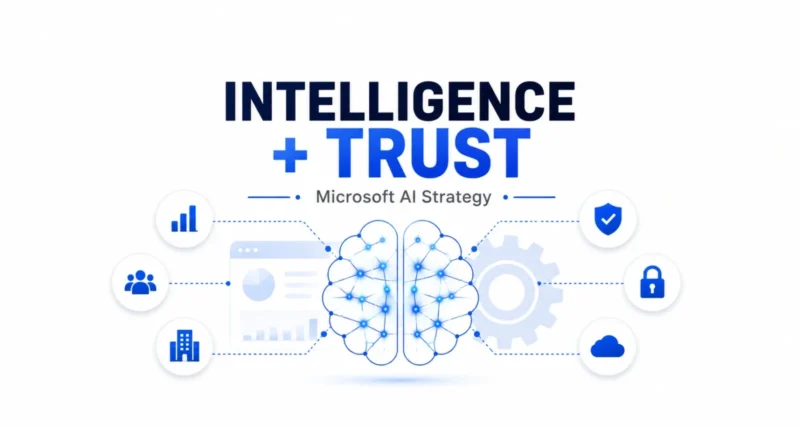
Most companies have tried AI by now. Far fewer have made it pay off. In a new post on the official Microsoft blog, commercial chief Judson Althoff argues the gap comes down to just two things: intelligence and trust. Get both right, he says, and AI compounds your advantage. Get them wrong, and you quietly hand your edge to someone else. Here is what that really means, in plain terms.
| Quick Answer Microsoft says successful AI rests on two pillars: Intelligence (AI that amplifies your own knowledge using many models, not just one) and Trust (governance, security, and clear costs so you stay in control). Its tools for this include Microsoft 365 Copilot, the new Agent 365 control plane, and Microsoft IQ. The big idea is to avoid depending on any single AI model. |
The Big Idea: Intelligence Plus Trust
Strip away the jargon and the Microsoft AI strategy is simple at its core. For AI to actually help a business, it needs to be both smart and trustworthy. Smart on its own is not enough if you cannot control it, and safe on its own is useless if it does not make you better at what you do.
Microsoft frames this as a single equation: Intelligence plus Trust. Intelligence means AI that makes your organization sharper, not AI that quietly learns your secrets for someone else’s benefit. Trust means you can prove the results are worth the money and that everything runs inside your own security and governance rules.
| Quick Take Think of it like hiring a brilliant new employee. Talent alone is not enough. You also need to trust them with sensitive information and know they are worth the salary. Microsoft argues AI is no different, and most failed projects ignore the trust half. |
The Three Questions Every Business Is Asking
The Microsoft AI strategy is shaped by three worries that come up again and again when companies weigh an AI rollout. They are worth knowing, because they apply to almost any business, not just big enterprises.
- Will AI grow my business or feed off it? Companies fear an AI tool will learn their best ideas and intellectual property, then use that against them.
- Can I trust the results and the cost? Leaders want a real return on investment, inside their own security and governance limits.
- Can I control the spending? As AI use grows, so do the bills, so businesses want visibility and flexibility over costs.
Why Microsoft Says Not to Rely on One AI Model
One of the strongest points in the post is about model diversity. Microsoft argues that AI models are becoming commodities, so no company should tie itself to a single model or provider.
Instead, the idea is to pick the right model for each task, balancing strength against cost. Microsoft notes that different models, such as GPT-5.5 or Claude Opus 4.8, suit different jobs with different economics. This echoes a wider industry shift, the same trend behind Google’s new data agents, where the goal is flexible AI that plugs into your own data rather than one rigid tool.
| Why It Matters Betting everything on one AI model is risky. Prices change, better models appear, and lock-in limits your choices. A mix-and-match approach keeps costs down and options open, which is useful advice whether you run a company or just pick AI tools for yourself. |
The Microsoft Tools Behind the Strategy
Microsoft ties this vision to a set of products. You do not need to use them to grasp the strategy, but they show how the pieces fit together.
| Tool | What It Does, in Plain Terms |
| Microsoft 365 Copilot | The AI assistant inside Office apps, built to use different models for different tasks |
| GitHub Copilot | The coding assistant for developers, also model-diverse by design |
| Microsoft IQ | Turns a company’s raw data into useful context so AI gives faster, more accurate answers |
| Agent 365 | A control panel to watch, govern, secure, and manage all the AI agents in an organization |
| Copilot Cowork | A newly launched tool, now available worldwide, for AI that works alongside teams |
The thread connecting them is control. Microsoft wants businesses to manage AI agents and their costs the same way they manage staff and budgets, as a normal part of running the company.
What This Means for You
Even if you never touch an enterprise tool, the takeaways are practical and they scale down to everyday use.
- Do not get locked in. Keep your options open across AI tools, since the best and cheapest option keeps changing.
- Mind the costs. Usage-based AI pricing can climb fast, so track what you actually use.
- Value trust as much as power. Pick tools that respect your data and privacy, not just the flashiest features.
- Let AI build on what you know. The most useful AI amplifies your own knowledge rather than replacing it.
If you want to see how this enterprise AI shift is playing out elsewhere, our coverage of Google’s agentic data tools makes a useful companion read.
The Microsoft AI strategy cuts through a lot of hype with a clear idea: intelligence and trust have to travel together. The smartest AI in the world will not help if you cannot control its costs, secure its data, or prove its value. For businesses, that means choosing flexible, model-diverse tools and treating AI spend like any other budget. For the rest of us, it is a reminder that the best AI amplifies what we already know. You can read Microsoft’s full argument in its official blog post.
Frequently Asked Questions
What Is Microsoft’s AI Strategy
Microsoft’s strategy centers on two pillars, Intelligence and Trust. AI should amplify a company’s own knowledge while running inside its security, governance, and cost controls.
What Does Intelligence Plus Trust Mean
It means AI must be both capable and trustworthy. Intelligence makes your organization smarter, and Trust ensures results are reliable, secure, and worth the cost.
Why Does Microsoft Say Not to Use One AI Model
Because models are becoming commodities. Relying on one provider creates lock-in, while using several lets you match the best model to each task for better cost and performance.
What Is Agent 365
Agent 365 is Microsoft’s control plane for AI agents. It lets IT and security teams observe, govern, secure, and manage all the agents in an organization from one place.
What Is Microsoft IQ
Microsoft IQ turns a company’s raw data into usable context for AI, so agents give faster and more accurate answers while using fewer resources.
Is This Relevant to Small Businesses
Yes. The core lessons, avoid lock-in, watch costs, and value trust, apply to any business or individual choosing AI tools, not just large enterprises.

