
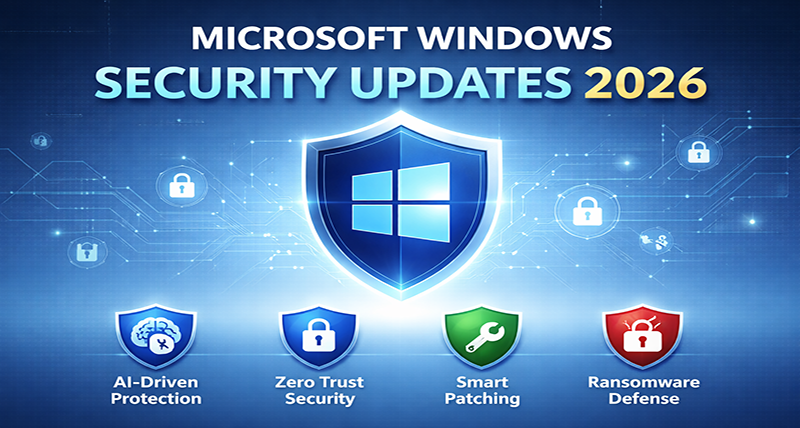
In 2026, cybersecurity is no longer just about firewalls and antivirus scans. It is about predictive intelligence, autonomous response systems, cloud-integrated threat detection, and real-time patching. Microsoft Windows has entered a new era where artificial intelligence, hardware-based protection, and zero-trust architecture define the security foundation of modern computing.
For businesses, developers, remote workers, and everyday users, Microsoft Windows security updates in 2026 represents one of the most significant security transformations in the operating system’s history. From smarter patch deployment to AI-powered threat isolation, this evolution directly addresses the increasing complexity of ransomware, supply chain attacks, deepfake phishing, and AI-generated malware.
This in-depth blog explores the major security enhancements and patch update strategies shaping Microsoft Windows in 2026 and explains how these changes redefine endpoint protection in the AI era.
Microsoft Windows security in 2026 is built around adaptive intelligence rather than reactive defense. Traditional signature-based antivirus systems are no longer sufficient against polymorphic malware and AI-generated exploit kits. Instead, the platform integrates:
- Behavioral AI models trained on global telemetry
- Hardware-anchored isolation mechanisms
- Kernel-level exploit detection
- Cloud-based threat intelligence synchronization
- Automated remediation and containment
At the center of this ecosystem is Microsoft Defender, which now operates as a predictive security engine. Instead of waiting for malicious code to execute, it analyzes behavior patterns, privilege escalation attempts, and memory anomalies in real time.
This shift reduces dwell time, prevents lateral movement, and dramatically lowers ransomware impact windows.
Zero Trust by Default
Zero Trust is no longer an enterprise add-on. In Microsoft Windows security updates rolling through 2026, particularly across Windows 11, it has become a default operating principle rather than an optional framework.
Every process, driver, and application must verify identity and integrity before execution. Features reinforcing this model include:
- Secure Boot with dynamic integrity validation
- Credential Guard enhancements
- Virtualization-based security expansion
- Application Control powered by machine learning
Even administrative accounts operate under conditional access principles. Privilege elevation is temporary, monitored, and risk-scored by AI models.
This means even if attackers compromise a device, lateral movement becomes significantly harder.
Patch Updates in Microsoft Windows 2026: Smarter, Faster, Invisible
Patch management has undergone a silent revolution. In earlier versions, updates were often disruptive. Reboots interrupted productivity, and organizations delayed deployment due to compatibility concerns.
In 2026, Microsoft Windows introduces:
AI-Prioritized Patch Deployment
Updates are ranked by risk severity using predictive analytics. Systems exposed to active exploits receive accelerated patch distribution.
Hot Patching Expansion
Critical security patches are applied without requiring system restarts. This significantly reduces downtime for enterprises.
Differential Micro Updates
Instead of large cumulative downloads, Windows now deploys smaller modular patches targeting only vulnerable components.
Adaptive Update Scheduling
Machine learning models study user activity patterns to install updates during low-impact windows.
For enterprises using cloud-based management tools, update compliance is near real-time. Integration with security analytics platforms ensures that patch visibility is centralized and measurable.
Ransomware Defense Evolution
Ransomware attacks in 2025 forced global organizations to rethink endpoint defense. In response, Microsoft Windows security updates throughout 2026, particularly within Windows 11, strengthen multiple protection layers across the operating system with:
- Real-time encryption anomaly detection
- Controlled folder access with AI behavioral gating
- Network isolation when suspicious mass file operations are detected
- Backup integrity validation before restoration
Microsoft Defender now correlates device telemetry across global networks, enabling faster identification of emerging ransomware variants.
Hardware-Based Security Integration
Modern processors now include built-in security features that Windows leverages deeply.
Key integrations include:
- Hardware-enforced stack protection
- Memory integrity enforcement
- Firmware attack detection
- TPM 2.0 expanded use cases
These protections ensure that even kernel-level exploits face hardware-anchored resistance.
Across Microsoft Windows security updates delivered through 2026, especially within Windows 11, driver signing policies are further tightened, and attack surfaces exposed by legacy components are significantly reduced. This hardening strategy minimizes exploitation opportunities while maintaining compatibility with modern hardware standards.
AI and Phishing Protection
Phishing has evolved into AI-generated voice cloning and hyper-realistic impersonation campaigns. Windows security now integrates contextual awareness.
Email, browser sessions, and downloaded content are scanned not only for malware but for:
- Behavioral inconsistencies
- Domain spoofing signals
- Deepfake pattern detection
- Credential harvesting indicators
With integration across Microsoft’s ecosystem, threats identified in one environment strengthen protection globally within minutes.
Enterprise Security & Cloud Synchronization
For enterprise environments, Windows 2026 enhances cloud-connected defense.
Security telemetry synchronizes with organizational dashboards, allowing administrators to:
- View device risk scores
- Isolate compromised endpoints instantly
- Deploy emergency patches
- Monitor compliance across hybrid networks
Integration with Microsoft Intune enables unified endpoint management, while Microsoft Azure provides scalable threat intelligence processing.
The convergence of endpoint, identity, and cloud security marks a major architectural milestone.
Windows Kernel and System Hardening
Windows 2026 introduces additional safeguards at the core operating system level:
- Reduced kernel attack surface
- Enhanced sandboxing of legacy applications
- Improved driver isolation
- Stronger exploit mitigation policies
Memory corruption attacks, once a dominant vector, are increasingly neutralized before payload execution.
These measures significantly strengthen system integrity without degrading performance.
Consumer Protection Improvements
Security enhancements are not limited to enterprise customers. Individual users benefit from:
- Passwordless authentication by default
- Biometric sign-in expansion
- Automatic malicious app blocking
- Simplified security dashboards
The user interface presents threat status in clearer language, reducing confusion and increasing proactive engagement.
Compliance, Regulation, and Global Standards
With increasing regulatory scrutiny worldwide, Windows security updates now align more closely with compliance frameworks. Enhanced logging, audit trails, and encryption enforcement help organizations meet:
- Data protection standards
- Cyber resilience regulations
- Industry-specific security mandates
Automated reporting simplifies compliance verification processes.
The Role of Artificial Intelligence in Windows Security
Artificial intelligence is not simply a feature in Windows 11. It is the foundation.
AI models now:
- Predict exploitation trends
- Identify zero-day behavioral anomalies
- Automate containment responses
- Optimize patch timing
- Reduce false positives
This evolution reflects the reality that attackers also use AI. Defensive AI must therefore operate faster, learn continuously, and adapt dynamically.
Microsoft Windows 2026 Security Updates
Microsoft Windows security enhancements in 2026 represent a shift from reactive defense to predictive resilience. Patch updates are smarter. Threat detection is proactive. Hardware and software defenses are unified. AI operates at every layer of the system.
For users searching for AI security in Windows, patch update improvements, ransomware defense evolution, zero trust architecture, enterprise endpoint protection, or Microsoft Windows 11 security features, the answer is clear:
Windows is no longer just an operating system. It is an intelligent security platform.
As cyber threats grow more automated and sophisticated, Microsoft Windows continues evolving to meet the challenge. In 2026, protection is continuous, adaptive, and deeply integrated into the fabric of the operating system itself.
Security is no longer an add-on. It is the architecture.

