
For the first time, scientists have found real sugar in space, floating in a cold cloud of gas and dust near the center of our galaxy. The molecule is erythrulose, the same kind of sugar found in raspberries, and it was spotted roughly 27,000 light-years from Earth. This matters far more than it might sound, because sugars help build RNA and DNA. The discovery hints that some of the raw ingredients for life may not have started on Earth at all. They may have drifted in from the stars. Here is the full story, step by step, and the one twist that genuinely surprised the scientists.
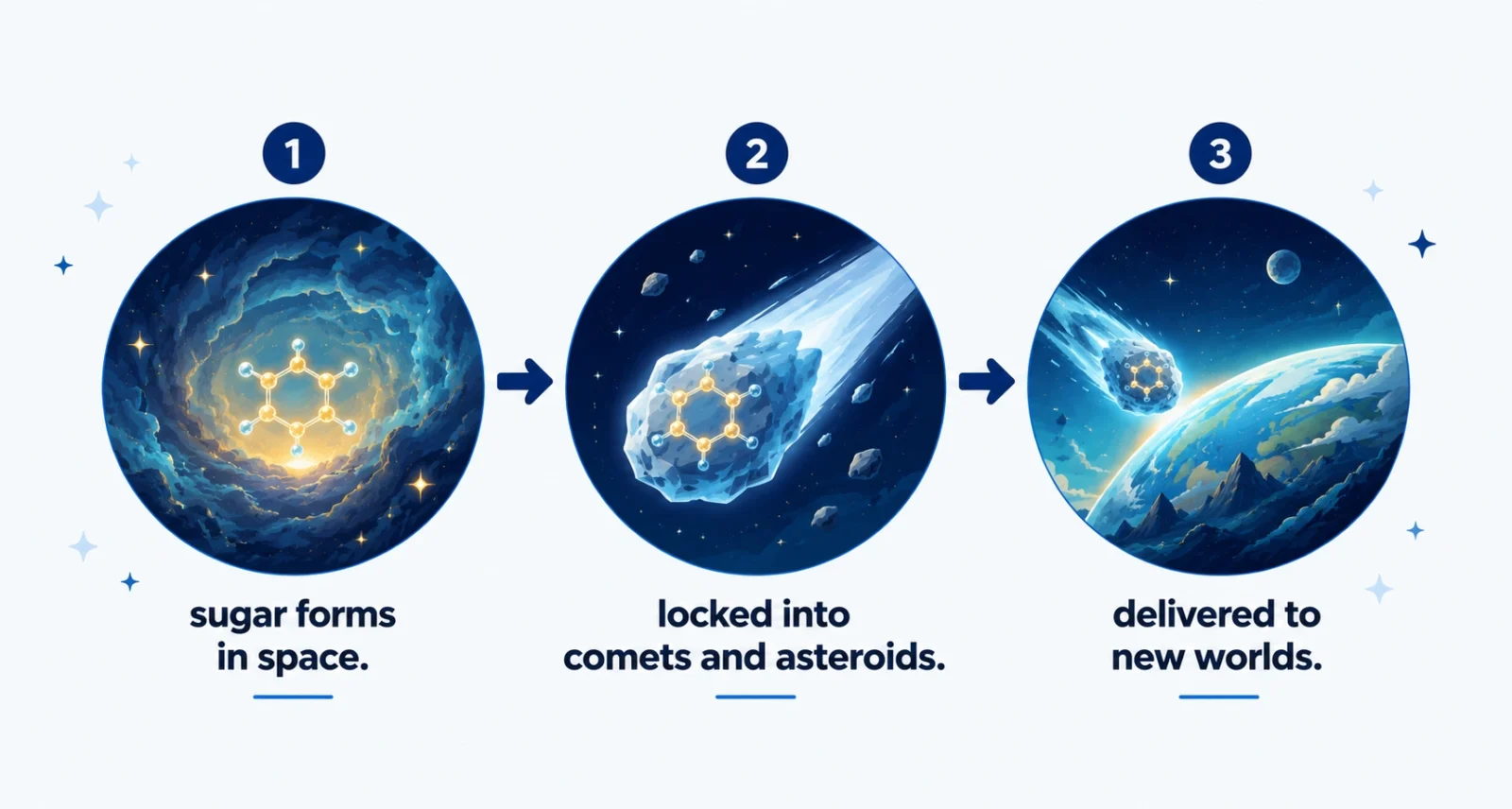
| The Short Answer Astronomers detected erythrulose, a four-carbon sugar, in a molecular cloud called G+0.693 near the center of the Milky Way, about 27,000 light-years away. Reported in Nature Astronomy on July 13, 2026, it is the first true sugar ever found in interstellar space. Sugars are part of the backbone of RNA and DNA, so finding one forming in space, before any planet exists, suggests that the building blocks of life can be made among the stars and later delivered to young worlds by comets and asteroids. It does not mean life itself was found. It means life’s ingredients are more common in the universe than we thought. |
What They Actually Found
The sugar is called erythrulose. It is a simple sugar, or monosaccharide, built from four carbon atoms, and you will find it in raspberries and in some self-tanning lotions. In the same family sit glucose and ribose, the sugar that forms part of the backbone of RNA.
It sits in a cloud of gas and dust known as G+0.693, near the crowded center of the Milky Way. As CNN reported, an international team led by Izaskun Jiménez-Serra at Spain’s Center for Astrobiology made the detection, and it is the first time a genuine sugar has been confirmed in the space between stars.
| Worth Knowing You may have read years ago that sugar was already found in space. That was glycolaldehyde, detected back in 2000. It is often called the simplest sugar, but chemically it is not a true sugar, because a real sugar needs at least three carbon atoms and glycolaldehyde has only two. Erythrulose, with four carbons, is the real thing. That is what makes this a first. |
Why Sugar in Space Is Such a Big Deal
A sugar in a dust cloud sounds like trivia. It is not. The reason scientists care comes down to what sugars do inside living things.
Sugars are not just fuel. They form part of the physical structure of genetic material. The R in RNA stands for ribose, a sugar. Without sugars, you do not get the molecules that store and copy the instructions for life. So finding a sugar forming out in space, long before any planet cools or any ocean forms, changes where we think life’s starter kit comes from.
| What Sugars Do in Life | Why It Matters Here |
| Provide and store energy | Basic fuel for every living cell |
| Build biological structures | The scaffolding that holds biology together |
| Form part of RNA and DNA | Ribose is literally part of the genetic backbone |
| Feed prebiotic chemistry | The chemistry that comes before life itself |
There has long been a puzzle here. On the early Earth, experiments show that sugars do not form easily in large amounts. Yet sugars like ribose and glucose have turned up inside meteorites and in asteroid samples, including material brought back from the asteroid Bennu. That hinted space rocks might be delivering sugars to planets. Finding erythrulose actually forming in interstellar space is the missing piece that ties it together.
How They Found It, Step by Step
You cannot fly to a cloud 27,000 light-years away and scoop up a sample. So how do you prove a specific sugar is there? The method is clever, and it works like reading a barcode. Here is the process in plain steps.
- Pick the right cloud. The team aimed at G+0.693, a cold cloud near the galactic center. It already ranks as one of the richest chemical reservoirs in the galaxy. Over 180 different molecular species have been identified in it.
- Know the fingerprint first. Every molecule spins at specific rates and gives off radio waves at exact frequencies, a pattern unique to that molecule. Scientists measured erythrulose’s pattern in the laboratory so they knew exactly what to look for.
- Point the radio telescopes. The team used two of the most sensitive radio telescopes available. Both sit in Spain: the Yebes 40-meter dish north of Madrid, and the IRAM 30-meter telescope in the Sierra Nevada.
- Sweep a huge range of frequencies. They scanned across more than 90 gigahertz of radio frequencies, collecting the faint signals coming from the cloud.
- Match the barcode. They compared the cloud’s signals against the lab fingerprint and found 12 sets of matching lines, from 17 individual transitions, lining up with erythrulose.
- Rule out coincidence. Because the cloud is so crowded with signals, the team checked the odds. The chance that the six cleanest lines matched by pure luck was about 0.2 percent, which is strong evidence the sugar is really there.
As Nature details in the study, this careful line-by-line matching is how astronomers identify a molecule they can never touch. The fingerprint either lines up or it does not, and for erythrulose, it did.
The Twist That Surprised the Scientists
This is where the story gets genuinely interesting, and it is the part most headlines skip. The team did not just find a sugar. They found the wrong one, in the best possible way.
For years, the assumption in this field was that molecules in space grow one carbon atom at a time. Build a two-carbon molecule, then a three-carbon one, then a four-carbon one, in order. So the team expected to find plenty of the simpler three-carbon sugars first. Instead, they found none of them, and plenty of the four-carbon erythrulose. The four-carbon sugar was at least 8 to 17 times more abundant than the three-carbon sugars, which did not show up at all.
| The Cool Part So how did a four-carbon sugar appear without its three-carbon stepping stones? The team’s models suggest it forms on the icy surfaces of tiny dust grains. Two common two-carbon molecules, glycolaldehyde and ethylene glycol, get activated by radiation and snap together directly into the four-carbon sugar. It skips the ladder entirely. One astrochemist described the chemistry as weird and unexpected, which in science is a compliment. |
Erythrulose also set a couple of records of its own. With 14 atoms, it is the largest non-cyclic molecule ever identified in interstellar space, and the first one found there with four oxygen atoms. This is not a marginal detection. It is a landmark one.
What This Does Not Mean
It is worth being clear, because this kind of story gets stretched fast. Finding sugar in space does not mean scientists found life in space, or even direct evidence of it.
What they found is an ingredient, not a cake. Erythrulose is a building block that sits on the path toward the chemistry of life, not life itself. The discovery makes the universe look more chemically fertile, and it strengthens the case that the ingredients for biology are widespread. Whether those ingredients ever assembled into living things, anywhere other than Earth, remains one of the biggest open questions in science.
The discovery of erythrulose is a genuine first: a real sugar, found forming in the space between stars. It does not prove life exists elsewhere, but it moves an important piece of the puzzle. The ingredients that build living things appear to form in cosmic dust clouds, ready for comets and asteroids to carry to young planets.
The bigger message is quietly profound. Some of the chemistry that made life possible on Earth may have begun long before Earth existed, out among the stars. For more on how discoveries like this get made, see our guide to the biggest James Webb telescope discoveries.

