
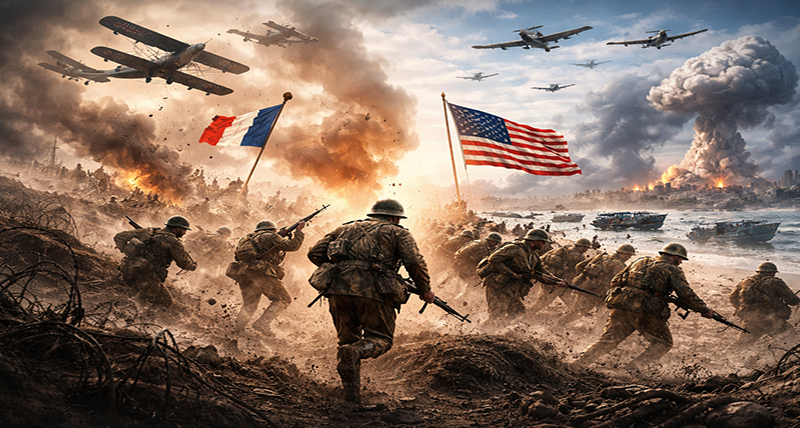
The two World Wars were not just large-scale conflicts. They were turning points that redrew borders, reshaped global power, transformed economies, accelerated technology, and changed how humanity understands peace, security, and international cooperation.
If you are searching for World Wars causes, major battles, global consequences, timeline summaries, or how they influence today’s geopolitics, this in-depth guide covers everything in a structured, research-focused format designed for clarity and depth.
World War I, 1914 to 1918
What Caused World War I
World War I began in 1914, but its roots stretched back decades. Historians often summarize the causes using four interconnected forces:
Militarism
European powers heavily invested in armies and navies. An arms race, especially between the United Kingdom and Germany, intensified global tension.
Alliances
Two major blocs formed:
Triple Entente –
France
Russia
United Kingdom
Triple Alliance –
Germany
Austria, Hungary
Italy
These alliances meant a regional conflict could quickly escalate into a continental war.
Imperialism
European powers competed aggressively for colonies in Africa and Asia, increasing rivalry.
Nationalism
Ethnic tensions in the Balkans played a crucial role. The assassination of Archduke Franz Ferdinand in Sarajevo triggered the war.
Major Battles of World War I
Battle of the Somme 1916
One of the bloodiest battles in history, with over one million casualties.
Battle of Verdun 1916
A symbol of French resistance against Germany.
First Battle of the Marne 1914
Stopped Germany’s rapid advance into France, leading to trench warfare.
Trench warfare became the defining feature of the Western Front. Soldiers lived in harsh, muddy conditions while machine guns and artillery caused devastating casualties.
Consequences of World War I
Collapse of Empires
The German, Austro-Hungarian, Ottoman, and Russian empires fell.
Treaty of Versailles 1919
Treaty of Versailles imposed heavy reparations and territorial losses on Germany, fueling economic instability and resentment.
Rise of Political Extremism
Economic hardship and humiliation contributed to the rise of authoritarian regimes, especially in Germany.
Creation of the League of Nations
An early attempt at global peacekeeping, which ultimately failed to prevent another war.
Although World War I reshaped Europe, it left behind unresolved tensions that directly contributed to the outbreak of another global conflict.
World War II, 1939 to 1945
Considered the deadliest conflict in human history, this war involved more than 30 countries and resulted in over 70 million deaths worldwide.
What Caused World War II
Treaty of Versailles Aftermath
Economic hardship in Germany fueled nationalism and extremism.
Rise of Totalitarian Leaders
Adolf Hitler in Germany
Benito Mussolini in Italy
Joseph Stalin in the Soviet Union
Expansionist Policies
Germany invaded Poland in 1939, prompting Britain and France to declare war.
Failure of Appeasement
European powers initially allowed territorial expansion to avoid conflict, which emboldened aggressive actions.
Major Battles of World War II
Invasion of Poland 1939
Marked the official start of the war.
Battle of Britain 1940
Air campaign defending the United Kingdom against German air attacks.
Operation Barbarossa 1941
Germany’s invasion of the Soviet Union.
Attack on Pearl Harbor,r 1941
Japan attacked the United States, bringing America into the war.
D Day 1944
Allied forces landed in Normandy, beginning the liberation of Western Europe.
Battle of Stalingrad 1942 to 1943
A decisive Soviet victory that shifted momentum against Germany.
The Holocaust
Nazi Germany carried out systematic genocide, murdering six million Jews and millions of others. The Holocaust remains one of the darkest chapters in human history and fundamentally changed global human rights discourse.
Atomic Bomb and War’s End
In August 1945, the United States dropped atomic bombs on Hiroshima and Nagasaki. Japan surrendered shortly after, ending the war.
The introduction of nuclear weapons permanently changed global military strategy.
Consequences of World War II
Emergence of Superpowers
The United States and the Soviet Union became dominant global powers.
The Cold War
Ideological conflict between capitalism and communism shaped global politics for decades.
Creation of the United Nations
The United Nations was formed to promote international cooperation and prevent future global wars.
Decolonization
European empires weakened, leading to independence movements across Asia and Africa.
Technological Advancement
Radar, jet engines, computers, and nuclear energy accelerated scientific development.
Comparing World War I and World War II
World War I was largely driven by alliances, militarism, and imperial tensions.
In contrast, World War II emerged from unresolved issues after World War I, combined with economic collapse and rising ideological extremism.
The First World War redrew national borders across Europe.
The Second World War went further and reshaped the entire global order.
The First World War ended long-standing empires.
The Second World War led to the rise of global superpowers.
Together, they defined the 20th century.
Long-Term Global Impact
Geopolitical Realignment
Europe’s dominance declined. The United States rose as a global leader.
International Law and Human Rights
War crimes trials and the Universal Declaration of Human Rights emerged from lessons learned.
Military Strategy Transformation
Total war, strategic bombing, and nuclear deterrence changed warfare permanently.
Economic Institutions
Global economic systems were redesigned, leading to institutions like the IMF and World Bank.
Why World Wars Still Matter Today
Modern geopolitics, NATO alliances, Middle Eastern borders, the European Union, and nuclear defense strategies are all shaped by the aftermath of these wars.
When people search for:
What caused World War I
Why did World War II start
Major battles of WW1 and WW2
Consequences of World Wars
How World Wars changed the world
They are seeking to understand how past conflicts have shaped the present reality.
The World Wars were not isolated events in history. They were global transformations that continue to influence diplomacy, military strategy, economics, and human rights frameworks even today.
Understanding their battles, causes, and consequences is not just about history. It is about understanding the modern world itself.

