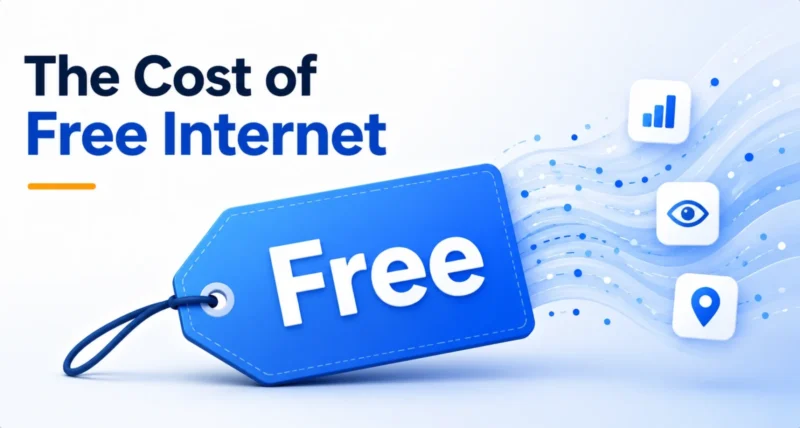
You do not pay a penny for Google, Instagram, YouTube, or most of the apps on your phone. They feel like gifts, always there, always free. Yet nothing online is truly free.
There is a famous line that sums it up. If you are not paying for the product, you are the product. It sounds harsh, but it captures how much of the modern internet actually works.
This article explains the real cost of free internet, the quiet price you pay in attention, data, and privacy. We will look at how free services actually make money, what the big platforms collect, and how to protect yourself, all in plain language.
Here is the short version. Free services are not charities. You pay with your attention, your behavior, and your personal information, which companies turn into targeted advertising and detailed profiles. The service is free. You are what gets sold.
1. Why Nothing Online Is Really Free
Running a service like a search engine or a social network costs an enormous amount of money. Servers, engineers, and storage are not cheap. So if you are not paying with cash, the cost has to come from somewhere.
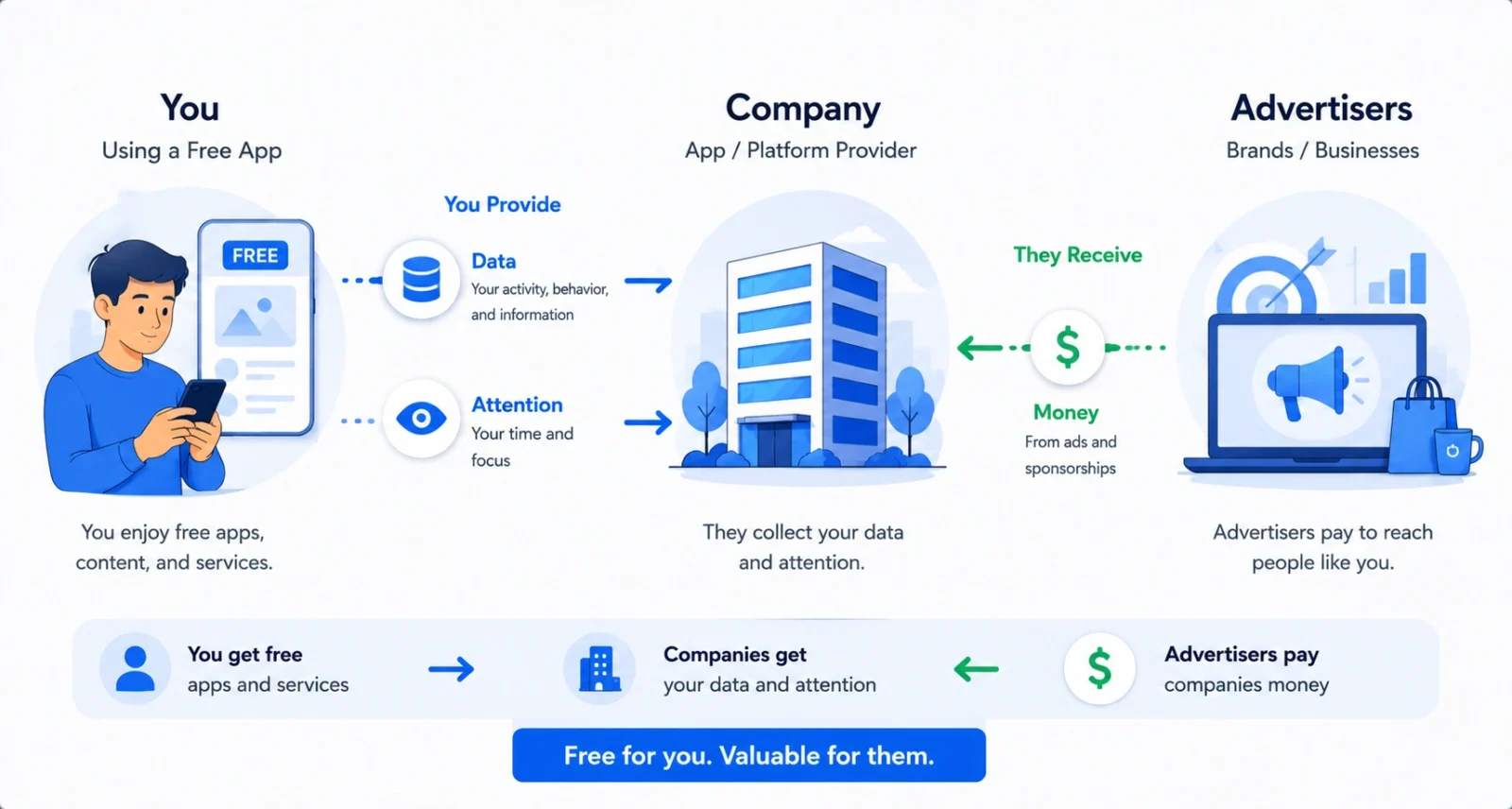
That somewhere is you. Not your wallet, but your information and your attention. Companies collect what you do, build a picture of who you are, and sell access to that picture to advertisers.
This model even has a name. Researchers call it surveillance capitalism, a system where everyday human experience becomes raw material for business.
It is not exactly a scam. It is a trade. The catch is that most people never see the full terms of the deal.
2. How Free Services Actually Make Money
Free apps and sites earn money in a few main ways, and most of them run on your data.
- Targeted advertising. The big one. Your data helps advertisers show you ads they think you will click.
- Behavior profiling. Every tap, search, and pause builds a profile that predicts what you want.
- Selling insights. Some services package anonymized data and sell it to advertisers and research firms.
- Attention itself. The longer you stay, the more ads you see, so apps are designed to keep you scrolling.
As privacy researchers at Privacy International have documented, the real value is not the app you use. It is the steady stream of data the app collects while you use it.
3. What the Big Platforms Really Collect
Each big platform has its own version of the same deal. The table below shows what you get for free, and what you actually hand over in return.
| Platform | What You Get Free | What You Pay With |
| Google Search | Instant answers and search | Your searches and attention, used to target ads |
| Photos, reels, and messaging | Your behavior and interests, sold to advertisers | |
| Spotify free | Music with ads between songs | Your listening habits and moods, used to target ads |
| Gmail | Free email and storage | Your wider Google activity, used to personalize ads |
| TikTok | Short video entertainment | Your behavior, plus data that can include face and voice |
Notice the pattern. In every row, the free thing is the bait, and your data is the price. The exact details differ, but the trade is always the same.
4. The Real Cost of Free Internet: What You Trade Away
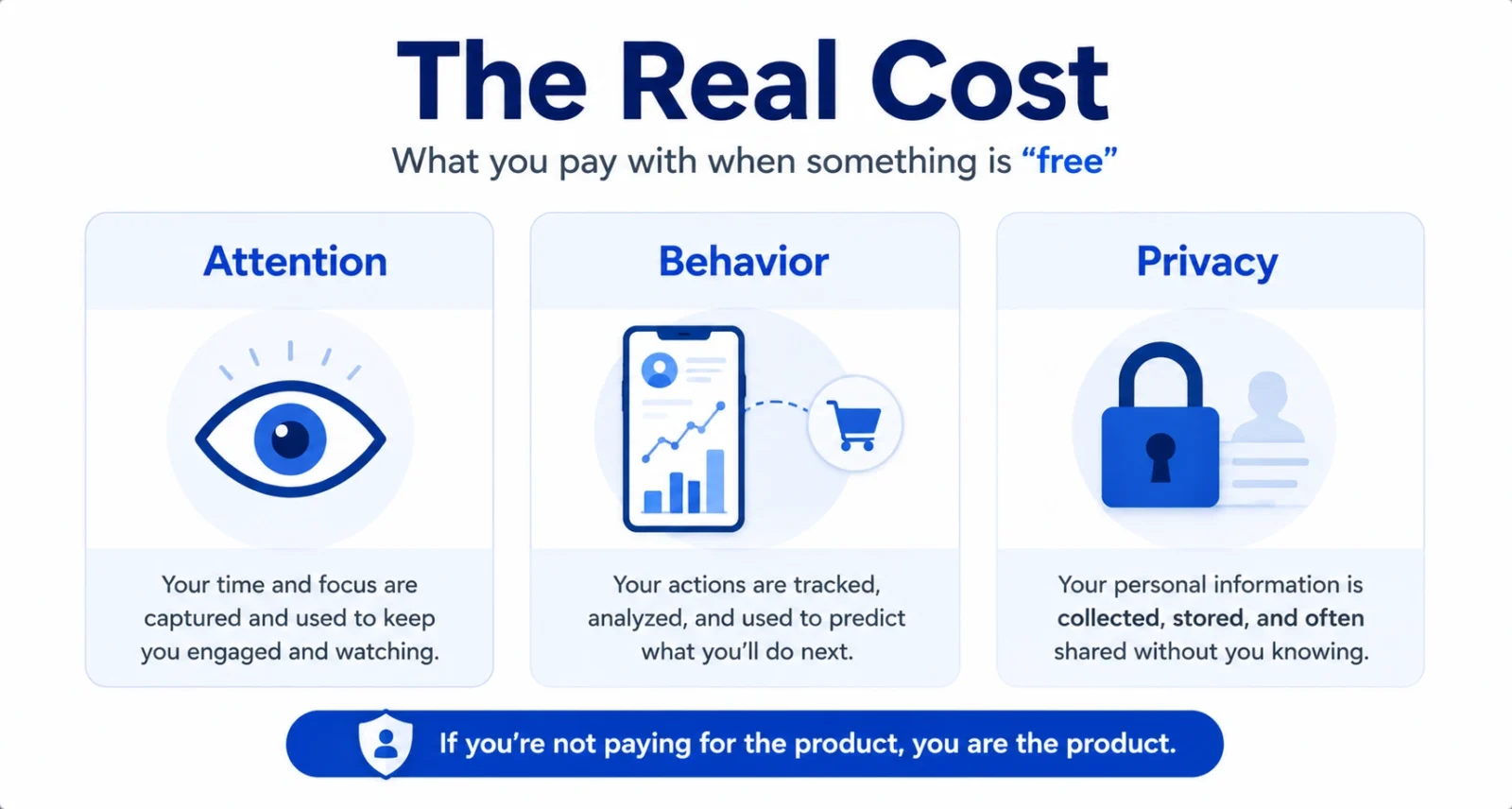
So what are you really paying? It comes down to three things.
First, your attention. Apps compete to keep your eyes on the screen, because attention is what they sell. That can cost you focus, time, and sometimes sleep.
Second, your behavior. Your clicks, likes, and pauses build a detailed profile of your habits, beliefs, and weak spots, which is then used to influence what you buy and even what you think.
Third, your privacy. Bit by bit, you reveal where you go, who you know, and what you care about. Alone, each piece seems harmless. Together, they form a remarkably complete portrait of your life.
Some of this data now also trains artificial intelligence systems. If you want to understand where that is heading, our guide to agentic AI explains how modern AI learns and acts on information.
5. Myths vs Facts About Free Services
A lot of what people believe about free services is only half right. Here are the most common mix-ups, set straight.
| Common Myth | The Fact |
| Gmail reads my emails to target ads | Google stopped scanning email content for ads in 2017. Ads come from your wider account activity |
| Incognito mode makes me invisible | It only hides history on your device. Sites, networks, and your provider can still see your activity |
| I have nothing to hide, so it does not matter | Data is not about hiding. It is about being profiled, predicted, and influenced without your say |
| Paying for an app means no data is collected | Paid apps can still collect data. Paying often removes ads, not always the tracking |
The Gmail change is real and well documented. As The Guardian reported, Google ended the practice in 2017, partly to reassure its business customers. So that particular fear is now out of date, even though plenty of other tracking continues.
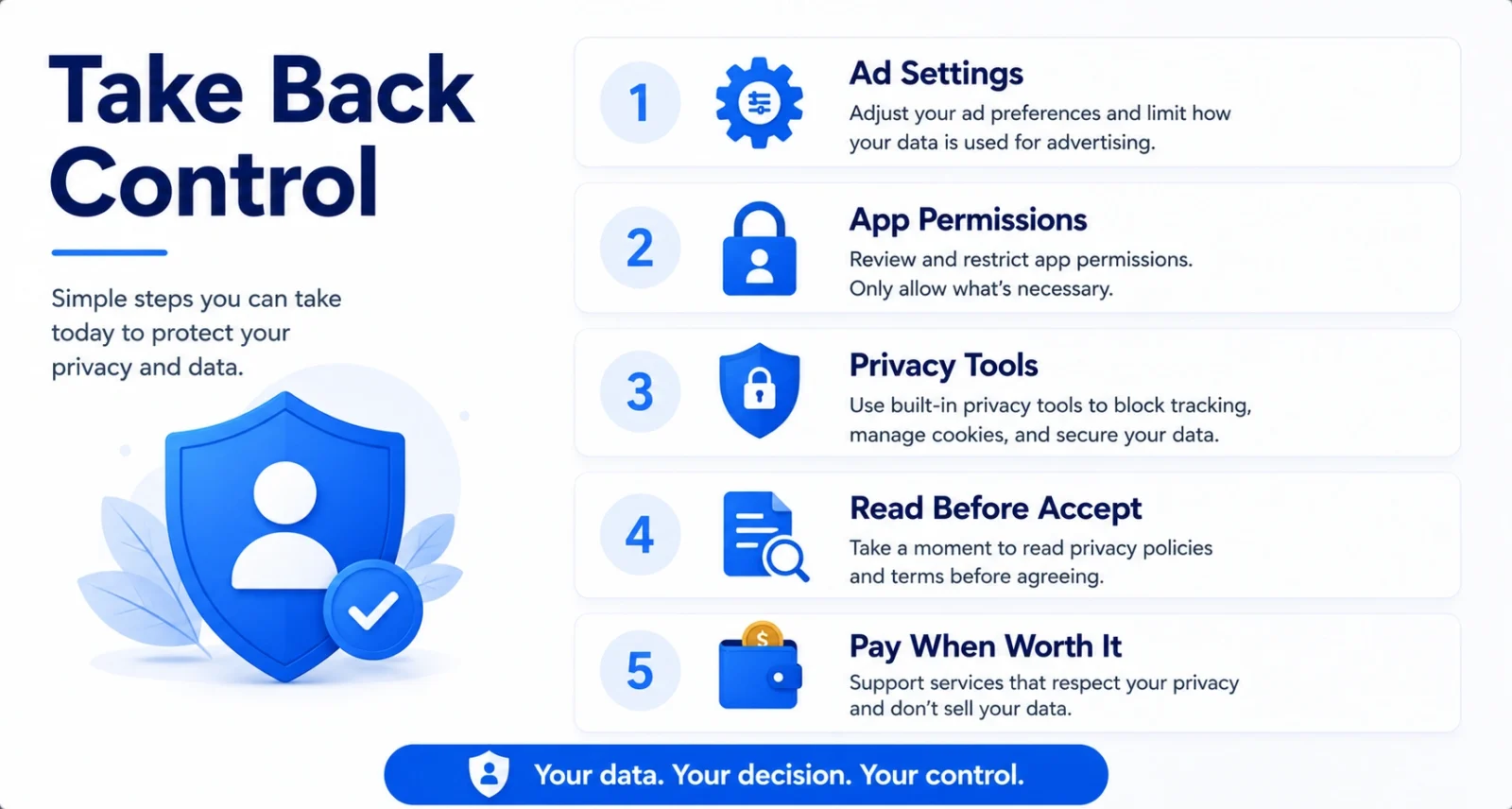
6. How to Take Back Some Control
You do not have to quit the internet to protect yourself. A few simple habits make a real difference.
- Check your ad settings. Google, Meta, and others let you limit ad personalization. Turn it down.
- Review app permissions. Remove access to your location, camera, and microphone where an app does not truly need it.
- Use privacy tools. A private browser, a tracker blocker, and a privacy-focused search engine all reduce what is collected.
- Read before you tap accept. A quick glance at what an app is asking for can save you a lot of exposure.
- Pay when it is worth it. Sometimes a small fee for an ad-free, private version is the better deal.
Tip: You will never reach zero tracking, and that is fine. The goal is informed control, not perfection. Small, steady steps add up to a much smaller footprint.
7. Is Free Internet Worth the Price?
It would be easy to end on a scary note, but the truth is more balanced than that.
Free, ad-supported services have done real good. They put search, maps, messaging, and entertainment into the hands of billions of people who could never have paid for them. That access genuinely changed the world for the better.
The problem is not that these services exist. It is that the deal is hidden. Most people never knowingly agreed to be profiled in such detail, because the terms were buried and the trade was never made clear.
So the honest answer is this. Free internet is worth using, with your eyes open. Enjoy the tools, but know the price, manage your settings, and decide for yourself how much of you is for sale.
If you found this useful, you may also like our how to use Google AI Mode beginner guide, which looks at another powerful, free tool worth understanding before you lean on it.
Frequently Asked Questions
Is the internet really free?
Not really. Most free services are paid for with your data and your attention. Companies turn what you do into targeted advertising and detailed profiles, so you pay with information rather than money.
What does the phrase you are the product mean?
It means that when a service is free, the company’s real customers are advertisers. Your attention and personal data are the product being sold to them, while the app you use is simply the bait.
Does Gmail read my emails to show me ads?
Not since 2017. Google stopped scanning email content for ad targeting that year. The ads you see in Gmail are now based on your wider Google account activity, not the words inside your emails.
Do paid apps still collect my data?
They can. Paying for an app usually removes ads, but it does not always stop tracking. It is worth checking the app’s privacy policy to see what it still collects even after you pay.
How do free apps make money if they show no ads?
Through other routes such as subscriptions, in-app purchases, selling anonymized data insights, sponsorships, or upgrades to a paid tier. Free is usually a way to attract users who later pay in some form.
How can I protect my privacy online?
Limit ad personalization in your account settings, review and remove unnecessary app permissions, use privacy tools like a tracker blocker, read prompts before accepting, and pay for private versions when it is worth it.