
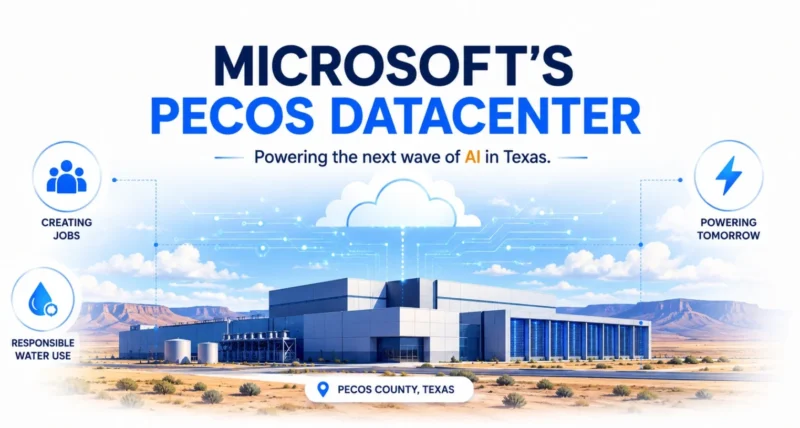
Microsoft just announced one of the biggest single expansions of computing power in its history, and it is landing in West Texas. The company is building a brand-new AI datacenter campus in Pecos, Texas, to keep up with soaring demand for AI and cloud services. It is a big, technical announcement, so we have broken it down into plain, simple steps. As Microsoft shared on its official blog, here is what is being built, why it matters, and what happens next.
| The Quick Answer Microsoft is building a major new AI datacenter campus in Pecos, Texas. It will add about 2 gigawatts of computing capacity, one of the largest single additions Microsoft has ever made, to power AI and cloud services. The multibillion-dollar project will create over 6,000 construction jobs, runs on its own dedicated energy so it does not strain the local grid, and uses closed-loop cooling that needs almost no water. |
The Big Picture: What Did Microsoft Announce?
Let us start simple. A Microsoft datacenter is a large, secure building full of powerful computers, the physical engine behind the cloud and AI tools you use every day, from Copilot to Azure. Microsoft is building a brand-new one, and it is a huge addition.
Here are the headline numbers in plain language, so you can grasp the scale at a glance.
| 2 GW | of new computing capacity, one of the biggest single additions in Microsoft history |
| 6,000+ | construction jobs expected at the peak of building the campus |
| 5-7 yrs | the timeline for this multibillion-dollar investment to be built out |
| 100s | of permanent jobs once the datacenter is up and running |
| Quick Take In short: Microsoft needs far more computing power to keep up with the AI boom, and Pecos, Texas is where it is building a big chunk of it. For the region, it means thousands of jobs and a brand-new industry. For Microsoft customers, it means more reliable AI and cloud capacity. |
Why Is Microsoft Building This? The Simple Reason
The answer is demand. More people, companies, and governments use AI and cloud services every day. All of that takes enormous computing power to deliver. Microsoft put it simply. It builds where its customers need it, and it builds for the long term.
Demand is coming from everywhere, startups building new apps, hospitals and schools modernizing their systems, and governments running critical services. To serve all of them reliably, Microsoft needs capacity that is predictable, resilient, and quick to scale. The Pecos campus is built to deliver exactly that.
How It Gets Built and Powered: Step by Step
This is where the announcement gets genuinely interesting, and where Microsoft is doing something a little out of the box. Here is how the project comes together, one step at a time.
1 | Microsoft builds the campus in West Texas |
The new Microsoft datacenter campus rises in Pecos, in Reeves County, Texas. Microsoft chose the region deliberately, building on nearly a decade of experience running datacenters near San Antonio, where its investment has generated billions in local economic activity. The local leadership has welcomed the move.
In Their Words
Reeves County Judge Leo Hung, the county’s top elected official, welcomed the project, saying it reflects the region’s strength and its ability to support innovation at a global scale, and that it will create new opportunities for local businesses. You can read more in Microsoft’s open letter to the community.
2 | Microsoft pays for its own dedicated power |
Here is the clever part. Instead of pulling electricity from the public grid and competing with local homes and businesses, Microsoft is funding its own dedicated energy supply right on site. At launch, the campus runs on a co-located natural gas power plant, an arrangement called “behind the meter,” which serves the campus directly and independently of the public grid.
Why It Matters
This is the key point for the community: because Microsoft builds and pays for its own power, the datacenter’s huge energy needs do not take from the grid that local residents rely on. Microsoft says its growth should strengthen, not strain, the energy resources the community depends on.
3 | The power plant is built to run cleaner |
The on-site power plant uses modern emissions controls, including Selective Catalytic Reduction systems that lower nitrogen oxide emissions. This builds on the 4.7 gigawatts of renewable electricity Microsoft has already contracted in Texas. Over time, Microsoft plans to connect the plant and datacenter to the wider regional grid. The goal is to help make it more reliable for everyone.
4 | Cooling uses almost no water |
Datacenters can use a lot of water to stay cool, but Microsoft is using closed-loop cooling here. The system takes one fill of water at the start, then reuses it continuously with almost no further consumption. That result is striking: the total lifetime water use of this datacenter is only a fraction of what a single typical fast-food restaurant uses in a year.
| The Cool Part To cut water use even further, Microsoft plans to use nonpotable water (not drinking water) where possible, easing pressure on the community’s freshwater. It is all part of the company’s goal to be water positive by 2030. |
What’s In It for West Texas? The Community First Plan
Microsoft is framing this as more than just a building. It calls its approach Community First. That approach rests on three clear priorities. Here is what each one means for local residents.
Listening and Engaging Early
Microsoft says it will engage early and often, through community meetings, local partnerships, and ongoing communication across the life of the project, giving residents multiple ways to ask questions and share feedback.
Creating Local Jobs and Opportunity
Microsoft will also invest in workforce training and small-business support, beyond the thousands of construction jobs and hundreds of permanent roles. Near San Antonio, its Datacenter Academy partners with local colleges and has already invested $545,000 to reach more than 450 students. Its statewide TechSpark program has helped create over 1,100 jobs. The same model is coming to West Texas.
Partnering for Lasting Impact
Microsoft’s investment reaches into education, digital inclusion, and nonprofits. In one recent year, Microsoft and its employees contributed $11 million in cash and $103.3 million in donated software and cloud technology to more than 10,000 Texas nonprofits, plus tens of thousands of volunteer hours. Pecos will see that same commitment.
| Community First Priority | What It Delivers |
| Listening early | Community meetings and ongoing two-way communication |
| Local opportunity | Construction and permanent jobs, training, small-business support |
| Lasting impact | Investment in education, digital inclusion, and local nonprofits |
Why This Matters for Microsoft Customers
If you use Microsoft’s AI and cloud tools, this is good news in a direct way. More Microsoft datacenter capacity means the services you rely on can keep growing, stay reliable, and handle the rising demand for AI without slowing down.
- More AI power: tools like Copilot and Azure AI need massive computing power from companies like NVIDIA behind them, and this adds a big chunk of it.
- Better reliability: the new capacity is designed to be predictable and resilient, so services scale smoothly.
- Built to last: a flexible design lets Microsoft adjust capacity as demand evolves over the coming years.
The new Microsoft datacenter in Pecos is a clear signal of just how fast the AI era is scaling, and a thoughtful blueprint for how to grow responsibly. Microsoft is adding about 2 gigawatts of capacity, funding its own cleaner power so it does not strain the grid, and cooling with almost no water. It is building for the AI future while trying to be a good neighbor to West Texas. For customers, it means more reliable AI and cloud services for years to come. For Pecos, it means thousands of jobs and a brand-new industry. You can read the full announcement on the official Microsoft blog.
Frequently Asked Questions
What Did Microsoft Announce in Pecos, Texas
Microsoft announced it is building a major new AI datacenter campus in Pecos, Texas. It will add roughly 2 gigawatts of computing capacity, one of the largest single additions in the company’s history. The goal is to meet growing demand for AI and cloud services.
How Many Jobs Will the Datacenter Create
Microsoft expects to support more than 6,000 construction jobs at the peak of building the campus. There will also be hundreds of permanent operational jobs once the datacenter is running, plus workforce training and small-business support.
Will the Datacenter Strain the Local Power Grid
No. Microsoft is funding its own dedicated, on-site energy supply. At launch it runs on a co-located natural gas plant that serves the campus directly and independently. So its energy needs do not draw from the public grid that local residents use.
How Much Water Will the Datacenter Use
Very little. Microsoft is using closed-loop cooling, which is filled with water once and then reused continuously. The total lifetime water use is only a fraction of what a single typical fast-food restaurant uses in a year, and nonpotable water is used where possible.
Why Is Microsoft Building More Datacenters
Demand for AI and cloud services is growing rapidly across startups, businesses, healthcare, education, and government. Delivering those services reliably requires far more computing power. That is what this new capacity provides.
What Is Microsoft’s Community First Approach
It is Microsoft’s commitment to building as a long-term local partner. It focuses on three priorities: listening and engaging with residents early, creating local jobs and economic opportunity, and partnering for lasting impact in education and nonprofits.

