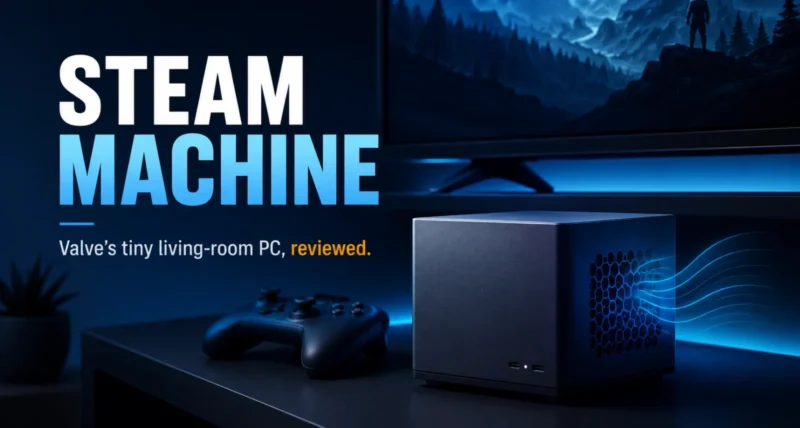
Valve’s Steam Machine is finally here, and it is one of the most charming pieces of gaming hardware in years: a tiny, near-silent cube that brings full PC gaming to your TV. There is just one catch, and it is a big one. The price. Early reviewers love the design but keep circling back to the cost, as the detailed hands-on review at Aftermath makes clear. Here is everything you need to know, in plain terms: what it is, what is inside, what it costs, how it performs, and whether it is worth buying.
| The Short Version The Steam Machine is a tiny, silent living-room PC from Valve that runs SteamOS and plays your Steam library on a TV. It starts at $1,049, more than a PS5 Pro, because a global memory shortage forced Valve to raise the price. The hardware is beautifully designed and easy to use, but the 8GB of video memory and the high price are real drawbacks. It is wonderful for the right person, just not the bargain it was meant to be. |
What Is the Steam Machine?
In simple terms, the Steam Machine is a small computer built for your living room. It is about the size of a six-inch cube and sits quietly under your TV. It boots straight into a console-style interface, so you can play with a controller from the couch. No keyboard or mouse required to get going.
The key thing to understand: this is a real PC, not a locked-down console. It runs SteamOS, Valve’s version of Linux, and plays games from your Steam library. But because it is an open computer, you can also install other software, emulators, and game stores, and you fully own it. There are no extra fees just to play online, unlike some consoles.
| Quick Take Think of it as a Steam Deck for your TV. It takes everything people love about Valve’s handheld, the easy setup, the instant access to your library, the polish, and puts it in a silent little box that lives under your television. |
Steam Machine Specs: What’s Inside
Valve calls the Steam Machine about six times more powerful than the Steam Deck, and the parts list backs that up. Here are the full specs in plain language.
| Component | What You Get |
| Processor (CPU) | Semi-custom AMD Zen 4, 6 cores and 12 threads, up to 4.8 GHz |
| Graphics (GPU) | Semi-custom AMD RDNA 3, 28 compute units, up to 2.45 GHz |
| Memory | 16GB DDR5 system RAM, plus 8GB GDDR6 video memory |
| Storage | 512GB or 2TB SSD, plus an SD card slot |
| Power | 300W power supply (smaller than a PS5 or Xbox Series X) |
| Size | A roughly 6-inch cube with swappable magnetic faceplates |
| Connections | HDMI 2.0, DisplayPort 1.4, Wi-Fi 6E, Bluetooth, USB-C and USB-A |
| Software | SteamOS (based on Arch Linux), boots into Big Picture Mode |
| Heads Up: The 8GB Question The one spec drawing criticism is the 8GB of video memory (VRAM). For 1080p and 1440p gaming it is fine, but in 2026 many demanding games want more, so you can hit that limit if you crank settings up to 4K. It is the main hardware compromise to be aware of. |
How Much Does the Steam Machine Cost?
This is the headline, so let us be clear about every option. There are four configurations, and the only differences are storage and whether a Steam Controller is included.
| Configuration | Storage | Price |
| Base model | 512GB | $1,049 |
| Base + Steam Controller | 512GB | $1,128 |
| Large storage | 2TB | $1,349 |
| 2TB + Controller (extra faceplates) | 2TB | $1,428 |
For comparison, a PS5 Pro costs around $900, so the entry Steam Machine is more expensive than Sony’s premium console. The 2TB bundle adds red fabric and walnut faceplates. All prices include tax where it applies, and the machine is launching in North America, the UK, the EU, and Australia, with other regions served through local distributors.
Why Is It So Expensive? The Honest Reason
Here is the part that explains everything, and it is not Valve being greedy. A global shortage of memory and storage chips, driven largely by the AI boom gobbling up supply, has made computer parts dramatically more expensive over the past year. Valve got caught in it.
Valve said so directly, admitting that its original price target is no longer viable. The company explained that the prices reflect what components actually cost as it secured them over six months. Valve also chose not to sell the hardware at a loss. The company believes in the PC as an open platform you control, rather than a subsidized box locked to one store.
| Why It Matters This is the bittersweet heart of the story. The Steam Machine was meant to be an affordable gateway into PC and Linux gaming. The technology delivers on that vision, but the timing, in the middle of a brutal parts shortage, means it arrived far pricier than planned. The same money buys a similar prebuilt PC, just not one this small or this polished. |
How Does It Perform?
The good news: in real-world use, it runs beautifully for what it is. Reviewers found most games ran great natively at 1080p and 1440p. The machine really shines when AI upscaling, AMD’s FSR, is switched on. Valve targets 4K at 60 frames per second with FSR. Demanding games like Cyberpunk and Black Myth Wukong handled it well enough in testing.
The standout, though, is not raw speed. It is how quiet and pleasant the machine is to live with. One reviewer said he had to put his ear next to it to tell it was even on. Making a computer this tiny run this silently is genuinely hard, and Valve nailed it. The inside is essentially one big cooler with a slice of computer attached. That makes it a living-room PC that never sounds like a jet engine.
| Strength | What It Means for You |
| Silent and tiny | Sits invisibly under your TV and stays whisper-quiet, even under load |
| Easy setup | Console-simple to start, link your account with a QR code in seconds |
| Great at 1080p and 1440p | Smooth performance for most games, with FSR helping push toward 4K |
| You own it | Install anything, emulators, mods, other stores, with no online fees |
SteamOS: Linux Made Easy
The Steam Machine runs SteamOS instead of Windows, and that is a feature, not a flaw. SteamOS is a friendly, gaming-focused version of Linux that is genuinely easy to use. It updates every app on the system with a single step. Better yet, it does not nag you or break the way Windows often can.
Thanks to Valve’s compatibility layer called Proton, the vast majority of Windows games just run on it. There are a few exceptions, mainly some online multiplayer games with strict anti-cheat. So if you live in a specific competitive title, it is worth checking compatibility first. For most players and most games, though, it simply works.
| Good to Know SteamOS is also a big deal beyond this one box. It is one of the most mainstream computers ever to ship with Linux, and the work Valve does to make TVs, controllers, and games play nicely benefits the whole open-source world. Buying in supports a more open future for PC gaming. |
Should You Buy the Steam Machine?
Here is the honest, practical verdict. The Steam Machine is wonderful, but it is not for everyone at this price. Use this quick guide to decide.
Buy It If
- You want PC gaming on your TV: it is a silent, tidy, console-easy way to play your Steam library from the couch.
- Owning your device matters to you: you like the freedom to install anything and skip the subscription fees consoles charge.
- The Steam Deck already won you over: this is the natural, more powerful living-room companion to Valve’s handheld.
- Small and quiet is the priority: nothing else this tiny runs this silently, which is the machine’s superpower.
Skip It If
- Price is your top concern: a PS5 Pro is cheaper, and a similar prebuilt PC costs about the same with more power.
- You chase maximum performance: the 8GB of video memory limits high-end 4K gaming, so power users may want more.
- You only play a few online shooters: check that your specific games support Linux before committing.
| The Big Picture If the price has put you off, there is no shame in waiting. Valve has hinted the machine will get better and better with software updates over time, just as the Steam Deck did, and parts prices may ease. The vision here is excellent. The timing is just unlucky. |
The Steam Machine is a small triumph of design wrapped in unlucky timing. It is tiny, silent, beautifully built, and dead simple to use. It is a genuinely lovely way to play PC games on your TV while actually owning the device. The only real problem is the price, pushed high by a memory shortage Valve did not cause and could not avoid. If you want a quiet living-room PC and the cost fits your budget, you will likely adore it. If the price stings, waiting is perfectly reasonable, because this machine should only get better with age. For the full hands-on impressions, read the detailed review at Aftermath.
Frequently Asked Questions
What Is the Steam Machine
The Steam Machine is a small living-room PC from Valve that runs SteamOS and plays your Steam game library on a TV. It is about a six-inch cube, very quiet, and works like a console with a controller. But it is a real, open PC you can install other software on.
How Much Does the Steam Machine Cost
It starts at $1,049 for the 512GB model and $1,128 with a Steam Controller. The 2TB model is $1,349, and the 2TB bundle with a controller and extra faceplates is $1,428. Prices include tax where applicable.
Why Is the Steam Machine So Expensive
A global shortage of memory and storage chips, fueled largely by the AI industry, pushed computer part prices up sharply. Valve said its original lower price target was no longer viable and that it will not sell the hardware at a loss.
What Are the Steam Machine’s Specs
The Steam Machine uses a semi-custom AMD Zen 4 six-core CPU up to 4.8 GHz and a semi-custom RDNA 3 GPU with 28 compute units. You also get 16GB of DDR5 RAM, 8GB of GDDR6 video memory, a 512GB or 2TB SSD, an SD card slot, and SteamOS as the operating system.
Is the Steam Machine Good for 4K Gaming
It can reach 4K at 60 fps using AMD’s FSR upscaling, and it is great at 1080p and 1440p. However, its 8GB of video memory can be a limit for the most demanding games at native 4K with high settings.
Does the Steam Machine Run Windows Games
Yes, most of them. It runs SteamOS (Linux) and uses Valve’s Proton layer to play the vast majority of Windows games. A few online games with strict anti-cheat are the main exceptions, so check compatibility for competitive titles.
When Can I Buy the Steam Machine
Valve opened reservations that run until June 25, 2026, then randomizes the list to deter scalpers. Selected buyers get emailed the option to purchase, with emails going out from late June onward.