
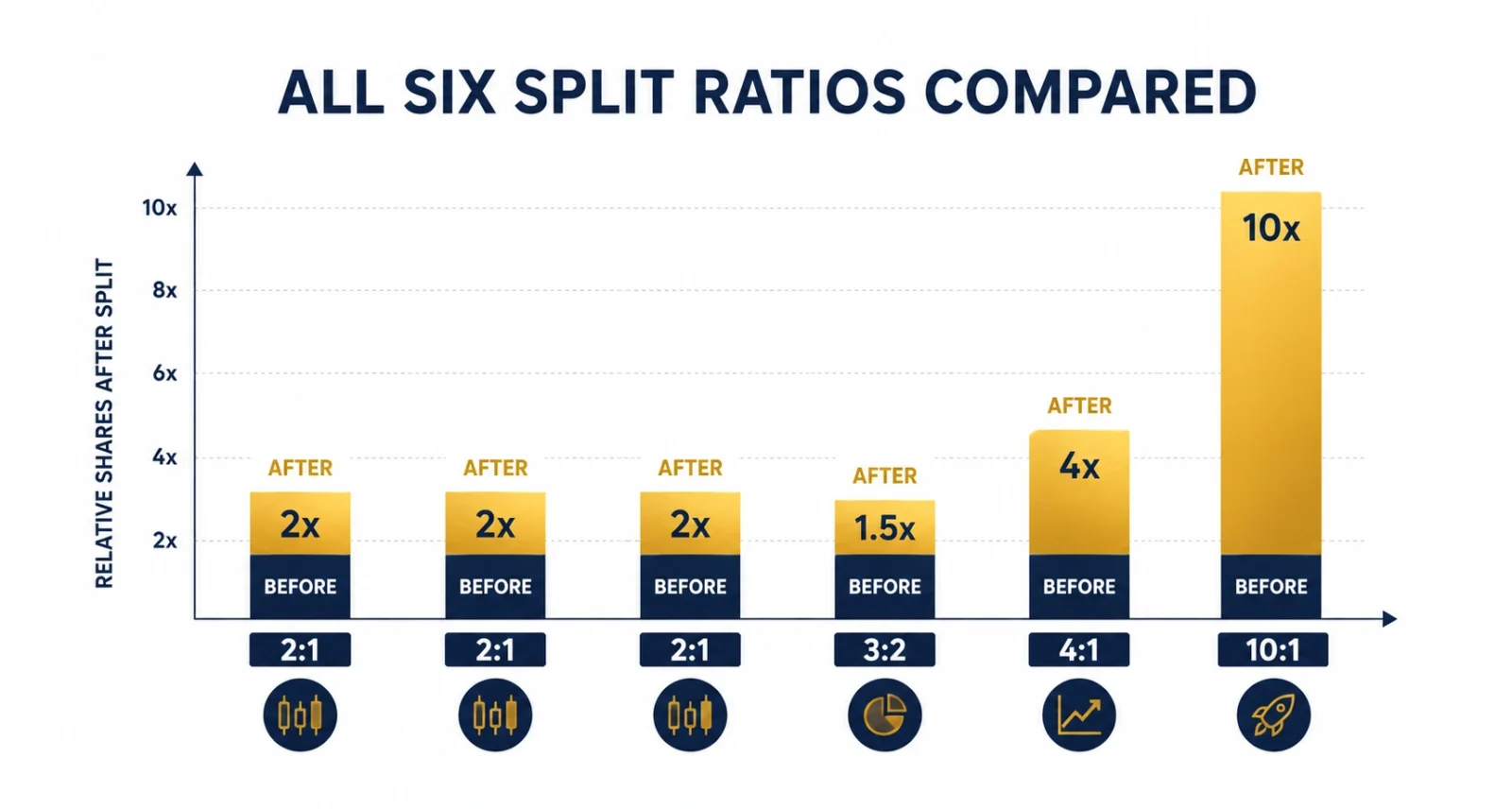
NVIDIA stock split history comes down to one striking number: six splits since 2000, adding up to a 480-for-1 multiple. That means a single share bought at the 1999 IPO would be 480 shares today. If you have ever wondered how a stock that once traded above $1,200 now sits near $210, splitting is most of the answer.
This guide walks through every NVIDIA stock split in order, with the dates, ratios, and the running total that connects them. You will also see what each split did to the share price, how the math rolls up across 26 years, and whether another split looks likely in 2026. Everything here is checked against NVIDIA’s own filings and major financial sources.
| Quick Take NVIDIA has split its stock six times: 2-for-1 (2000), 2-for-1 (2001), 2-for-1 (2006), 3-for-2 (2007), 4-for-1 (2021), and 10-for-1 (2024). Multiply those together and you get 480:1. The most recent split took effect on June 10, 2024, and there has been no split or reverse split in 2025 or 2026. |
What a Stock Split Actually Does
A forward stock split increases the number of shares while cutting the price of each one by the same factor. Own one share at $100 before a 2-for-1 split, and afterward you hold two shares at $50. Your total stake is unchanged. The company carves the same pie into more slices.
Because the math is symmetric, a split does not change a company’s market value or its fundamentals. The U.S. Internal Revenue Service treats it the same way: a split is not a taxable event, and your total cost basis stays put even though your per-share basis drops. You only owe tax when you actually sell. For the official wording, see the IRS guidance on stock splits and cost basis.
| Why It Matters Companies usually split to keep the share price within reach of everyday investors and employees, and to improve trading liquidity. A lower sticker price does not make the stock cheaper in any real sense, but it can widen the pool of people willing to buy a whole share. |
Every NVIDIA Stock Split Since 2000
Here is the running tally at a glance, then the story behind each one.
| Date (effective) | Ratio | Cumulative | Price before | Price after |
| June 2000 | 2-for-1 | 2:1 | ~$100+ | ~$50 |
| September 2001 | 2-for-1 | 4:1 | ~$60 | ~$30 |
| April 2006 | 2-for-1 | 8:1 | ~$50 | ~$25 |
| September 2007 | 3-for-2 | 12:1 | ~$50 | ~$33 |
| July 2021 | 4-for-1 | 48:1 | ~$750 | ~$190 |
| June 2024 | 10-for-1 | 480:1 | ~$1,208 | ~$120 |
Prices for the earliest splits are approximate. Cumulative multiple = how many shares today equal one pre-2000 share.
June 2000: The First 2-for-1 Split
NVIDIA went public in January 1999 at $12 a share. By the spring of 2000 the stock had climbed past $100, riding the late dot-com wave and strong demand for its graphics chips. In May 2000 the board approved a 2-for-1 split, carried out as a 100% stock dividend in June. That set the cumulative multiple at 2:1 and was the company’s first taste of a tool it would reach for again and again.
September 2001: A Split Around a Closed Market
The second 2-for-1 split is the one with an asterisk. NVIDIA’s own plan documents date it to September 11, 2001. U.S. markets then closed for the rest of that week after the terrorist attacks and reopened on September 17. That is why different data providers list the split-adjusted date as September 11, 12, or 17 depending on whether they use the scheduled date or the first actual trading day. Either way, the cumulative multiple moved to 4:1.
April 2006: Splitting Into the GPU Boom
By 2006 NVIDIA was a very different company, powering a generation of gaming GPUs and edging into professional graphics. Announced in early March and effective in early April, this third 2-for-1 split left the company with roughly 360 million shares outstanding and pushed the cumulative multiple to 8:1. You can read the original announcement in NVIDIA’s April 2006 SEC filing.
September 2007: The Odd One Out at 3-for-2
The September 2007 split breaks the pattern. Instead of doubling the share count, NVIDIA went 3-for-2, handing investors one extra share for every two they held and paying cash for any fractional shares. It nudged the cumulative multiple to 12:1. This is the only NVIDIA split that did not use a whole-number ratio, which is worth remembering when you reconstruct the math by hand.
July 2021: The 4-for-1 Split That Marked the AI Turn
After a 14-year gap, NVIDIA returned to splitting in 2021. The stock had run to around $750 as data-center and AI demand took off. The board announced a 4-for-1 split in May, won shareholder approval at the June 3 annual meeting, and distributed the new shares after the close on July 19, with split-adjusted trading starting July 20. The price reset to roughly $190, and the cumulative multiple jumped to 48:1. The full announcement sits in NVIDIA’s 2021 stock split press release.
June 2024: The Record 10-for-1 Split
NVIDIA’s largest split came alongside its May 22, 2024 earnings, when the stock traded above $1,200. Each holder as of the June 6 record date received nine additional shares after the close on June 7, and split-adjusted trading began on June 10. The price reset to about $120, and the cumulative multiple reached 480:1. NVIDIA also raised its dividend at the same time. The mechanics are spelled out in the company’s June 2024 stock split filing.
| The Standout The 2024 split is NVIDIA’s biggest ever. A 10-for-1 ratio is unusually large, and it reflects how far the stock had run on AI demand. It single-handedly accounts for the jump from 48:1 to 480:1 in the cumulative tally. |
The Cumulative Math: One IPO Share Equals 480 Today
Stack the ratios end to end and the arithmetic is clean: 2 x 2 x 2 x 1.5 x 4 x 10 = 480. So one share from the January 1999 IPO has become 480 shares. The effective cost basis works out to about 2.5 cents per share once you spread the original $12 across all of them.
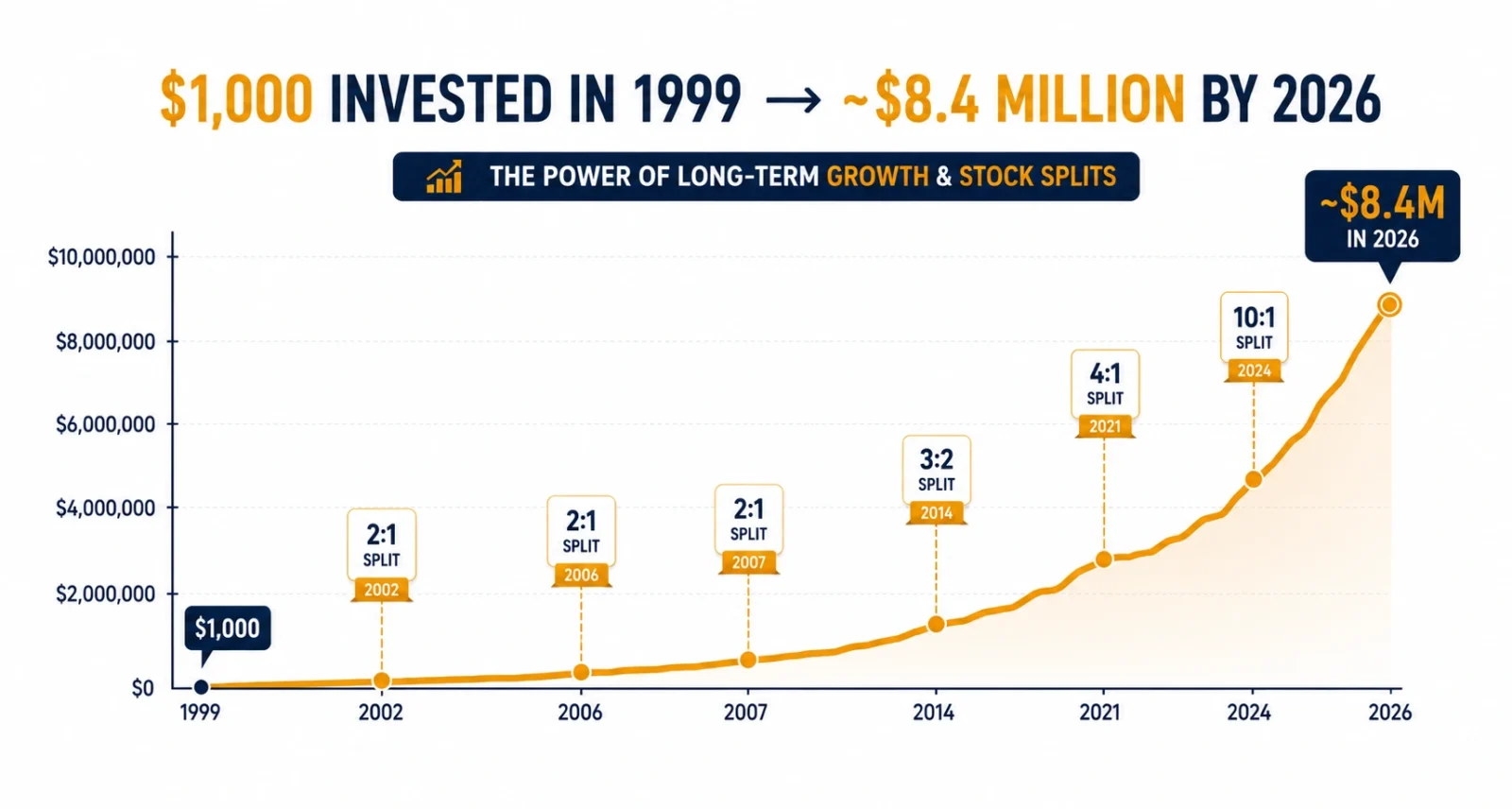
Run that through a real position and the numbers get dramatic. A $1,000 investment at the IPO bought about 83 shares, which today would be roughly 39,840 shares. At around $210 each, that stake is worth on the order of $8.4 million before counting dividends. For an independent breakdown of long-run returns, The Motley Fool has tracked NVIDIA’s IPO math in detail.
| Worth Knowing Splits do not create those gains. The returns come from the business growing into a leader in AI accelerators. Splitting just changed how the same value is divided across shares. If you are new to the mechanics, our guide to stock market basics on nerdyinfo.com walks through the core ideas. (Internal link points to the Finance hub; swap for a specific stock-basics post once published.) |
A Common Mix-Up: Six Splits, Not Seven
One data vendor lists seven NVIDIA splits and a 960:1 multiple. That figure is wrong. The authoritative count from NVIDIA’s filings and from sources like Nasdaq, Yahoo Finance, and CompaniesMarketCap is six splits totaling 480:1. If you see 960:1 anywhere, it has likely double-counted one event. When the data conflicts, the SEC filings linked above are the tiebreaker.
Will NVIDIA Split Its Stock Again in 2026?
As of June 2026, NVIDIA has not announced a seventh split, and at around $210 there is little pressure to. The company has historically waited until the price pushed into the high hundreds or past $1,000 before acting. It split near $750 in 2021 and near $1,200 in 2024. On that pattern, the stock would probably need to roughly double from current levels before another split moves onto the table, which could take years.
| Heads Up Predictions about future splits are guesses, not facts. Watch for an official board announcement rather than rumor. NVIDIA publishes these through its investor relations newsroom, which is the first place a real split would appear. |
Where NVIDIA Stands in 2026
The backdrop to all of this is a historic run. NVIDIA traded near $210 in mid-June 2026 with a market value around $5.1 trillion, making it the most valuable public company in the world. It was the first company ever to close above both $4 trillion (July 2025) and $5 trillion (October 2025), driven by relentless demand for its AI data-center chips. For current price and market-cap figures, Macrotrends maintains NVIDIA’s full price history.
That climb is what keeps the split question alive. The more the stock appreciates, the more likely a future board revisits the idea, just as it has six times before.
NVIDIA’s stock split history is a compact record of one of the great runs in market history: six splits, a 480:1 cumulative multiple, and a journey from a $12 IPO to the world’s most valuable company. Splits did not create that value, but they tell you when the price had climbed far enough that management wanted to reset the sticker. Keep an eye on the share price and NVIDIA’s investor newsroom, and you will know the moment a seventh split is ever on the way.
Frequently Asked Questions
When did NVIDIA last split its stock?
NVIDIA’s most recent split was a 10-for-1 split that took effect on June 10, 2024. It was announced on May 22, 2024.
How many times has NVIDIA split its stock?
Six times: in 2000, 2001, 2006, 2007, 2021, and 2024. Combined, they produce a cumulative 480-for-1 split.
What was NVIDIA’s biggest stock split?
The 10-for-1 split in June 2024 was the largest in the company’s history, and it remains the most recent.
How many shares would one NVIDIA IPO share be worth today?
One share from the 1999 IPO equals 480 shares today, after all six splits are applied.
Will NVIDIA split again in 2026?
No split has been announced as of June 2026. At a share price near $210, another split looks unlikely in the near term, though that can change if the stock keeps climbing.
Do stock splits make NVIDIA a better investment?
No. A split changes the share count and price but not the underlying value of the business. It can make a single share easier to buy, but it does not improve the company’s fundamentals.