
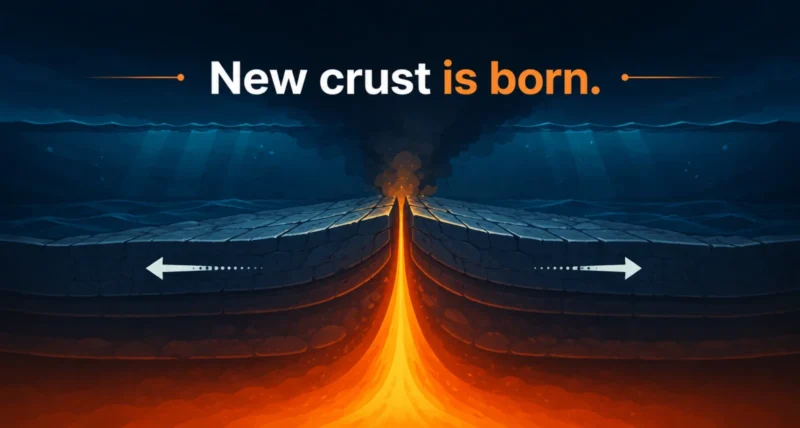
Deep beneath the waves, in darkness no human eye has ever seen, our planet is constantly building itself. Most of Earth’s crust is born on the ocean floor, where giant tectonic plates pull apart and molten rock rises to create fresh land. It is one of the most important processes on the planet, yet until now, no one had ever watched it happen. That just changed. For the first time ever, scientists have recorded seafloor spreading in real time, capturing the violent birth of brand new oceanic crust. As covered by The New York Times, here is the incredible story of how they did it, and what they found.
| The Short Version Here is the discovery in a nutshell. Scientists set up an underwater observatory on a remote mid-ocean ridge between Australia and Antarctica, hoping to one day catch the ocean floor in the act of spreading apart. Just months later, in April 2024, they got astonishingly lucky. Over 16 dramatic days, the seafloor tore open, magma surged up to form new crust, and the ground collapsed by more than four meters. The results, published in the journal Nature, reveal that Earth builds its crust not in a slow, steady creep, but in sudden, violent bursts. |
What Is Seafloor Spreading?
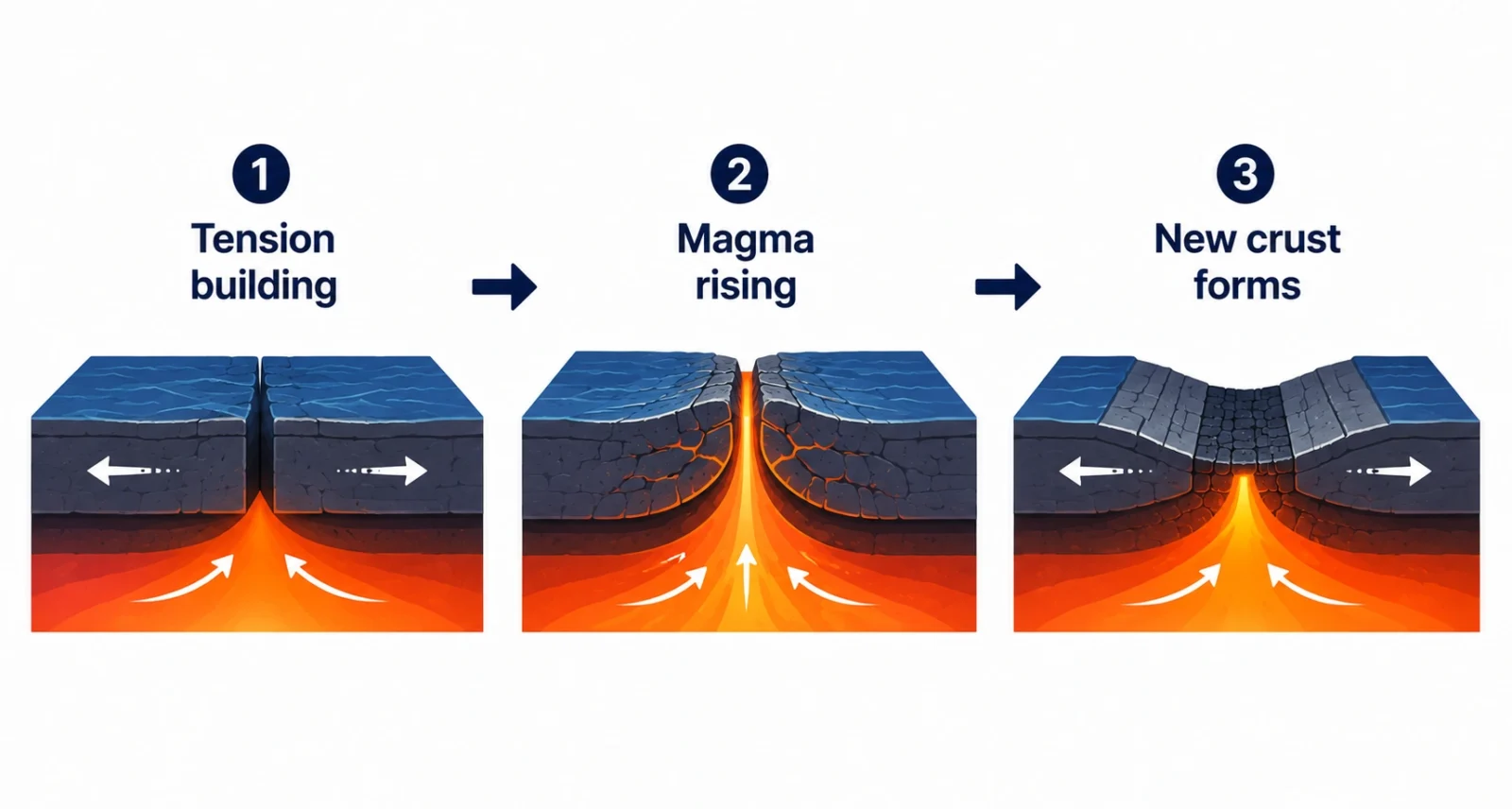
Let us start with the basics. The Earth’s surface is broken into giant slabs called tectonic plates that slowly shift over time. Running through the middle of the oceans is a vast chain of underwater mountains known as mid-ocean ridges. This chain stretches roughly 65,000 kilometers around the globe. This is where two plates pull apart. As they separate, hot molten rock, or magma, rises up from below to fill the gap, then cools and hardens into solid rock. That fresh rock is new oceanic crust. This process, called seafloor spreading, is how more than two-thirds of Earth’s entire crust was made.
A Bold Experiment in the Middle of Nowhere
Watching this happen is incredibly hard, because it unfolds deep underwater in some of the most remote places on Earth. A team led by marine geophysicist Jean-Yves Royer decided to try anyway. In early 2024, they set up a special underwater observatory called OHA-GEODAMS on the Southeast Indian Ridge. That is near a tiny speck of land called Amsterdam Island, between Australia and Antarctica. The system used five listening devices, called hydrophones, to monitor the seafloor around the clock. They had spent years building it, hoping to one day catch one of these rare, violent events, as ScienceAlert reported. As it turned out, they would not have to wait long.
Then the Seafloor Split Open
Just a couple of months after the observatory went live, the Earth put on a show. Over 16 days at the end of April 2024, the ridge cracked open. Deep below, huge sheets of magma called dikes ripped through the crust in under two hours. They injected an estimated 150 million cubic meters of molten rock. As the magma surged, it set off earthquakes, jolted long-dormant faults back to life, and drained the reservoir of magma below. With that support gone, the seafloor above collapsed. Lava poured onto the ocean floor, and the valley along the ridge sank by a dramatic 4.2 meters. “We did not dream of capturing such a massive event,” Royer said. The full account appears in the journal Nature.
Spreading Happens in Giant Lurches
This was the perfect proof of something scientists had suspected but never seen. Seafloor spreading does not happen as a slow, smooth creep. On average, mid-ocean ridges spread at about 6.3 centimeters per year, roughly the speed your fingernails grow. This event showed the truth is far more dramatic. At its peak, the ridge was ripping apart at 5 centimeters every single minute, almost half a million times faster than the long-term average. In just 16 days, the seafloor moved as much as it normally would in 30 to 60 years. Here are the astonishing numbers behind the event.
| The Event | By the Numbers |
| Where it happened | Southeast Indian Ridge, near Amsterdam Island |
| How long it lasted | 16 days in April 2024 |
| Magma injected | About 150 million cubic meters |
| Dikes tore through the crust in | Under 2 hours |
| Seafloor collapse | 4.2 meters (13.8 feet) |
| Peak spreading rate | 5 centimeters per minute |
| Long-term average rate | About 6.3 centimeters per year |
Solving a Long-Standing Mystery
The discovery also cracked a puzzle that had stumped scientists for decades. Researchers knew how fast the plates were moving apart, but the math never quite worked. When they added up all the motion from recorded earthquakes, it was never enough to explain the full amount of spreading. Some of the movement was simply going missing. This event revealed the answer. The faults slipped far more than the earthquakes alone suggested, and most of the motion happened silently, without shaking the ground. In other words, a huge part of how the ocean floor grows is invisible to earthquake sensors. Now scientists finally have a real-world measurement to test their models against.
Why This Discovery Matters
Beyond the sheer wow factor, this is a big deal for science. It is the first time anyone has recorded the birth of oceanic crust hour by hour. That gives researchers a front-row seat to a process that shapes our entire planet. It helps explain how continents drift, how earthquakes behave at sea, and how the ground beneath the ocean truly works. As Royer put it, the achievement opens new horizons for ocean science. It is also a humbling reminder of how much we still do not know about our own planet. The vast, hidden world under the sea holds countless surprises. If you find this fascinating, our look at the secrets of the ocean is a great next read.
For the first time, scientists have witnessed our planet building new crust on the ocean floor, and the story is every bit as dramatic as it sounds. In just days, the seafloor split, magma erupted, and the ground dropped more than four meters. A clever observatory captured it all, in one of the loneliest corners of the ocean.
Seafloor spreading, once a process we could only imagine, has finally been seen in action. It proves that even the most familiar ideas in science can still surprise us. For more of the ocean’s secrets, see our piece on record ocean temperatures.
Frequently Asked Questions
What is seafloor spreading?
Seafloor spreading is the process where two tectonic plates pull apart at mid-ocean ridges. Magma rises to fill the gap, then cools into new oceanic crust. It is how more than two-thirds of Earth’s crust formed.
Where did scientists observe this event?
It happened at the Southeast Indian Ridge, near Amsterdam Island, between Australia and Antarctica. A team recorded it using an underwater observatory called OHA-GEODAMS, which listens to the seafloor with five hydrophones.
How fast does the seafloor spread?
On average, mid-ocean ridges spread about 6.3 centimeters per year. But this is not steady. During the recorded event, the ridge tore apart at up to 5 centimeters per minute, nearly half a million times faster than the average.
Why is this discovery important?
It is the first real-time record of new oceanic crust forming, and it solved a long-standing puzzle about missing motion. Much of the spreading happens silently, without earthquakes, which reshapes how scientists study the ocean floor.
How is oceanic crust formed?
Oceanic crust forms at mid-ocean ridges. As plates separate, magma rises from below and fills the gap. It then cools and hardens into solid rock, adding a fresh strip of crust to the ocean floor.
What are dikes in geology?
Dikes are sheet-like bodies of magma that force their way through cracks in existing rock. In this event, dikes tore through the crust in under two hours, carrying huge volumes of molten rock toward the seafloor.

