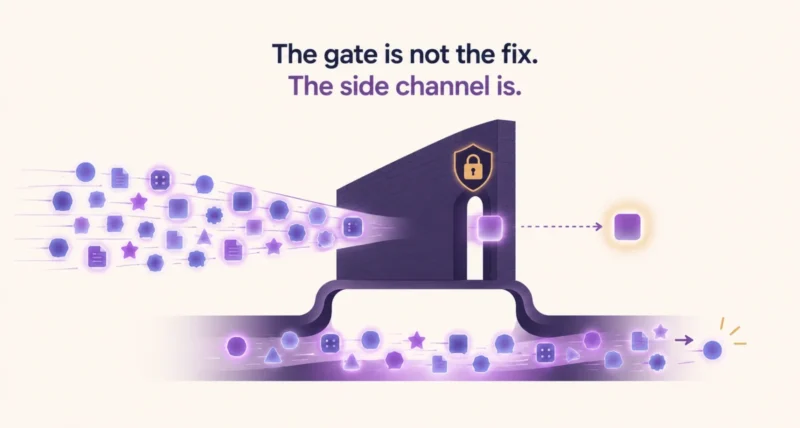
You can build a working AI app over a coffee now. Getting it past a corporate review board is where it dies, and the numbers on that are brutal.
Google published an engineering account of why AI apps fail in production, built on how YouTube fixed the problem internally. The conclusion is the opposite of what you would expect. The teams that ship fastest are not the ones that reduced their failure rate. They are the ones that made failing cheap.
| The Short Answer Only about 5 percent of AI prototypes ever reach production. The cause is rarely the code, it is the gap between how fast AI lets you build and how slowly enterprises let you ship. YouTube fixed this by separating experimentation from production entirely, giving prototypes safe read-only access to real data and injecting test interfaces directly into the browser rather than the codebase. Review times fell from quarters to weeks. The underlying shift is treating prototype code as disposable, and treating the 95 percent failure rate as the strategy rather than the problem. |
The Number That Frames Everything
One statistic sits underneath this whole discussion. Roughly 5 percent of AI prototypes make it into production, which means 19 out of every 20 die somewhere between the demo and the launch.
Worth noting where that figure comes from. That figure does not come from Google’s own research. Google cites the State of AI in Business 2025 report, an independent study that was widely discussed when it landed. Attribution matters here, because a vendor quoting an external failure statistic is a stronger claim than a vendor quoting itself.
| Quick Take Think about what a 95 percent failure rate actually implies. If almost everything fails, then the cost of each individual failure is the only variable that matters. Making failures cheaper beats making them rarer, and that single reframe is the whole argument of the piece. |
Why AI Apps Fail in Production: The Speed Versus Risk Paradox
The failure is structural rather than technical, and it has a simple shape. Two clocks run at completely different speeds.
On one side, AI has made building almost free. You can go from idea to working prototype in an afternoon. On the other side, enterprise review pipelines still take months, because they were designed for code that humans wrote slowly and deliberately.
The result is a trap that has nothing to do with quality. By the time a demo clears review, the underlying models have moved on and the feature is already dated. Teams are not failing to build. They are failing to ship before their own work expires.
| The Clock | How Fast It Runs | What Breaks |
| Building with AI | Hours to days | Nothing, this part works |
| Enterprise review | Weeks to months | The feature ages out before approval |
| Model generations | Months | Your approved demo is now behind |
The Blast Radius Problem
There is a real reason enterprises move slowly, and the article is honest about it rather than dismissive.
When you build alone, a misbehaving AI agent costs you a prompt rewrite and a server restart. Inside a company, unconstrained agents create what engineers call a blast radius. Google’s piece cites Addy Osmani, who ran ten agents in parallel on a personal project. Because the changes were not properly isolated, technical debt accumulated instantly and broke two of his applications outright.
Now scale that to YouTube, which serves billions of users on a codebase roughly twenty years old. The caution is not bureaucratic timidity. It is a rational response to genuine risk, which is exactly why speeding up reviews was never going to be the answer.
How YouTube Actually Solved It
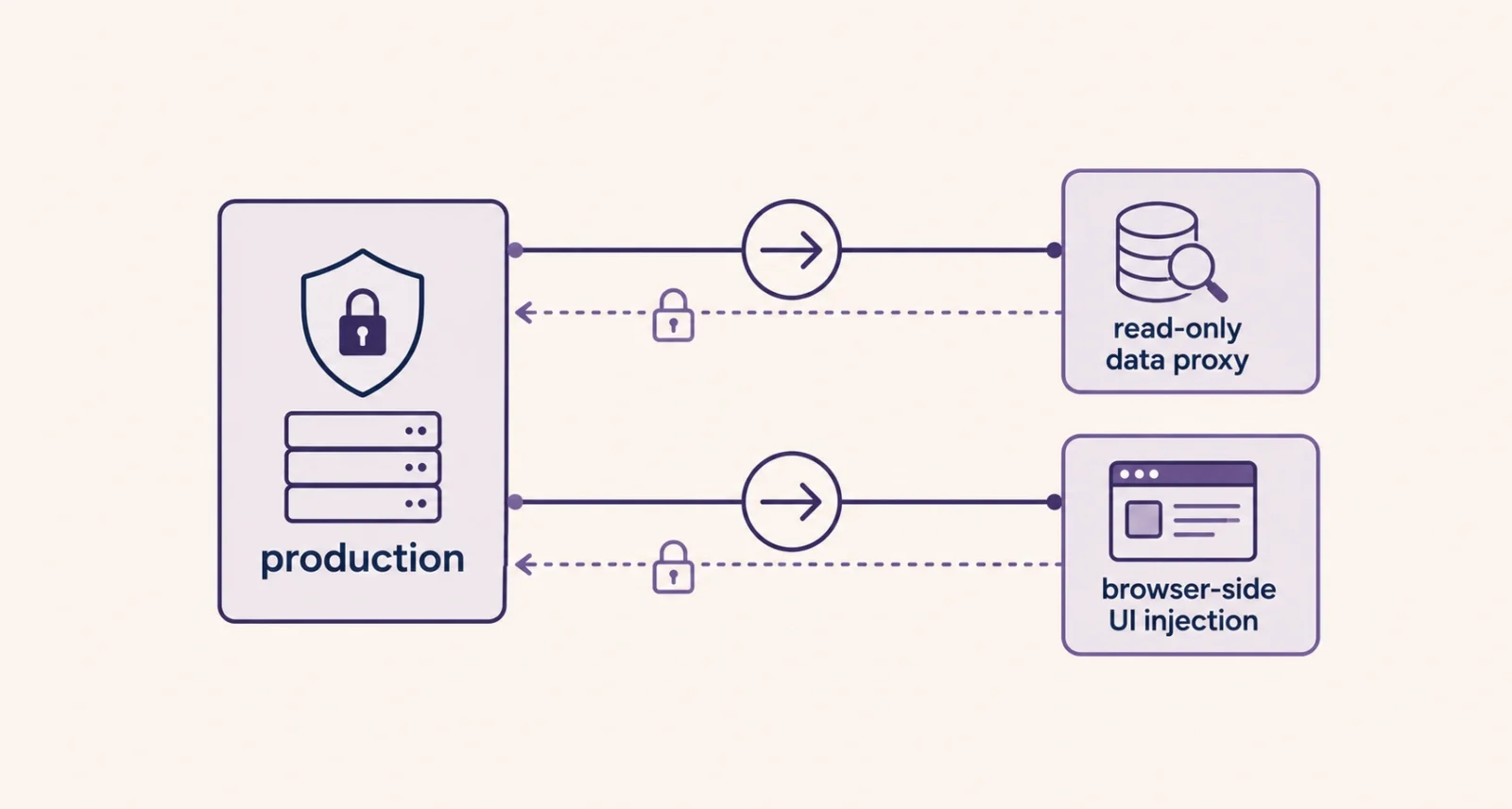
Benji Bear, a Google DeepMind and former YouTube engineer, took a different route, in an account Google also republished in full. Rather than making reviews faster, his team removed prototypes from the review path altogether by decoupling experimentation from production servers. The result is a two-part system.
Part 1: A safe, live data layer
Fake data produces prototypes that fall apart on contact with reality. Production databases risk breaking when you test against them. The stack takes a third route.
Developers start from Google AI Studio templates, which connect through a secure Google Cloud proxy server. That proxy grants pre-authenticated, read-only access to live components such as playlists, videos, and channels. Prototypes see real data with real structure, and they cannot write anything back.
Part 2: Live UI injection
The second bottleneck is knowing how a feature actually feels to use. Rather than merging experimental interface code into the product, developers use client-side extension wrappers to inject test interfaces directly into their own browser.
The experiment runs on top of the real product, visible only to the person testing it, and completely separate from production code. Updates go from idea to on-screen in minutes instead of waiting on a deployment cycle.
| The Problem | The Old Way | The Prototyping Stack |
| Realistic data | Mock data, or risky production access | Read-only proxy to live data |
| Seeing the real feel | Merge experimental UI into the product | Inject UI into your own browser only |
| Approval time | Quarters | Weeks |
The outcome is the part worth quoting to a skeptical manager. YouTube moved from taking quarters to evaluate a single feature to putting several prototypes, including YouTube Recap, in front of user research studies within weeks.
The Mindset Shift: Throw the Code Away
The infrastructure only works alongside an uncomfortable habit change, and this is where most teams will struggle.
Engineers are trained to write clean, permanent, maintainable code. Prototype code should be none of those things. Its only job is answering one question: do users actually want this? Google calls forcing a messy AI-generated script into an enterprise codebase an architectural trap. That matches what most engineers have watched happen.
The sequence instead runs: build fast and messy, establish an accurate baseline, run real user tests, look at the data, then delete the script. If the idea won, you rewrite it properly, and that rewrite is faster and safer precisely because the parameters are already proven.
| The Golden Rule Prototype code and production code are different products with different purposes. One exists to answer a question. The other exists to run for years. Confusing the two is what turns a two-week experiment into a six-month cleanup, and it is the single most common way good AI ideas die inside good engineering teams. |
How to Apply This Without YouTube’s Budget
Most teams do not have a dedicated platform team building custom proxies. The principles still transfer, and four of them cost almost nothing.
- Create read-only credentials for experiments. Most APIs and databases support scoped keys. A prototype that physically cannot write is a prototype nobody needs to review for safety.
- Put experiments in a separate cloud project or account. Isolation at the billing and permissions boundary is cruder than a proxy layer and achieves most of the same protection.
- Test interfaces in the browser, not the codebase. A browser extension or userscript that overlays your experimental interface lets you feel the real thing without touching a deployment pipeline.
- Agree in advance that the prototype gets deleted. Writing that into the ticket before anyone starts removes the argument at the end, which is when it always happens.
The uncomfortable part is not technical. It is persuading a manager that deliberately throwing away work is the efficient path, which is much easier once you can point to the review-cycle numbers above.
What This Means for Your Role
The closing argument is the most interesting claim in the whole piece, and it is worth sitting with.
Because AI has made writing code cheap, the value of being the person who writes it correctly has fallen. The article describes the shift as moving from “syntax gatekeepers to System Architects”. Your job becomes designing the sandboxes, permissions and pipelines that let a team fail quickly and safely, rather than personally guarding code quality.
Notice that the risk framing flips too. Messy AI code breaking a server is no longer the danger, since isolation handles that. The real danger is review loops running so slowly the company misses the shift entirely while its demos sit in a queue.
The useful insight here is not a tool, it is an inversion. Every company trying to raise its AI success rate is solving the wrong problem. In a field where 19 of 20 ideas fail, the cost of each failure decides how many ideas you get to test.
The useful insight here is not a tool, it is an inversion. Every company trying to raise its AI success rate is solving the wrong problem. In a field where 19 of 20 ideas fail, the cost of each failure decides how many ideas you get to test.
Frequently Asked Questions
Why do most AI apps fail in production?
Rarely because the technology fails. The common cause is a mismatch of speed: AI lets teams build prototypes in hours, while enterprise review and compliance pipelines still take months. By the time a demo is approved, the underlying models have advanced and the feature is outdated. Roughly 5 percent of AI prototypes reach production.
What is an AI prototyping stack?
It is infrastructure that separates experimentation from production entirely. YouTube’s version has two parts. A secure proxy gives prototypes read-only access to real live data. Client-side extension wrappers then inject experimental interfaces into a developer’s own browser rather than into the product. Experiments get realistic conditions with no ability to affect production.
What does throw-away code mean?
It means writing prototype code with the explicit intention of deleting it. The prototype exists only to test whether users want a feature, not to become the feature. Once the data answers that question, you discard the script. If the idea proved worthwhile you rewrite a clean version, which goes faster because the parameters already hold.
Is a 95 percent failure rate really acceptable?
The argument is that it becomes acceptable once each failure is cheap and fast. If experiments run in isolation and take days rather than quarters, a high failure rate is simply the cost of testing many ideas. The problem is not the rate itself. It is failures that run slow, cost a lot, and eat production engineering time.
Can small teams use this approach?
Yes, in simplified form. Four things deliver most of the benefit without custom infrastructure: scoped read-only API credentials, a separate cloud project for experiments, browser-based interface testing, and an upfront agreement to delete the prototype. The principles are about isolation and disposability rather than about tooling budget.
What was the actual result at YouTube?
According to Google, the time to evaluate a single feature fell from quarters to weeks. Several prototypes, including YouTube Recap, went straight into user research studies under the new approach. That is Google reporting on its own internal process, so treat it as a credible account rather than independently verified measurement.