

On Thursday morning, June 25, 2026, Apple’s online store quietly went dark. When it flickered back to life a short while later, something had changed. Almost every Mac and iPad wore a new, higher price tag. The Apple Mac and iPad price increase was not a glitch. It was the moment a far-away problem, the AI data center boom, finally landed on your doorstep. And the company pointed straight at the cause: a memory shortage unlike anything it had seen in 40 years.
| Quick Answer On June 25, 2026, Apple raised prices across Macs, iPads, HomePod, Apple TV, and Vision Pro, with increases from $30 to $1,300 depending on the model. The reason is a historic surge in memory chip costs, driven by AI data centers buying up the world’s supply of DRAM and storage. The iPhone, Apple Watch, and AirPods were spared for now, though the iPhone may see increases this fall. Analysts expect high prices to last into 2027 or 2028, so buying sooner is generally the better move. |
Key Takeaways
- Apple raised prices on Macs, iPads, HomePod, Apple TV, and Vision Pro on June 25, 2026.
- Increases range from $30 on a HomePod mini to $1,300 on a high-end Mac Studio.
- The cause is an AI-driven memory shortage, as data centers buy up DRAM and storage chips.
- The iPhone, Apple Watch, and AirPods were not touched, though the iPhone may rise this fall.
- Experts expect high prices into 2027 or 2028, so buying now usually beats waiting.
What Apple Changed Overnight
Apple rarely changes prices on products already sitting in its store. It usually waits for a new model, then folds higher costs into a fresh launch. This time was different. On June 25, the prices simply moved, mid-cycle, on hardware people were buying that very morning.
The company did not hide it. In a rare statement, Apple said the industry faced an “unprecedented challenge.” The rapid expansion of AI data centers, it explained, had created an “extraordinary surge” in demand for memory and storage. It added that it had shielded customers so far, but had now reached a point where it had to begin raising prices. As Reuters reported, this Apple Mac and iPad price increase tracks closely with how much memory each device carries.
| In Apple’s Words “We have never seen a component price increase this much, this quickly. We have shielded our customers from these increases so far, but we have now reached a point where we need to begin raising prices on a number of products.” That last phrase, a number of products, is the part worth watching. It leaves the door open for more. |
How Much More the Apple Mac and iPad Price Increase Costs You
The increases are not uniform. They scale with how much memory and storage a device carries, which is exactly what you would expect if memory is the culprit. Here is a clear look at the changes on popular models, based on reporting from Reuters, 9to5Mac, and other outlets.
| Model | Old Price | New Price | Increase |
| iPad (base) | $349 | $449 | +$100 |
| iPad Air | $599 | $749 | +$150 |
| iPad Pro | $999 | $1,199 | +$200 |
| MacBook Air (13-inch, M5) | $1,099 | $1,299 | +$200 |
| MacBook Pro (M5, 14-inch) | $1,599 | $1,999 | +$400 |
| Mac mini (M4 Pro) | $1,399 | $1,599 | +$200 |
| Mac Studio (M3 Ultra) | $3,999 | $5,299 | +$1,300 |
| HomePod mini | $99 | $129 | +$30 |
| Vision Pro (base) | $3,499 | $3,699 | +$200 |
Figures are based on outlet reporting of US prices and may vary by configuration. Part of the MacBook Pro change traces to an earlier 2026 update, so the pure memory-driven portion may be smaller.
| Worth Knowing Upgrades got pricier too. On the high-end MacBook Pro, moving from 24GB to 48GB of memory now adds an extra $600, and a fully maxed-out model can reach $9,999. Memory is no longer a small add-on. It is the headline cost. |
Why Apple Blamed Memory Chips
Every Mac and iPad needs two kinds of memory: DRAM, the fast working memory your apps run in, and NAND flash, the storage that holds your files. Both come from a handful of suppliers, and both have shot up in price.
The numbers are staggering. According to the research firm TrendForce, conventional DRAM contract prices jumped around 90 percent in early 2026. They looked set to climb another 58 to 63 percent in the next quarter, with NAND flash rising 70 to 75 percent. One PC maker said memory went from about 15 percent of a laptop’s parts cost to roughly 35 percent in a single quarter.
When a core component nearly doubles in price, even Apple’s famous supply-chain muscle runs out of room. The cost had to land somewhere, and it landed on the shelf. Our look at the $3,000 PS5 SSD and surging storage prices traced this same memory crunch hitting gamers first.
The Company Quietly Winning
Here is the twist that makes this story land. Just one day before Apple raised prices, a memory maker named Micron reported the kind of earnings that stop a room. Record revenue, up more than 300 percent from a year earlier, and a gross margin near 85 percent.
To put that in plain terms, that margin briefly beat even Nvidia and Meta, the poster children of the AI boom. The same shortage squeezing your wallet is making memory suppliers extraordinarily rich. CNBC reported Micron’s record quarter and its place as tech’s new margin leader.
| The Standout On June 24, a memory supplier posts historic profits. On June 25, the world’s most valuable consumer-tech company says it can no longer protect its customers and raises prices. Two days, one story: the AI boom is quietly rerouting money from your pocket toward whoever makes the chips. |
Why AI Is Eating the World’s Memory
The reason is scale. Modern AI models run on special high-bandwidth memory, and the appetite is enormous. A single top-end AI chip can carry 192GB of this memory. Eight of them go into one server, and thousands of servers form a single cluster. Your iPhone, by comparison, holds around 8 to 12GB.
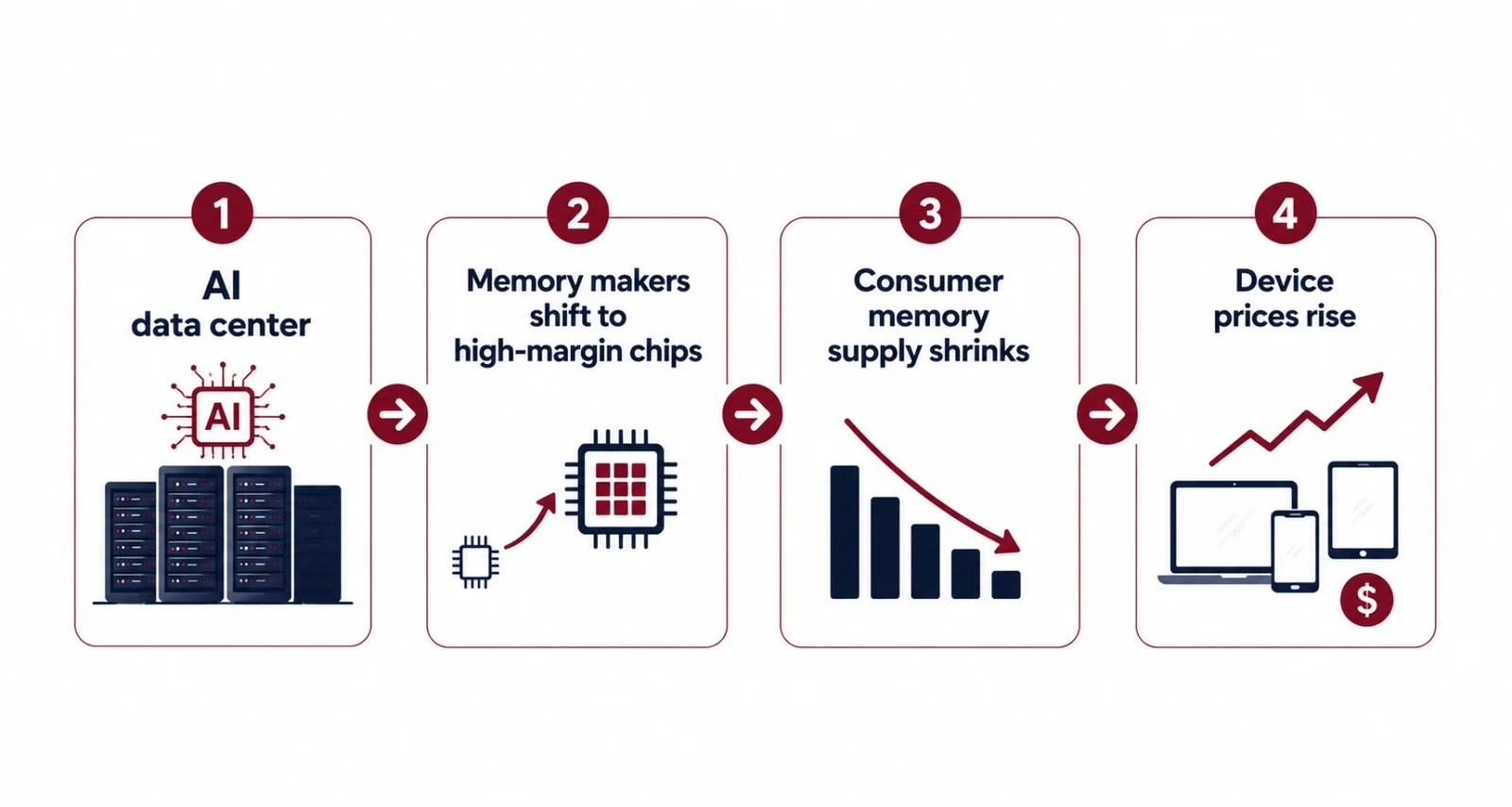
Only three companies make most of the world’s memory, and this AI-grade memory is far more profitable to produce. So the makers are shifting their factories toward it. Every wafer used for AI memory is one not used for the ordinary chips inside laptops, tablets, and phones. Supply for consumer devices shrinks, and prices rise.
| Quick Take Think of it as a consumer tax on the AI buildout. The data centers training tomorrow’s chatbots are bidding for the same raw material your next laptop needs, and they are winning the auction. |
Apple Is Not Alone
It would be easy to read this as an Apple story. It is not. Across the industry, device makers are raising prices or warning that they must.
- Microsoft raised Surface prices, with its flagship models now starting hundreds of dollars above their earlier launch prices.
- Dell began lifting commercial PC prices by 10 to 30 percent starting in late 2025.
- Lenovo, Acer, and Asus all confirmed or called 2026 price increases unavoidable.
- Samsung and Sony rolled out device price hikes of their own.
Analysts at firms like Gartner and IDC expect the broader fallout to include fewer devices sold and the slow disappearance of the cheapest laptops. If you have been eyeing a budget machine, this trend is worth watching closely. For context on the hardware side, see our explainer on the NVIDIA RTX Spark chip and where computing power is heading next.
Will the iPhone Be Next?
Apple spared the iPhone, Apple Watch, and AirPods on June 25, but the iPhone is widely expected to rise this fall. Analysts estimate the memory inside a Pro model could cost Apple several times more than last year, which points toward a higher starting price for the next iPhone Pro. Apple has not confirmed any figure, and the clearest answer will come at the September launch.
| Worth Knowing Reported analyst projections for the next iPhone Pro hover above $1,200 for the first time, but these are cost-model estimates, not Apple prices. Treat any specific number as a forecast until Apple says otherwise. |
Should You Buy Now or Wait?
For most people, the honest answer is buy now if you genuinely need the device. Every major analyst expects memory prices to stay high through 2026, with meaningful relief unlikely before late 2027 or even 2028. New factory capacity takes years, and most of it is aimed at AI memory, not the kind in your laptop.
- Favor current stock. Devices already on shelves came from older, cheaper component contracts, so they are the better value.
- Buy what you need, not extra. Hoarding does not help. Get the device you actually use, at the tier you actually need.
- Go easy on memory tiers. Higher RAM and storage configs are hit hardest, so a sensible tier softens the premium.
- Consider refurbished. Certified pre-owned and trade-in deals can offset the increase, especially for older models.
- Do not wait for cheaper launches. New models will likely debut at higher starting prices, not lower ones.
The Apple Mac and iPad price increase is more than a line item. It is the clearest sign yet that the AI boom has a price, and that ordinary shoppers are starting to pay part of it. A shortage born in distant data centers has reached the checkout page.
The practical takeaway is simple. If you need a Mac or iPad, buying sooner beats waiting, since prices are heading up rather than down. Choose the memory tier you truly need, look at current stock and refurbished options, and keep an eye on the iPhone news this fall.
| Your Move Want to follow the memory crisis and what it means for your next device? Browse more in our Technology section for clear, practical breakdowns. |
Frequently Asked Questions
Why did Apple raise Mac and iPad prices?
Apple raised prices because memory chip costs surged to record levels in 2026. AI data centers are buying up the world’s supply of DRAM and storage. That pushed component costs so high that Apple said it could no longer absorb them.
Which Apple products got more expensive?
Macs, iPads, HomePod, HomePod mini, Apple TV, Mac mini, Mac Studio, and Vision Pro all rose on June 25, 2026. Increases ranged from $30 to $1,300 depending on the model and its memory.
Did the iPhone get more expensive?
Not on June 25. The iPhone, Apple Watch, and AirPods were spared in this round. However, analysts widely expect the iPhone to see increases at its fall launch, since it also relies on the same costly memory.
How long will high prices last?
Most analysts, including Gartner and TrendForce, expect memory prices to stay elevated through 2026, with relief unlikely before late 2027 or 2028. New supply takes years and is largely aimed at AI memory, not consumer chips.
Are other brands raising prices too?
Yes. Microsoft, Dell, Lenovo, Acer, Asus, Samsung, and Sony have all raised prices or signaled increases. This is an industry-wide effect of the memory shortage, not something unique to Apple.
Should I buy a Mac or iPad now or wait?
If you need one, buying now is generally smart. Prices are expected to rise further, not fall, and current stock was built on cheaper component contracts. Choosing a sensible memory tier helps soften the cost.

