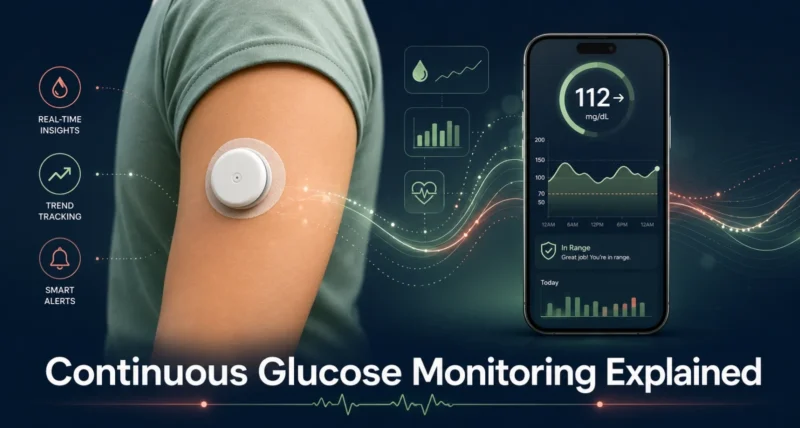
Continuous glucose monitoring for non-diabetics is now widely available through FDA-cleared over-the-counter devices like Dexcom Stelo and Abbott Lingo, as well as prescription subscriptions such as NutriSense and Signos. Whether it is worth it depends entirely on who you are. Pre-diabetics and serious athletes may benefit. Weight-loss seekers and general wellness users see little or no proven benefit. Anyone with a history of disordered eating should avoid CGMs entirely. FDA clearance proves these devices measure glucose accurately, not that they make healthy people healthier.
Medical disclaimer: This article is for general education, not medical advice. CGMs are medical devices, so talk to a doctor before using one, especially if you have a history of eating disorders or anxiety. For any concern about blood sugar, see a physician for proper testing. Information is current as of May 2026.
Key Takeaways
- CGMs for non-diabetics became widely accessible in 2024, starting with Dexcom Stelo, the first over-the-counter clearance. The FDA cleared them for accurate measurement, not for health benefits.
- The honest answer to “is it worth it” depends on your cohort. Pre-diabetics may benefit, athletes may gain insights, weight and wellness seekers see little proven gain, and people with eating disorder risk should avoid CGMs.
- No published study shows measurable long-term health improvements from CGM use in non-diabetic adults. Marketing claims often run ahead of the evidence.
- 2026 costs run from about $49 per sensor to $225 per month, with $500 to $2,700 or more per year. None are covered by insurance for wellness use.
- The biggest risk most articles ignore is mental health. CGMs can trigger food anxiety and restrictive eating in vulnerable people.
What CGM for Non Diabetics Actually Is
A continuous glucose monitor is a small wearable sensor, usually worn on the upper arm. It measures glucose in the fluid around your cells and sends readings to a phone app every few minutes. One sensor lasts about 10 to 15 days.
A fingerstick test shows a single moment. A CGM shows patterns across the whole day and night. Think of a fingerstick as a photo and a CGM as a video.
Until recently, CGMs were prescription-only devices for diabetes. That changed in 2024, when the FDA cleared the first over-the-counter models from Dexcom and Abbott. One point matters most: FDA clearance confirms these devices measure glucose accurately, not that they make healthy people healthier.
How CGMs Work and Their Limits
The sensor filament sits about 5mm under the skin and reacts with glucose to produce an electrical signal, which the app turns into readings. Most users report minimal discomfort.
The technology has real limits. CGMs measure interstitial fluid, not blood directly, so readings lag actual blood glucose by roughly 5 to 20 minutes. Accuracy can vary by 10 to 15 percent compared to a standard blood test. Pressure on the sensor, dehydration, and the device range can all skew results. Over-the-counter models also lack the emergency alerts that prescription CGMs include, so they are built for trend tracking rather than safety monitoring.
The 5 Major Consumer CGM Options Compared
| Product | Type | Cost/Month | Wear | Best For |
| Dexcom Stelo | OTC | $89 (subscription) or $99 per 2-pack | 15 days | Data-rich self-tracking |
| Abbott Lingo | OTC | About $49 per 14-day sensor | 14 days | First-timers wanting coaching |
| Abbott Libre Rio | OTC | TBD | 15 days | Adults with type 2 diabetes, not insulin users |
| NutriSense | Prescription | $225 or more | Varies | Dietitian coaching included |
| Signos | Prescription | Subscription | Varies | Weight management focus |
A few quick notes. Stelo suits people who want comprehensive pattern data and can interpret it themselves. Lingo leans on a coaching-style app and easier onboarding. Libre Rio is designed for type 2 diabetes managed by lifestyle, so it is less relevant for wellness use. NutriSense bundles a registered dietitian. Signos earned FDA clearance specifically for weight management in August 2025.
Important reality on cost. None of these are covered by insurance for non-diabetic wellness use. All are HSA- and FSA-eligible, but that is tax-saving, not free access. Annual cost runs roughly $500 to $2,700 or more.

What the Science Actually Says
As of 2026, no published study shows that CGM use leads to measurable long-term health improvements in people without diabetes. Harvard Health Publishing has reached the same conclusion, noting there is no solid evidence of value for non-diabetic users.
This does not mean CGMs are useless. It means the marketing often exceeds what the science strictly supports. Strong evidence backs CGM use in diabetes management. Evidence is limited or emerging for pre-diabetes support and athletic performance. Evidence does not strongly support general wellness, weight loss, or “metabolic optimization” claims in healthy adults.
Most endocrinologists land in a measured middle ground. CGMs can help in specific situations, offer interesting self-experiment data for motivated people, and pose real risks for vulnerable users. They are not a substitute for proven health basics.
The 6 Cohort Verdict: Who Should Actually Use CGM
Rather than a single yes or no, here is an honest verdict for six user types.
Cohort 1: Pre-diabetics With Elevated A1C
Likely beneficial with physician guidance. CGM data can flag problem foods, motivate change, and track progress. Consider a 30 to 90 day trial and measure A1C before and after. Note that lifestyle changes work without a CGM, too.
Cohort 2: Serious Endurance Athletes
May provide useful fueling and recovery insights. Trial it during specific training cycles and look for personal patterns. The benefit varies by sport and individual.
Cohort 3: Weight Management Seekers
Mixed evidence. Spotting foods that spike glucose may support better choices, and Signos has FDA clearance for weight management. However, weight loss still depends on a sustained caloric deficit, which CGM data does not change. Treat it as one tool among proven approaches.
Cohort 4: Biohackers and Quantified-Self Enthusiasts
Interesting self-experiment data, with a personal cost-benefit decision. Results describe you specifically, not universal truths. Do not expect a dramatic health transformation.
Cohort 5: Healthy General Wellness Seekers
No proven benefit beyond what dietary basics provide. This is exactly the group where evidence shows no clear long-term gain. The yearly cost almost certainly does more good spent on quality food, a dietitian, exercise, sleep, or an annual physical.
Cohort 6: Anyone With a History or Risk of Disordered Eating
Avoid CGMs. This warning matters most. Constant glucose data can trigger or worsen food anxiety, restrictive eating, obsessive checking, and avoidance of normal, healthy foods. At-risk groups include anyone with an eating disorder history, anxiety, OCD tendencies, perfectionism around diet, or current body image struggles. If this describes you, speak with a mental health professional before using any tracking technology. If you already use a CGM and notice these patterns, stop and talk to a healthcare provider. The National Alliance for Eating Disorders offers a helpline and support.
Cohort Summary Table
| Cohort | Verdict | Recommendation |
| Pre-diabetics | Likely beneficial | Use with physician guidance |
| Serious athletes | May benefit | Trial during training cycles |
| Weight management | Mixed | Use alongside established approaches |
| Biohackers | Interesting | Personal cost-benefit |
| Healthy wellness | No proven benefit | Skip, use money for proven approaches |
| Eating disorder risk | Avoid | Do not use, mental health priority |
What CGMs Reveal, and What They Mislead You About
For the right cohorts, CGMs reveal genuinely useful things. They show that food responses vary between individuals, that stress and poor sleep raise glucose, that exercise timing matters, and that combining fiber, fat, or protein with carbohydrates changes the response. That personalized feedback has real value.
They also mislead in predictable ways. A glucose rise after eating is normal physiology, not a problem to eliminate, yet many users treat every spike as a fault and eat restrictively as a result. One person’s data is not universal advice. Short-term readings do not equal long-term health, and an A1C blood test often tells most people more for far less. CGMs also measure glucose, not insulin resistance, which is the more important predictor of metabolic disease.
The Honest Cost Analysis
| Product | Per Year | 5 Year Cost |
| Lingo (continuous use) | About $1,170 | About $5,850 |
| Stelo subscription | About $1,068 | About $5,340 |
| NutriSense | $2,700 or more | $13,500 or more |
| Signos | Subscription | $5,000 to $15,000 or more |
Beyond the price tag, there are hidden costs: time spent logging and reviewing data, the mental load of constant glucose awareness, and the risk of cutting out enjoyable healthy foods. For most non-diabetic adults, the same money spent on quality food, a dietitian, exercise, or sleep support likely produces more health benefit than a monitoring subscription.
Risks and Drawbacks Often Ignored
The most serious risk is to mental health and eating behavior. Clinicians report rising cases of CGM use feeding food anxiety and disordered patterns. Warning signs include avoiding social meals, labeling foods “good” or “bad,” compulsive checking, and shame about glucose responses. If you notice these, discontinue use and consider speaking with a professional.
Other drawbacks include over-medicalizing normal biology, a false sense of “optimization” that crowds out sleep and stress, skin irritation, app glitches, information overload, and data privacy questions, since commercial companies collect continuous health data.
Alternatives to Consider
For most non-diabetic adults, simpler options serve better. Standard blood tests give meaningful information at low cost: an A1C test (about $30 to $50), a fasting glucose test, an oral glucose tolerance test, or a fasting insulin test. Proven lifestyle habits matter more than any device: a whole-foods or Mediterranean-style diet, regular aerobic and strength exercise, 7 to 9 hours of sleep, and stress management. A registered dietitian consultation or an annual physical with bloodwork often delivers more value than a year of CGM subscriptions.
What People Get Wrong About CGM for Non Diabetics
- Myth 1: FDA clearance means CGMs improve health. It confirms accurate measurement, not benefit.
- Myth 2: Eliminating glucose spikes is a health goal. Normal post-meal rises are healthy physiology.
- Myth 3: Lower glucose is always better. Stable, normal-range glucose is the goal, not minimization.
- Myth 4: CGM data matters more than other health metrics. Sleep, stress, exercise, and diet quality matter at least as much.
- Myth 5: Everyone benefits from glucose monitoring. Some people are clearly harmed, and many see no benefit.
- Myth 6: CGMs replace traditional glucose testing. A1C and other tests serve purposes that CGMs do not.
The Bottom Line for Non Diabetics
Your decision depends on your situation. Pre-diabetics should discuss a 30 to 90 day CGM trial with a physician and track A1C as the real measure. Serious athletes can try one during specific training cycles. Anyone focused on weight loss or general wellness is better off skipping the CGM and spending the money on proven habits and bloodwork. Biohackers can treat it as optional self-experimentation. Most importantly, do not use a CGM if you have any history or risk of disordered eating, and prioritize mental health support instead.
The bigger picture is simple. The 2024 to 2026 over-the-counter wave made interesting technology widely available, but access does not equal benefit. For most healthy adults, the boring proven basics, a good diet, regular exercise, adequate sleep, and stress management, produce far more health benefit than an expensive subscription. For any concern about blood sugar or metabolic health, consult a qualified healthcare provider, and if you or someone you know is struggling with disordered eating, the National Alliance for Eating Disorders provides resources and support.
Frequently Asked Questions
What is CGM for non diabetics? Continuous glucose monitors worn by people without diabetes to track blood sugar patterns, sold as over-the-counter devices like Stelo and Lingo or prescription services like NutriSense and Signos.
Is wearing a CGM worth it if you don’t have diabetes? It depends on your cohort, since pre-diabetics and athletes may benefit while weight and wellness seekers gain little.
Do CGMs actually help with weight loss? Evidence is limited and varies by person, and no CGM beats caloric awareness, exercise, and sleep.
How much does a CGM cost without insurance? Roughly $49 per sensor up to $225 or more per month, totaling $500 to $2,700 or more per year.
Are CGMs safe for healthy people? Physically safe for most adults, but they carry real mental health risks for anyone with eating disorder history or anxiety.
Should I get a CGM or just see a doctor? For most non-diabetic adults, a physician visit for A1C testing offers far better value than buying a CGM.