
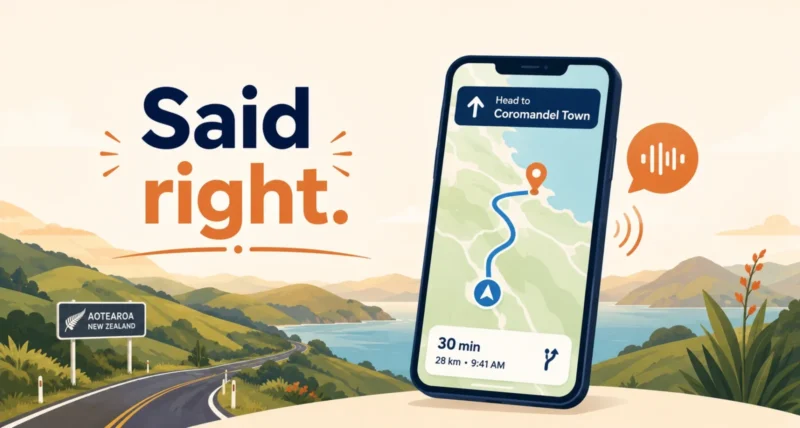
You know that moment when your phone’s navigation confidently mangles a local place name? In New Zealand, that used to happen a lot, especially with te reo Māori names. Not anymore. The new Google Maps Māori voice speaks English with a real Kiwi accent. And, at last, it pronounces Māori place names the way they are meant to be said.
Google switched it on July 1, 2026. It is a small update, but it lands in a big way. For locals, directions suddenly feel properly local. For everyone else, it is a quietly lovely example of technology showing respect for culture. Here is what changed, why it matters, and how to switch it on yourself.
So, what actually changed?
Google Maps in New Zealand has a brand-new voice. It still gives you directions in English, but now it does two things at once. It speaks with a Kiwi accent, and it pronounces te reo Māori (the Māori language) place names correctly. So names like Taranaki and Whangārei finally sound right instead of butchered.
The whole thing runs on AI, specifically an improved text-to-speech model. And it is not stuck on your phone. The voice is rolling out globally on Android, iOS, Android Auto, and CarPlay. So it works whether you are walking, driving, or plugged into your car’s screen. If you like seeing where Google is taking natural-sounding AI voices, our roundup of the latest Google AI updates has plenty more.
Why does saying a place name correctly matter?
Here is the part that makes this more than a tech tweak. In Aotearoa, the Māori name for New Zealand, place names are not just labels on a map. They carry history, stories, and identity. The country treats te reo Māori as a taonga, a treasure, and it is one of New Zealand’s official languages.
People feel that, too. In a 2025 Verian survey, nearly three quarters of New Zealanders said they value te reo Māori as an important part of the national identity. That is 73 percent. So when a map says a name wrong, it is not a tiny slip. It quietly chips at something people care about.
Ngahiwi Apanui-Barr, chief executive of Te Taura Whiri (the Māori Language Commission), put it beautifully. He explained that Māori place names hold stories about people and history, and that correct pronunciation is the first step to unlocking them. As he said, “If we can hear the words said correctly, we can say the words correctly.”
A few te reo Māori words come up in this story. Here is what each one means:
| Te reo Māori word | What it means |
| Aotearoa | New Zealand |
| te reo Māori | the Māori language |
| taonga | a treasure |
| kaitiaki | guardians |
| kaupapa | a mission or purpose |
Who helped Google build the voice?
Google did not do this alone, and for a project like this, that really matters. It teamed up with language experts from Te Taura Whiri, the Māori Language Commission. It also used publicly available data from the New Zealand Geographic Board to get every name right.
What happens to that data matters just as much. Google says Māori data sovereignty and its own AI Principles guided the build. To start, Te Taura Whiri will act as kaitiaki, the guardians of the te reo Māori word list. Over time, the plan is to hand stewardship to a wider group of custodians. That way, Māori academics, researchers, and communities can access and benefit from the data, and keep the kaupapa alive.
How to turn on the Google Maps Māori voice
Want to hear it for yourself? It takes about a minute.
- Update the Google Maps app to the latest version from your app store.
- Open your language settings and set your language to English (New Zealand).
- Start navigating. The new voice works on Android, iOS, Android Auto, and CarPlay.
| Quick Tip Because the voice is rolling out globally, you do not need to be in New Zealand to try it. Just set your Maps language to English (New Zealand) and listen. It is a fun way to learn how names like Whangārei should actually sound. |

A small change worth noticing
It is easy to scroll past an update like this. But getting a name right is a form of respect, and it is genuinely nice to see a map that bothers to. The technology is clever, sure, yet the point is simpler than that. Names carry meaning, and meaning deserves to be spoken well.
So the next time you drive to Whangārei, your phone will say it properly. That is a small, good thing. It also fits the same push behind Google’s Gemini for Home voice assistant, where the goal is technology that sounds less robotic and more human.
Quick questions, answered
What is the new Google Maps voice in New Zealand?
It is a new AI voice for Google Maps. The voice speaks English with a Kiwi accent and correctly pronounces te reo Māori place names, like Taranaki and Whangārei. Google built it to make navigation feel more local and to respect Māori culture.
How do I get the te reo Māori voice on Google Maps?
Update the Google Maps app, then set your language to English (New Zealand) in your settings. The voice works on Android, iOS, Android Auto, and CarPlay.
Does the Google Maps Māori voice work outside New Zealand?
Yes. The voice is rolling out globally, so anyone can try it by setting their Maps language to English (New Zealand). You do not need to be in the country to hear it.
Who did Google work with to build it?
Google partnered with language experts from Te Taura Whiri, the Māori Language Commission, and used publicly available New Zealand Geographic Board data. Māori data sovereignty and Google’s AI Principles guided the project.

