
If your phone, laptop, and even your speaker felt smarter this month, you were not imagining it. The Google AI updates June 2026 mark a clear shift. Artificial intelligence moved out of the cloud and onto the devices you already own. Google’s official recap runs long, so this is the version that matters: every major launch, what it does, and the thread that ties them together.
Rather than a simple list, the announcements below are grouped the way you would actually use them. We start with what you will notice first on your own devices, then work toward the bigger research and safety projects. Every detail here comes straight from Google’s official June AI recap.
On Your Devices: The Updates You Will Notice First
Most of June’s changes share one theme: AI you can touch on the hardware in your hand or your home. These are the launches most people will feel right away.
New on Your Phone
Android 17. The new version of Android brings floating app windows for faster multitasking, Screen Reactions for picture-in-picture recording, and an optimized layout for foldable gaming. Security improves too, including the ability to lock a missing phone using your biometrics. It rolls out first to Pixel devices, then to other eligible Android phones through 2026. Our full breakdown of the new Android 17 features covers what to expect on your device.
The June Pixel Drop. Pixel phones picked up screen recording reactions, AI-powered video and music creation, and floating app bubbles for easier multitasking. The drop also added expanded real-time voice translation, custom voicemail greetings, and automated emergency notifications.
Natural Conversation and Translation
Gemini 3.5 Live Translate. This new audio model handles live speech-to-speech translation, automatically detecting more than 70 languages while keeping the speaker’s natural intonation and cutting out awkward pauses. As Google detailed in its announcement, it makes near-real-time multilingual calls, meetings, and travel conversations possible, and it is rolling out across the Gemini Live API, Google AI Studio, and the Google Translate app.
The Google Home Speaker, built for Gemini. Google’s new smart speaker makes talking to your home assistant feel natural. You skip the rigid commands, and it handles several requests at once, answers complex questions, and remembers what you just asked. Google also shared 100 new ways to use the Gemini for Home voice assistant to make daily routines easier.
Smarter Money Tracking
The new Google Finance. Google Finance left beta with tools to track and understand your investments. You can monitor your own portfolio, follow market intel, and use the new Android app, which adds an AI research tool and AI-powered “key moments” that explain why a stock moved.
| The Standout If one launch defines the month for everyday users, it is Gemini 3.5 Live Translate. Real-time speech translation across 70 languages, with natural intonation kept intact, turns a science-fiction idea into something you can use on your next call or trip. |
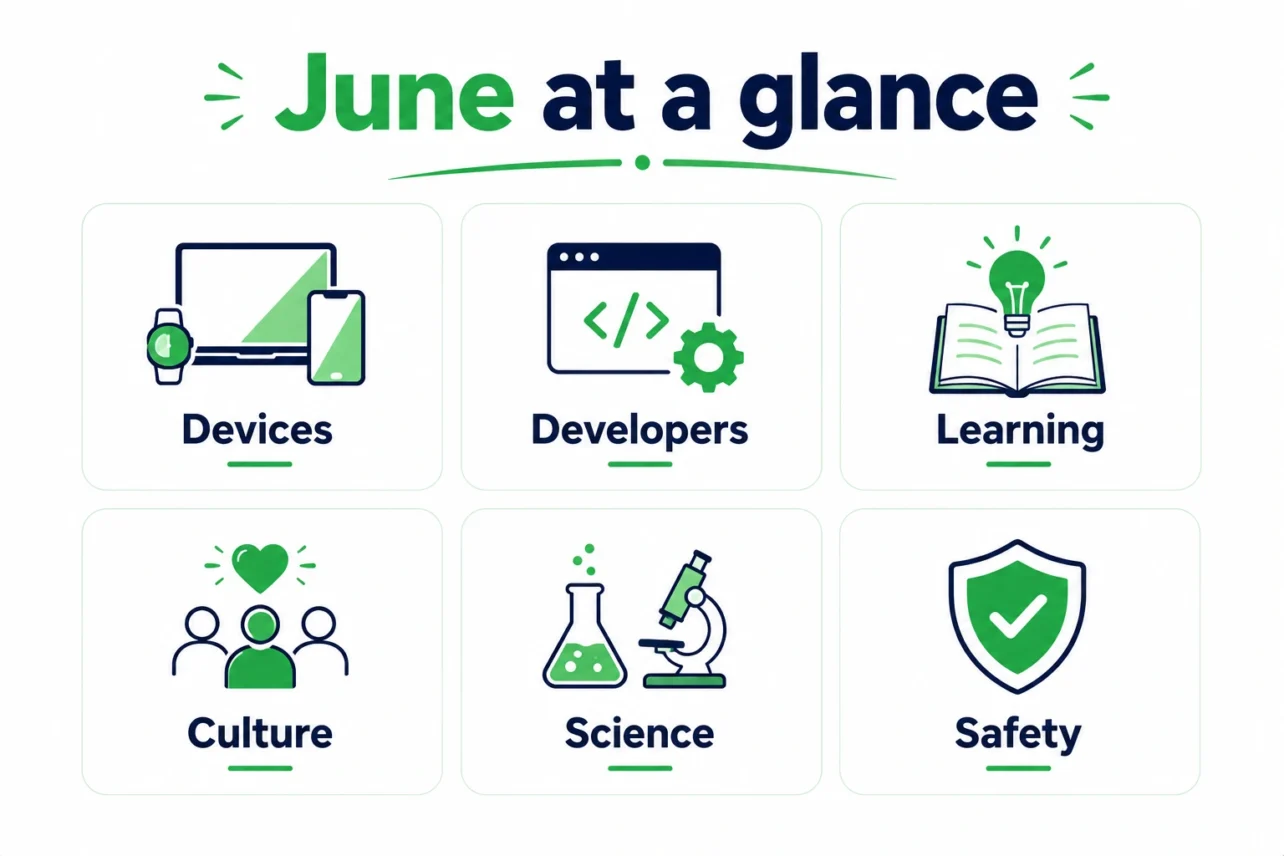
What the Google AI Updates June 2026 Mean for Developers
June was a strong month for the people who build with AI. The new models run locally, act on your behalf, and generate media faster and cheaper.
Gemma 4 12B. Google’s latest open model brings capable AI agents directly to your laptop. It runs locally on just 16GB of memory, pairing a new unified architecture with vision and native voice processing in one system. The result is advanced reasoning and private workflows on everyday hardware, without giving up speed. Google shared the details when it introduced Gemma 4 12B.
Computer use in Gemini 3.5 Flash. Google added computer use to Gemini 3.5 Flash, letting developers build custom agents that can see, reason, and act across desktop, mobile, and browser environments. It improves performance on long-horizon and enterprise automation work, such as continuous software testing and knowledge tasks.
Nano Banana 2 Lite and Gemini Omni Flash. Two model updates landed together. Nano Banana 2 Lite is now Google’s fastest and most cost-efficient Gemini Image model, while Gemini Omni Flash arrived in APIs in public preview as a natively multimodal model for building custom, dynamic video workflows. Our deeper look at Nano Banana 2 Lite and Gemini Omni Flash walks through what each one does.
AI That Helps You Learn
Google leaned hard into education this month, with tools aimed at both students and teachers.
A bigger NotebookLM. NotebookLM gained advanced reasoning, a secure cloud computer for running code, and the ability to generate charts, spreadsheets, and slide decks. It now helps you turn loose ideas and web sources into a structured research repository, and it is available globally for Google AI Ultra subscribers and specific Workspace accounts.
Study notebooks in the Gemini app. Set a goal, upload your class notes, and take a baseline quiz, and Gemini pinpoints exactly where you need help. It then builds lessons tailored to how you learn and tracks your progress on a custom dashboard.
Connected tools for the classroom. Google rolled out updates across Google Classroom, Chromebooks, and Gemini. Teachers can securely use real class context to streamline daily tasks and guide curriculum-backed activities, while students get adaptive study notebooks and free standardized test prep.
A real-world study in Sierra Leone. Google DeepMind released a study measuring how AI affects learning outcomes in Sierra Leone, where teachers are in short supply. To help others build on the results, it also published a free teacher training guide and a research playbook.
AI for Culture and Creativity
Two projects showed how the same technology can serve history and art.
Colonial Williamsburg, brought online. For the country’s 250th birthday, Google Arts & Culture teamed up with Colonial Williamsburg on a digital collection that lets you explore 18th-century streets and artifacts. A custom NotebookLM, loaded with more than 150 primary sources, lets you chat directly with the archives to see how early Americans imagined their new democracy.
Dataland, the first AI arts museum. Google worked with media artist Refik Anadol to open Dataland, described as the world’s first museum dedicated entirely to AI arts. Powered by Google Cloud and Gemini, it treats neural networks as an artistic medium, turning billions of data points into shifting, sensory landscapes.
AI for Science and Society
The month’s heaviest work aimed at research, public services, and safety.
Research and Public Services
Co-Scientist in the lab. Co-Scientist, built for structured scientific thinking, helps life science researchers develop and refine hypotheses. Google shared how global teams are already using it on major challenges like infectious diseases, cellular aging, and ALS.
Faster public services in the UK. A Gemini-powered planning prototype, built with Google DeepMind, Faculty, and the UK government, shows how AI can clear administrative backlogs. By automating hours of manual data extraction and policy cross-referencing, the experiment aims to cut the processing of household planning applications by half.
Safety and Climate Resilience
A lawsuit against AI scams. Google filed a civil lawsuit against an organized cybercrime operation it calls the “Outsider Enterprise.” Based in China and coordinating through Telegram, the network sells phishing kits used to send fake text campaigns that imitate Google and other trusted brands. Google is also backing seven bipartisan bills to fight scams, including those made with AI.
Earlier warnings for extreme weather. At the AI for the Planet event, Google shared how a decade of research now helps predict river floods seven days in advance, track wildfire boundaries by satellite, and forecast cyclone paths with high confidence. These real-time alerts already reach people through Search and Maps.
AI in the Workplace
Proof that AI skills pay off. Working with the research agency Public First, Google published one of the most comprehensive UK AI adoption studies yet. Workplace AI adoption more than doubled in a year, reaching 73 percent, up from 34 percent in 2025. The study also found the top 15 percent of UK AI users are fast-tracking their careers, reporting more promotions and pay rises.
| Worth Knowing That adoption jump, from 34 percent to 73 percent in a single year, is the number to watch. It suggests AI at work has crossed from early experiment to everyday habit faster than most forecasts expected. |
What June’s Updates Signal
Step back from the individual launches and three clear directions stand out. First, AI is moving on-device. Gemma 4 12B runs on a laptop, and Android 17 pushes more intelligence onto the phone itself. That means faster responses and more privacy.
Second, AI is becoming agentic. Computer use in Gemini 3.5 Flash, Co-Scientist, and the UK planning prototype all point in one direction. This is software that does not just answer questions but takes real steps to finish a task. Third, it is getting more natural and multimodal. Live Translate, the Google Home Speaker, and Gemini Omni Flash all trade rigid commands for fluid conversation across voice, text, and video.
Put together, June looks less like a set of features and more like a direction of travel. If you want the wider context on how Google is reshaping search around this shift, our guide to Google AI Mode explains where everyday search is heading.
June 2026 was the month Google’s AI stopped feeling like a destination you visit. Instead, it started feeling like a layer running quietly across your devices. On-device models, agents that act, and assistants that actually converse are no longer previews. They are shipping.
The smart move now is simple: try the updates that fit your life. That might be Live Translate for travel, study notebooks for class, or Gemma 4 12B for building. The tools are here, and they are only getting more capable.
Frequently Asked Questions
What are the biggest Google AI updates from June 2026?
The headline launches were Gemini 3.5 Live Translate for real-time speech translation and Android 17 with new multitasking and security features. Google also unveiled the Google Home Speaker built for Gemini and the Gemma 4 12B open model that runs locally on a laptop. On top of that, it upgraded NotebookLM and the Gemini app for learning.
What is Gemini 3.5 Live Translate?
Gemini 3.5 Live Translate is a Google audio model for live speech-to-speech translation. It automatically detects more than 70 languages, preserves the speaker’s natural intonation, and removes awkward pauses for near-real-time multilingual conversations. The model is rolling out in the Gemini Live API, Google AI Studio, and the Google Translate app.
What is Gemma 4 12B?
Gemma 4 12B is Google’s latest open AI model, designed to run locally on everyday hardware using just 16GB of memory. It combines a unified architecture with vision and native voice processing. That brings capable AI agents and private workflows directly to your laptop.
When is Android 17 rolling out?
Android 17 rolls out first to Pixel devices, followed by other eligible Android devices throughout 2026. It adds floating app windows, Screen Reactions for picture-in-picture recording, and a foldable gaming layout. It also lets you lock a missing phone using your biometrics.
What can the new NotebookLM do?
The upgraded NotebookLM adds advanced reasoning, a secure cloud computer for running code, and the ability to generate charts, spreadsheets, and slide decks. It helps organize ideas and web sources into a structured research repository. It is available globally for Google AI Ultra subscribers and specific Workspace accounts.
What is the Google Home Speaker built for Gemini?
The Google Home Speaker is Google’s new smart speaker powered by Gemini. It understands natural, conversational requests instead of rigid commands. Beyond that, it can handle multiple requests at once, answer complex questions, and remember the context of what you just asked.

