
If you have opened the Google Play Store recently, you might have noticed it looks a little different. That is just the beginning. The Google Play Store changes rolling out in 2026 are the biggest shake-up the app store has seen in years. They range from a fresh redesign to a court-ordered opening on July 22. Together, these updates change how the store looks, how much developers pay, and how much choice you have as a user. Here is a clear, simple breakdown of everything that is changing, and what it actually means for you.
| Key Changes at a Glance Here are the three big shifts in a nutshell. First, the Play Store has a new look, with redesigned Games and Apps tabs. Second, and most importantly, a court order takes effect on July 22, 2026, forcing Google to share its app catalog with rival Android stores in the US. Third, the old flat 30 percent commission is gone, replaced by lower, tiered fees. The result is a more open Android world, with more app store choices than ever, while your downloads stay just as secure. |
A Fresh New Look for the Play Store
Let us start with what you can see. Google is rolling out a redesign of the Play Store, focused on the Games and Apps tabs. The tabs at the top now sit in rounded, pill-shaped buttons, and the old For You tab has been folded into the main home page. Tapping Top Charts or Categories now opens a separate screen, so you use a back arrow to return home. Google has also tweaked its Play Points rewards, dropping the blue badge that used to sit at the top. The Books tab, for now, keeps its familiar older design. As Android Authority spotted, it is a modest refresh, but you will likely notice it the next time you go looking for an app.
The Big Change: Google Play Opens Up on July 22
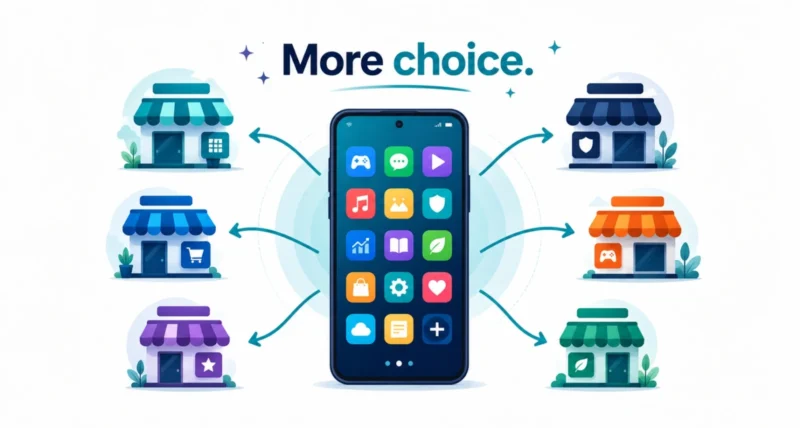
The real headline is not the new paint job, it is a court order. Starting July 22, 2026, Google must let rival US Android stores display listings from the Play Store. A new system, the Play Catalog Access program, makes it happen. In plain terms, a competing store can now show you an app’s full Play Store page: its name, icon, screenshots, and description. It can even let you start the download from there.
This matters because it removes the single biggest barrier that kept other app stores tiny. Before, a rival store had almost no apps, so no one used it, so developers ignored it. Now those stores can offer the same huge catalog you already know. Importantly, the actual download still runs through Google Play, complete with Play Protect security scanning, so apps installed this way stay just as safe as before. As Tech Times reports, this whole shift comes from a six-year antitrust battle, Epic versus Google, which Epic won. A 2023 jury found Google had broken antitrust law, and a 2026 settlement locked in these changes worldwide through 2032.
The End of the Flat 30% Commission
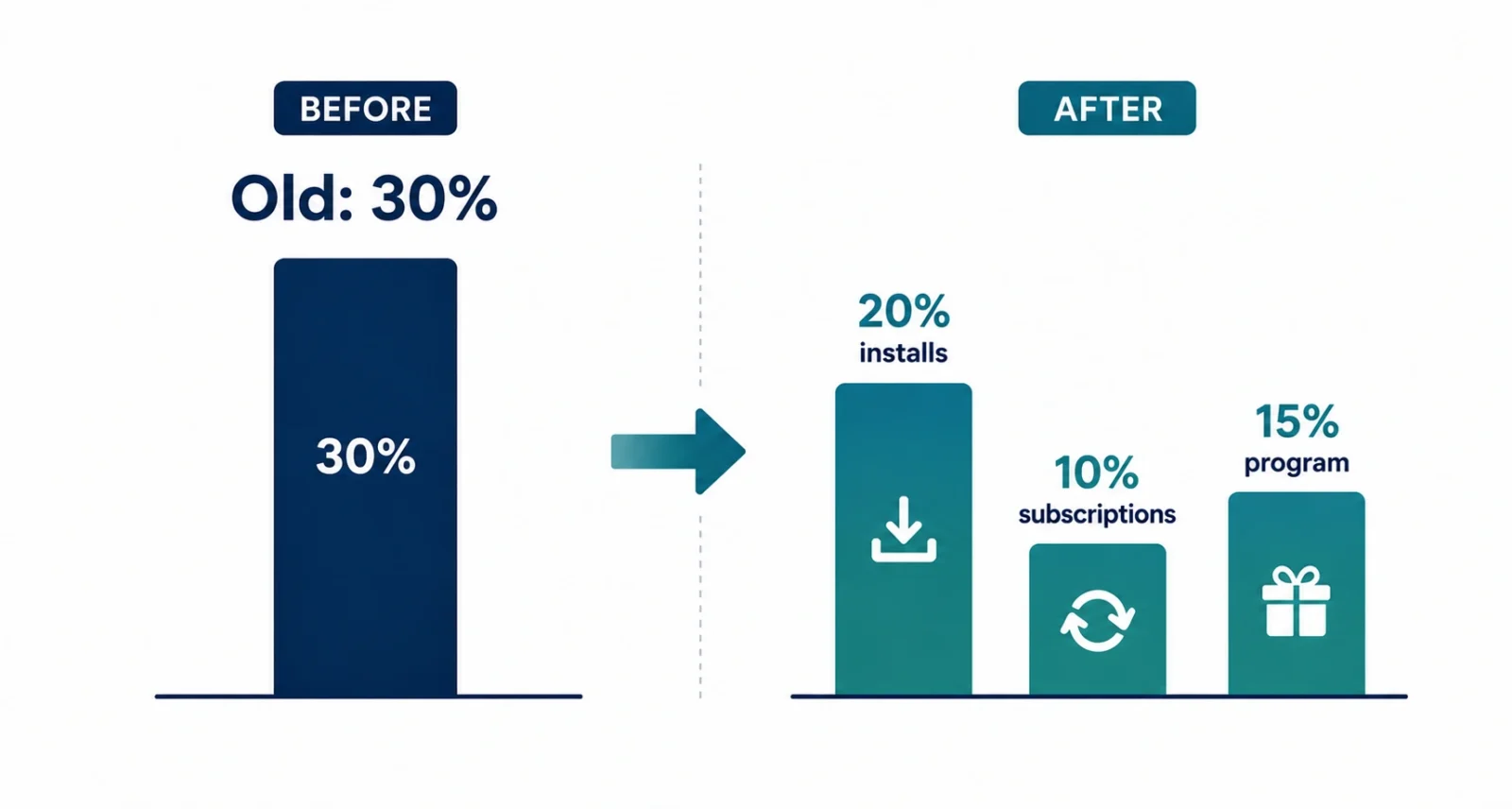
For app makers, another change is just as big: the money. For years, Google, like Apple, took a flat 30 percent cut of app and in-app sales, a rate that shaped the entire industry. That era is over. Under the new rules confirmed on the Android Developers Blog, Google’s fees are lower and tiered, as shown below.
| Transaction Type | Old Commission | New Commission (2026) |
| New app installs | 30% | 20% |
| Subscriptions | Up to 30% | 10% |
| Google Play billing | Included | 5% (optional) |
| Apps Experience Program | Not available | 15% |
The upshot is that most developers now keep more of what they earn, especially those who rely on subscriptions. For a small studio or a solo developer, that difference can be substantial.
What Developers Should Do Before July 22
If you publish an app on Google Play, July 22 comes with a decision. If you do nothing, Google will automatically start sharing your app’s listing with all enrolled third-party stores. You can change your choice at any time in the Play Console under Catalog Settings. Here are your three options.
- Share with every store. Your listing can appear in all enrolled third-party stores. This is the simplest path, and your fees do not change.
- Manage stores one by one. After July 22, you can review the list of enrolled stores and decide app by app, or store by store, for full control.
- Opt out completely. No third-party store receives your listing. This suits enterprise or internal apps, or apps with age ratings and content rules that need extra care.
One key point: rival stores follow their own content policies, not Google’s. If your app has age ratings or sensitive content, it is worth checking that any store showing it applies similar safeguards.
What the Google Play Store Changes Mean for You
So what does all this mean if you just want to download apps? In short, more choice and more competition, which is usually good news. As rival stores gain access to the full app catalog, they will compete on price, privacy, and perks. That could mean cheaper apps or better deals over time. You are not required to change anything, since the Play Store works exactly as before. But for the first time in years, real alternatives are becoming genuinely useful. And July 22 is shaping up to be a landmark day for Android in general, since it is also the date of Samsung’s big Galaxy Unpacked event.
Meet the Alternative App Stores
If the idea of more choice appeals to you, here are some app stores worth knowing. Some are official rivals, while others are open-source options popular with privacy-minded users. One favorite in that camp is Aurora Store, an open-source app. It lets you browse and install the same Play Store apps without signing in to a Google account. Its standout feature is transparency, since it shows you which hidden trackers an app contains before you install it, something the Play Store does not do. Here is a quick look at the main options, as covered by MakeUseOf.
| App Store | What It Offers |
| Aurora Store | An open-source Play Store client; no Google account needed, and it shows app trackers |
| F-Droid | A catalog of free, open-source apps with a strong privacy focus |
| Samsung Galaxy Store | Preinstalled on Samsung phones, with apps, games, and exclusives |
| Amazon Appstore | Amazon’s app store, with deals and Amazon Coins |
| Epic Games Store | Home to Fortnite and other games, now expanding on Android |
A quick safety note: stores like Aurora Store and F-Droid are not on the Play Store. You install them yourself by downloading their file directly, a process called sideloading. Stick to official websites to stay safe, and avoid random app files from unknown sources.
Should You Switch or Stick With the Play Store?
Here is the honest take. For most people, the Google Play Store remains the easiest and most reliable choice, and there is no need to leave it. It is fast, secure, and built into your phone. Alternative stores shine if you care about privacy, want apps not offered on the Play Store, or simply like having options. The good news is that it is not either-or. You can keep the Play Store and add an alternative alongside it, then see what fits your needs. With the changes rolling out in 2026, you finally have that freedom.
The Google Play Store changes of 2026 mark a real turning point. A fresh design, a court-ordered opening to rival stores, the end of the 30 percent commission, and a growing lineup of alternatives together signal a more open Android. Whether you are a developer weighing your options or a user exploring your choices, the takeaway is the same. You have more control than ever before.
Technology keeps moving fast, from app stores to the AI tools we covered in our guide to Copilot, and this is one shift worth watching closely.
Frequently Asked Questions
What are the Google Play Store changes in 2026?
There are three main changes. First, a redesign of the Games and Apps tabs. Second, a court-ordered program that lets rival stores show Play Store listings from July 22, 2026. Third, a new fee structure that ends the flat 30 percent commission. Together they make Android more open.
What is the Play Catalog Access program?
It is a system that lets enrolled third-party Android stores in the US display an app’s full Play Store listing and let users start a download. The download still completes through Google Play, with the same security scanning, so it is safer than traditional sideloading.
Is the 30% Play Store fee gone?
Yes. The flat 30 percent commission is gone. In its place are tiered fees: 20 percent on new installs, 10 percent on subscriptions, and an optional 5 percent billing fee. A special program can lower the service fee to 15 percent for qualifying developers.
What happens on July 22, 2026?
Google’s Play Catalog Access program goes live. Developers who have not chosen a preference in the Play Console are automatically opted in, meaning their listings can appear in enrolled third-party stores. The choice can be changed at any time.
Are third-party Android app stores safe?
It depends on the store. Stores enrolled in Google’s catalog program must meet strict malware standards, and downloads still pass through Play’s security checks. Open-source stores like Aurora Store are generally trusted, but only install app stores from their official websites.
What is Aurora Store?
Aurora Store is a free, open-source app that works like the Play Store but without requiring a Google account. It connects to the same app catalog and adds privacy features, including a list of the trackers inside each app before you install it.

