
You probably say it 100 times a day. It shows up in your texts, your emails, and almost every casual conversation. Sometimes it is a question (‘OK?’). Sometimes an answer (‘OK.’). Other times it is a quiet complaint (‘It was just OK’) or a casual confirmation (‘OK, sounds good’) Linguists believe it is the most commonly spoken word on the planet, recognised in nearly every language on Earth. And almost nobody knows where it came from.
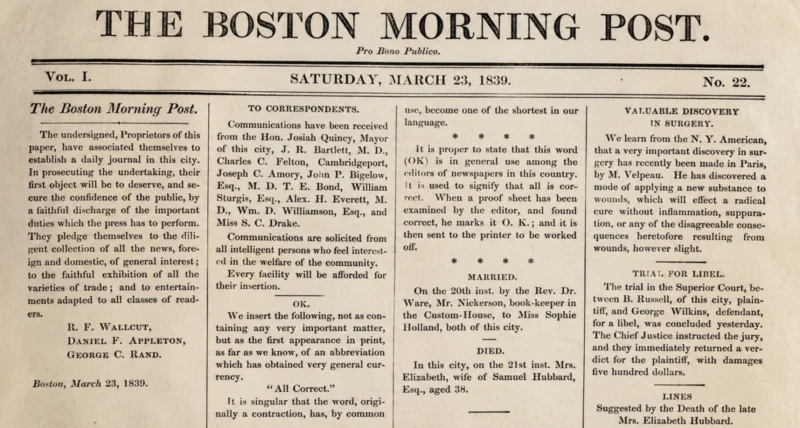
Here is the strange truth. OK was born on March 23, 1839 in a Boston newspaper, as a deliberately bad joke by an editor named Charles Gordon Greene. He was making fun of a rival paper, and he wrote “o.k.” as a tongue-in-cheek abbreviation for “oll korrect,” itself a humorously misspelled version of “all correct.” The joke was supposed to last about a week. It is still alive 187 years later.
Below is the full story, including how a one-off newsroom joke survived where dozens of similar abbreviations died, why a US presidential election in 1840 saved it from extinction, and why “OK” might literally have been the first word ever spoken on the surface of the moon.
1. The Short Answer: Where Did ‘OK’ Come From?
OK was first published on March 23, 1839 in the Boston Morning Post, in a satirical article written by the paper’s editor Charles Gordon Greene. It was an intentional joke abbreviation for “oll korrect,” which was itself a deliberately misspelled version of “all correct.”
That is the academically accepted origin, established by Columbia University linguist Allen Walker Read in a series of six papers published in the journal American Speech between 1963 and 1964. Read systematically disproved every competing theory (and there were many) and traced OK back to that one newspaper joke.
The story is so well documented that Merriam-Webster, Smithsonian Magazine, NPR, and pretty much every reputable etymology source treat it as settled. The 2010 book OK: The Improbable Story of America’s Greatest Word by linguist Allan Metcalf is the definitive popular treatment.
2. The 1839 Boston Newspaper Joke That Started It All
Picture Boston in March 1839. Andrew Jackson’s presidency had ended two years earlier. The country was in a financial panic. Newspapers were the social media of the day, and editors loved to take shots at each other in print.
Charles Gordon Greene, editor of the Boston Morning Post, was writing a satirical piece poking fun at the Providence Journal in Rhode Island. The joke involved a fictional suggestion that the Providence paper sponsor a party for some “boisterous Boston lads” passing through their town. At the end of a throwaway paragraph, Greene tossed in an abbreviation: o.k., and helpfully added (all correct) in parentheses so readers would understand the joke.
The joke worked on two levels. First, “o.k.” abbreviated “oll korrect,” and the humour was that NEITHER letter was correct. Second, it played into a wider abbreviation craze sweeping Boston newspapers at the time. Greene’s readers would have recognised it immediately as belonging to that fad.
Fun fact: The original 1839 article reappeared in print just three days later, on March 26, with Greene using OK again. Within months it had spread to other Boston papers, and by July 1839 it was showing up in The Baltimore Sun. By 1840 it had crossed the Atlantic.
3. The Forgotten Abbreviation Craze of 1838 and 1839
OK was not the only joke abbreviation flying around Boston newsrooms in the late 1830s. It was just the one that survived. To understand why OK existing in the first place is not weird, here are some of its long-dead cousins.
| Abbreviation | What it stood for (misspelled) | What it meant (correct) |
| O.K. | Oll Korrect | All correct |
| O.W. | Oll Wright | All right |
| K.G. | Know Go | No go |
| K.Y. | Know Yuse | No use |
| S.P. | Small Potatoes | Insignificant |
| N.S. | Nuff Said | Enough said |
| O.F.M. | Our First Men | The elites |
| A.R. | All Right | All right (this one is just regular) |
This is essentially the 1830s version of LOL, IMO, TBH, NGL, and FWIW. The History.com analysis calls it “the 1800s version of texting slang,” and that is exactly right. Young, educated elites in Boston used these abbreviations to signal cleverness and in-group status. The joke was that smart people were pretending to be dumb.
Every one of those abbreviations died within a couple of years. Except OK.
4. Why OK Survived: The Martin Van Buren Connection
The reason OK is the world’s most used word is not because the original joke was funnier than “oll wright” or “know yuse.” It is because, by sheer coincidence, OK happened to fit the nickname of Martin Van Buren, the 8th President of the United States.
Van Buren was running for re-election in 1840. He had been born in the village of Kinderhook, New York, and his supporters called him Old Kinderhook. When his Democratic supporters formed a political club in New York City to organise his campaign, they named it the O.K. Club. The double meaning was perfect: OK stood for Old Kinderhook, AND it tied into the popular Boston abbreviation that meant “all correct.”
Suddenly OK was a campaign slogan. It was printed on posters, banners, and pamphlets. Even though Van Buren lost the 1840 election to William Henry Harrison, the O.K. Club brand had pushed the abbreviation into national consciousness. By the time the election was over, OK had escaped the Boston in-joke and become genuinely American slang. See our coverage of the broader US semiquincentennial in 2026 for context on how this 1840 moment fits into the larger arc of American history.
Important to note: The Whigs (the opposing party in 1840) tried to use OK against Van Buren by claiming his mentor Andrew Jackson had invented it as a way to hide his own bad spelling. Supposedly Jackson wrote “OK” on documents thinking it stood for “all correct” but really because he could not spell. This was almost certainly political slander, but it spread the abbreviation even further.
5. The Other Origin Theories (and Why They’re All Wrong)
Before Allen Walker Read solved the mystery in the 1960s, dozens of competing theories floated around. Some are still cited today, despite being demonstrably false. Here are the main ones, and why none of them holds up.
The Choctaw ‘Okeh’ Theory
This claim suggests OK comes from the Choctaw word “okeh,” used as an affirmative response. President Woodrow Wilson famously believed this and even signed documents with “okeh.” Problem: there is no documented path from the Choctaw word into English-speaking newspapers in 1839, and Read found no chain of usage connecting them.
The Andrew Jackson Misspelling Theory
The political slander from the 1840 campaign. Claim: Jackson wrote OK on documents because he could not spell “all correct.” Problem: no document Jackson actually signed has been verified with this notation, and the timing does not work.
The Civil War Biscuit Theory
Claim: OK came from Orrin Kendall biscuits supplied to Union soldiers during the Civil War. Problem: the Civil War started in 1861. OK was already in print 22 years earlier.
The Old Keokuk Theory
Claim: named after the Sauk chief Old Keokuk who signed treaties with “OK.” Problem: again, no documentary evidence, and the timing does not match the 1839 print appearance.
Why Read’s Theory Won
Allen Walker Read’s 1963 to 1964 papers in American Speech did something the other theories could not. He produced actual newspaper evidence of OK appearing in the Boston Morning Post on March 23, 1839, alongside dozens of other joke abbreviations from the same period, in the same papers, written by the same editors. He demonstrated the cultural craze in which OK was born, and traced its spread step by step through the 1840s. Nobody has produced equally good evidence for any other origin since.
6. How OK Conquered the World
After surviving the 1840 election, OK kept spreading. A few key milestones in its global takeover.
The Telegraph (1844 Onwards)
When Samuel Morse opened the first telegraph line in 1844, OK became telegraph slang for “message received, all clear.” Telegraph operators across the US, and eventually the world, used it as standard shorthand. This was the moment OK escaped American English and started becoming international.
Railroads, Business, and Bureaucracy
By the late 1800s, OK was being scribbled on shipping manifests, invoices, work orders, and approval forms across the US. “O.K.’d” became a verb meaning “approved.” By the 20th century it was the default approval annotation across English-speaking business culture.
Hollywood and Global English
American films exported OK to every market they entered. By the 1950s, OK was understood without translation in Russian, Japanese, Hindi, Arabic, Mandarin, French, German, Spanish, Portuguese, and dozens of other languages. Allan Metcalf’s research suggests OK is now recognised in essentially every living language on Earth.
The Moon (Maybe)
Here is a fact that is contested but worth knowing. According to NASA spokesman Joshua Buck and Allan Metcalf’s research, the first word actually spoken on the surface of the moon was “OK.” The chronology, per Apollo 11 transcripts: Buzz Aldrin said “Contact light” the moment the lunar module’s probes touched the surface (technically before “landing”), then said “OK, engine stop” seconds later. Only after that did Neil Armstrong say the famous “Houston, Tranquility Base here. The Eagle has landed.” NASA’s official position credits “Houston” as the first word on the moon, but several historians and NASA staff have argued Aldrin’s “OK” came first. Either way, OK was certainly among the first three or four words spoken on another world.
7. What Does ‘OK’ Officially Stand For?
Strictly speaking? Nothing meaningful anymore. OK started as an abbreviation for a joke misspelling, but it has been a freestanding word for over 180 years. Most modern dictionaries treat it as a standalone interjection, adjective, noun, and verb, with no specific expansion.
The most accurate historical answer: OK originally stood for “oll korrect,” a deliberately misspelled version of “all correct.” But in normal modern usage, OK does not stand for anything. It is just OK.
Both “OK” and “okay” are accepted spellings in major dictionaries (Merriam-Webster, Oxford, Cambridge). “OK” is older. “Okay” appeared later as a phonetic spelling and is now slightly more common in formal writing. Both are correct.
8. OK in 2026: Still the World’s Most Used Word
Almost two centuries after Charles Gordon Greene’s throwaway joke, OK is still the most commonly used word on the planet. Linguist Allan Metcalf calls it “the English language’s most successful export.” Some additional context for 2026:
- OK and its variants (okay, k, kk, okk, okies) appear in text messages and instant messages billions of times per day globally.
- AI assistants like Claude, ChatGPT, and Gemini use OK as a standard confirmation token in their responses.
- The OK hand gesture (thumb and forefinger forming a circle) is a separate symbol with its own complicated history, and is not directly connected to the spoken word OK.
- “OK boomer” became a meme in 2019 and is still in casual use, layering a new generational meaning onto a 187-year-old word.
The takeaway: The most successful word in the history of human language was a half-baked joke buried in a paragraph in a 19th-century Boston newspaper. It survived because of a presidential nickname coincidence. The history of language is full of accidents like this, and OK is the most famous one.
Frequently Asked Questions
Who invented the word OK?
Charles Gordon Greene, the editor of the Boston Morning Post, first published the abbreviation OK on March 23, 1839, as an intentional joke meaning “oll korrect” (a misspelling of “all correct”). Allen Walker Read, a Columbia University linguist, established this origin in academic papers published 1963-1964.
What does OK stand for?
Historically, OK stood for “oll korrect,” a humorously misspelled version of “all correct.” In modern usage, OK does not stand for anything specific. It is treated as a standalone word meaning approval, acceptance, or acknowledgment.
When was OK first used?
OK first appeared in print on March 23, 1839, in the Boston Morning Post. The article was written by editor Charles Gordon Greene as a satirical jab at the Providence Journal newspaper in Rhode Island.
Why did Martin Van Buren use OK?
Martin Van Buren’s 1840 re-election campaign adopted OK because it conveniently matched his nickname Old Kinderhook (he was born in Kinderhook, New York). His supporters formed the O.K. Club in New York City, and the abbreviation became a campaign slogan. Although Van Buren lost the election, the campaign pushed OK into national vocabulary.
Is OK really the most spoken word in the world?
According to linguist Allan Metcalf and most language researchers, yes. OK is the most commonly spoken or typed word globally, recognised in essentially every living language. It crosses language barriers more thoroughly than any other English word.
Was OK the first word spoken on the moon?
It is contested. Buzz Aldrin said “OK, engine stop” seconds after the lunar module touched down on July 20, 1969, before Neil Armstrong’s famous “Houston, Tranquility Base here. The Eagle has landed.” NASA officially credits “Houston” as the first word on the moon, but a NASA spokesman and several historians have argued Aldrin’s “OK” technically came first.
What is the difference between OK and okay?
Both are correct and accepted by major dictionaries. OK is the original (1839) spelling. Okay appeared later as a phonetic version. They mean the same thing. In formal writing, “okay” is slightly more common in 2026. In casual texting and messaging, “OK” or just “k” dominate.
Why did OK survive when other 1830s abbreviations like KG and KY didn’t?
Pure historical accident. OK happened to match Martin Van Buren’s Old Kinderhook nickname during the 1840 presidential campaign, which gave it sustained national exposure right at the moment the original joke would have died out. Then the telegraph adopted it. By the time those events ran their course, OK had escaped its original joke context and become a genuinely useful word.
If you enjoyed this, you may also like our piece on the US semiquincentennial in 2026 and our guide to Google AI Mode in 2026.

