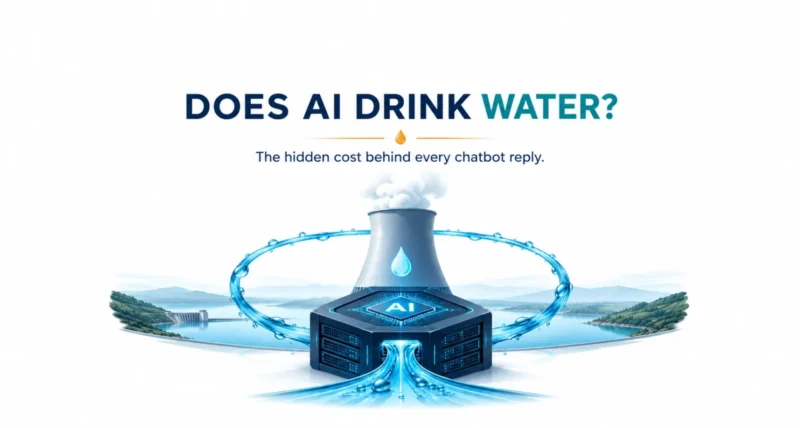
Every time you ask a chatbot to write an email or answer a question, something surprising happens far away: a little water gets used up. It sounds strange, software does not drink, after all, but AI really does have a water footprint. So how does AI use water, and is it something to worry about? As researchers at UC Riverside have shown, the answer is real but widely misunderstood. This guide explains it in plain language, with the latest numbers, honest context, and what is being done about it.
| The Short Version AI uses water mainly to cool the data centers that run it, and to generate the electricity those data centers need. A single chatbot question uses only a tiny amount, somewhere between a few drops and a couple of tablespoons, depending on where and how it runs. The real concern is not your one query, but the massive, fast-growing scale of AI worldwide, and the fact that it often draws clean freshwater in places already short of it. |
How Does AI Use Water? The Simple Explanation
Let us clear up the biggest confusion first. The water does not flow inside your phone or laptop. It flows in giant buildings called data centers, the warehouses full of powerful computers that actually run AI. There are three main ways AI ends up using water.
First, Cooling the Computers
This is the big one. The chips that run AI, especially the powerful processors called GPUs, get extremely hot when they work. A single high-end AI chip can give off as much heat as a small space heater. Pack thousands of them into one building, and you have a serious heat problem.
To stop everything from overheating, many data centers use water for cooling. Often this works by evaporation. The system sprays water or passes it through cooling towers, and as it evaporates it carries the heat away, just like sweating cools your body. The catch is that the evaporated water does not come back. It is gone into the air.

Second, Making the Electricity
Here is the part most people miss. Data centers use enormous amounts of electricity, and making electricity often uses water too. Many power plants boil water to spin turbines or use water to cool their own equipment, and a lot of that water evaporates. So even a data center that uses very little water on-site is still indirectly responsible for the water used back at the power plant.
| Worth Knowing Experts split AI’s water use into two buckets: on-site water (used directly for cooling at the data center) and off-site water (used to generate the electricity). When you see a scary-sounding water number, it often includes both, which is why estimates vary so wildly. |
Third, Building the Chips
There is a third, quieter source. Making the computer chips themselves takes water, a lot of it. Chip factories use ultra-pure water to rinse the delicate silicon during manufacturing. This happens once, before the chip ever runs a single task, but it adds to AI’s overall water story.
How Much Water Does One AI Question Actually Use?
This is the question everyone asks, and the honest answer is: it depends, and the popular numbers are often misunderstood. Let us look at the real figures side by side.
| The Claim | The Number | The Source |
| Google’s Gemini (median text prompt) | about 0.26 ml | Google, 2025 (roughly 5 drops) |
| OpenAI’s ChatGPT (average query) | about 0.3 ml | Sam Altman, 2025 (a company claim) |
| The famous bottle figure | about 500 ml | UC Riverside, 2023 |
| Heads Up: The 500 ml Myth You have probably seen the headline that ChatGPT drinks a bottle of water per question. That is a misread. The UC Riverside study found about 500 ml for a whole session of 10 to 50 questions, not a single one, and that figure includes the water used to make the electricity. Per single question, the study works out to roughly 10 to 25 ml, and newer company figures are far lower. |
So why the huge gap between 0.26 ml and 500 ml? Three reasons: what gets counted (cooling only, or electricity too), where the data center is (a hot, dry region uses more), and how big the model is. The takeaway for you: one question uses a genuinely tiny amount of water. The story is about scale, which we get to next.

The Real Issue: Scale, Not Your Single Query
If one question uses just a few drops, why is anyone worried? Because there are billions of questions, plus the gigantic, one-time cost of training AI models. Small drops add up to oceans when you multiply them across the whole planet.
Training a Model Is the Thirsty Part
Before an AI can answer anything, it has to learn, a process that runs thousands of chips non-stop for weeks. The UC Riverside team estimated that training GPT-3 alone evaporated around 700,000 liters of clean freshwater. That is roughly what 370 people use in a day, for a single training run, and today’s models are far bigger.
The Aggregate Numbers Are Huge
Add up all the data centers, and the totals get serious. Here is the big-picture water use behind the AI boom.
| 8.1B | gallons of water Google consumed in 2024, about 95% of it at data centers |
| +34% | jump in Microsoft’s water use in a single recent year, tied to AI growth |
| 17.4B | gallons used directly by US data centers in 2023, plus 211 billion more for their electricity |
| 4.2-6.6B | cubic meters of water AI worldwide may withdraw per year by 2027 |
To put that last one in perspective, researchers note AI’s projected 2027 water withdrawal is more than the entire yearly water use of a country like Denmark, or about half of the United Kingdom’s. That figure comes from the Making AI Less Thirsty research paper.
| Why It Matters The problem is not the total so much as where it lands. AI’s water use is small next to farming, but it is highly concentrated. A single data center can strain one town’s water supply, and many are built in hot, dry regions where every drop of freshwater already counts. |
What About AI’s Energy Use?
Water and electricity are joined at the hip, so AI’s energy use is the other half of the story. And the growth here is staggering.
According to the International Energy Agency, the world’s data centers used about 415 terawatt-hours of electricity in 2024, roughly 1.5% of all the electricity on Earth. That is already a lot. The bigger news is where it is heading.
| 2x | Data center electricity use is set to roughly double to about 945 TWh by 2030, near Japan’s entire usage |
| 4.4% | of all US electricity went to data centers in 2023, possibly 6.7% to 12% by 2028 |
More electricity usually means more water (to generate it) and more carbon (if it comes from fossil fuels). Researchers estimate that training one large model produces hundreds of tons of carbon dioxide. So energy, water, and carbon are really three views of the same footprint.
Is AI Bad for the Environment? An Honest Look
Here is where many articles get one-sided. The fair answer is: AI has a real and growing footprint, but it needs honest context, not panic. A few balancing truths:
- Your personal use is a drop in the ocean: a few dozen AI questions a day barely register next to a single long shower, load of laundry, or hamburger.
- AI is still small overall: even by 2030, data centers are projected to be under 3% of global electricity. Farming uses vastly more water.
- But it is growing fast and concentrated: the speed and the local impact are the genuine concerns, not the global average.
- AI can also help the planet: it is used to make power grids smarter, improve climate models, and cut waste in other industries.
| The Big Picture The most useful way to think about it: do not feel guilty about asking a chatbot a question. Do care about how and where the giant infrastructure behind it is built, because those choices, made now, lock in water and energy use for decades. |
What’s Being Done to Fix It
The good news is that the industry has plenty of room to improve, and a lot of work is underway. Here are the main solutions.
| The Solution | How It Helps |
| Better cooling | Liquid and immersion cooling pipe coolant straight to the chips, using far less water than evaporation |
| Recycled water | Using reclaimed or non-potable water, or seawater, instead of drinking water |
| Smart location | Building data centers in cooler climates, and reusing their waste heat for nearby buildings |
| Water-aware computing | Scheduling heavy AI work for times and places where water and clean power are plentiful |
| Efficient models | Smaller, smarter models and faster chips that do the same work for less energy and water |
Big AI companies have also pledged to become water positive by 2030, meaning they aim to replenish more water than they use. It is a promising goal, though critics rightly point out that returning water in one region does not help a different town whose local supply is being drained. Transparency and local accountability are the parts still catching up.
What Can You Actually Do?
If you want to use AI more responsibly without giving it up, here are realistic, no-guilt steps:
- Use AI deliberately: batch your questions into one good prompt rather than dozens of tiny ones.
- Pick the right tool: you do not need the biggest, most powerful model to write a grocery list.
- Push for transparency: support companies that openly report their water and energy use and invest in cleaner cooling.
- Keep perspective: the biggest wins come from better infrastructure and policy, not from feeling bad about a single chat.
So, does AI use a lot of water? Per question, no, it is a few drops, and you should not lose sleep over a chat. But added up across billions of queries and the huge cost of training, AI’s thirst is real, growing fast, and often concentrated in places that can least afford it. Its energy and carbon footprint follow the same pattern. Encouragingly, smarter cooling, cleaner power, and honest reporting can shrink that footprint a lot. In the end, how AI uses water is really a story about choices, where we build, how we cool, and how openly companies measure it. For the deep research behind these numbers, see the IEA’s Energy and AI report.
Frequently Asked Questions
How Does AI Use Water
AI uses water in three main ways: to cool the hot computer chips inside data centers (often by evaporation), to generate the large amount of electricity those data centers need (power plants use water), and to manufacture the chips in the first place. The data center uses the water, not your device.
How Much Water Does One ChatGPT Query Use
A single query uses a tiny amount, estimates range from about 0.26 ml (Google’s figure for a Gemini prompt, roughly five drops) to around 10 to 25 ml, depending on the model, location, and what is counted. The famous 500 ml figure is for a session of 10 to 50 questions, not a single one, and includes electricity-related water.
Why Does AI Need Water at All
Mainly to stop its computers from overheating. AI chips generate intense heat, and many data centers use water, often through evaporative cooling, to carry that heat away. Extra water is used indirectly to produce the electricity the data centers consume.
Does AI Use Drinking Water
Often, yes. Many data centers use clean, potable freshwater for cooling because impurities can damage equipment. This is a key concern when data centers are located in regions already facing water shortages.
How Much Water Does Training an AI Model Use
A lot, because training runs thousands of chips non-stop for weeks. One study estimated that training GPT-3 evaporated about 700,000 liters of freshwater, and modern models are larger. Training is far more water-intensive than answering a single question.
Is AI Bad for the Environment
It has a real, growing footprint in water, energy, and carbon, but context matters. Your individual use is tiny, and AI is still a small slice of global resource use. The genuine concerns are its rapid growth and concentrated local impact. AI can also help the environment by improving efficiency and climate research.
Will AI’s Water Use Get Worse
Likely in total, yes, because usage is growing faster than efficiency gains. Researchers project global AI could withdraw 4.2 to 6.6 billion cubic meters of water per year by 2027. But better cooling, recycled water, and efficiency improvements could ease the strain.