
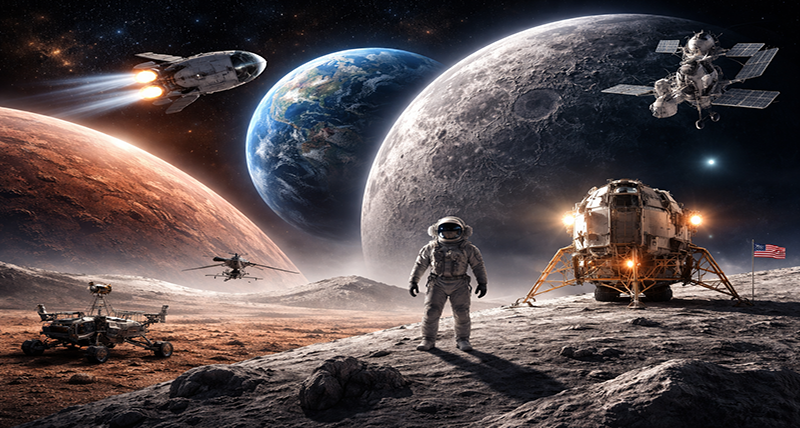
Space exploration has entered a defining decade. What was once symbolic is now strategic. Nations are building lunar infrastructure. Private companies are designing interplanetary spacecraft. Artificial intelligence is transforming how missions operate beyond Earth. The combined focus on Mars, the Moon, and the Artemis program represents more than exploration. It represents preparation for humanity’s multi-planetary future.
This is not a revival of the old space race. It is the beginning of sustained expansion into deep space.
Mars: The Long-Term Frontier
Mars has become the ultimate target for long-term human settlement. Its geological history suggests ancient rivers, lakes, and possibly microbial life. Unlike other planets, Mars offers conditions that, while harsh, are not entirely incompatible with human adaptation.
The NASA Mars 2020 mission, featuring the Perseverance rover, is actively collecting rock samples that may reveal signs of ancient life. These samples are central to future return missions designed to bring Martian material back to Earth for detailed study.
Alongside Perseverance, Ingenuity demonstrated the first powered flight on another planet. That breakthrough proved that aerial exploration is possible in Mars’ thin atmosphere, expanding the scope of planetary science.
Private aerospace companies are also shaping Mars’ future. SpaceX is developing Starship with the explicit goal of enabling human missions to Mars. The long-term objective is cargo transport, crewed missions, and eventually sustainable settlements.
Why Mars Matters
Mars is not just about scientific curiosity. It represents redundancy for human civilization. The concept of becoming a multi-planetary species is increasingly discussed in scientific, technological, and economic contexts.
However, Mars presents immense challenges:
- Extreme cold temperatures
- Radiation exposure
- Thin atmosphere
- Long communication delays
Because signals between Earth and Mars can take up to 24 minutes one way, spacecraft and habitats must operate autonomously. This is where artificial intelligence becomes essential.
AI enables:
- Autonomous rover navigation
- Hazard avoidance during landing
- Scientific data prioritization
- Predictive maintenance of systems
- Automated habitat management
Without AI, sustained Mars operations would be impractical.
Artemis: Humanity’s Return to the Moon
Before Mars, there is the Moon.
The Artemis program marks humanity’s return to lunar exploration with long-term sustainability as its core objective. Led by NASA, Artemis aims to establish a permanent presence on the Moon and prepare for deep-space missions beyond it.
Central components of Artemis include:
- The Space Launch System, designed for powerful deep-space launches
- The Orion, built to carry astronauts beyond low Earth orbit
- The Lunar Gateway, an orbital platform around the Moon
Unlike Apollo, Artemis is not a short visit. The objective is infrastructure: habitats, power systems, and resource extraction capabilities.
The Importance of the Lunar South Pole
The lunar south pole is a strategic target because permanently shadowed craters may contain water ice. Water can be converted into drinking supplies, breathable oxygen, and hydrogen fuel. This transforms the Moon from a distant destination into a logistical hub for deep-space missions.
Robotic systems powered by AI will play a major role in identifying safe landing zones, mapping terrain, and locating usable resources.
The Moon serves as a testing ground for technologies required on Mars:
- Surface habitats
- Radiation shielding techniques
- Closed-loop life-support systems
- Autonomous robotics
Operating on the Moon allows engineers to refine these systems in a relatively close environment before attempting Mars missions.
Global Lunar Momentum
Lunar exploration is now international.
The Indian Space Research Organization achieved a historic landing near the Moon’s south pole, demonstrating cost-efficient deep-space capabilities. The China National Space Administration continues its Chang’e lunar program, including advanced robotic missions and sample return efforts.
Commercial partnerships are also expanding access to lunar orbit and surface transport.
This combination of national and private efforts indicates that the Moon is becoming an economic and technological focal point rather than a symbolic destination.
Moon vs Mars: Strategic Roles
The Moon and Mars serve complementary purposes.
The Moon is:
- Close to Earth
- Suitable for rapid mission turnaround
- Ideal for infrastructure testing
Mars is:
- Far more complex
- Potentially suitable for long-term settlement
- Scientifically rich in astrobiological interest
The Moon reduces risk. Mars expands the possibility.
Together, they define the roadmap for human expansion.
Artificial Intelligence: The Invisible Astronaut
Artificial intelligence is not a secondary tool in space exploration. It is foundational.
Modern missions generate enormous data volumes. Rovers capture high-resolution imagery. Spacecraft monitor radiation, temperature, structural stress, and propulsion systems. Astronauts rely on medical monitoring systems. Manual analysis alone cannot keep pace.
AI systems now:
- Analyze planetary surfaces in real time
- Optimize fuel efficiency during flight
- Detect anomalies before failures occur
- Automate communication routing
- Assist in astronaut health diagnostics
As missions extend farther from Earth, AI autonomy will increase. Deep-space habitats will rely on intelligent systems to regulate oxygen production, water recycling, crop growth, and structural integrity.
The success of Artemis and future Mars missions will depend not only on rockets but on advanced software systems capable of operating independently.
The Decade Ahead
The late 2020s and early 2030s are expected to define the next milestone era of space exploration. Artemis missions aim to establish sustained lunar operations. Mars sample return initiatives may unlock new scientific discoveries. Private-sector innovation is accelerating launch frequency and reducing costs.
The strategic vision is clear:
- Establish a stable lunar presence
- Use the Moon as a deep-space training ground
- Develop autonomous systems powered by AI
- Prepare for human missions to Mars
Space exploration is no longer about isolated missions. It is about building an ecosystem beyond Earth.
The Moon is the proving ground.
Mars is the long-term objective.
Artificial intelligence is the enabling force connecting both.
Humanity stands at the threshold of becoming a spacefaring civilization. The missions underway today are not just about exploration. They are about survival, expansion, and redefining what it means to inhabit the universe.

