
The countdown is on. In just one month, the moon will slide in front of the sun and briefly turn day into night for millions of people. The total solar eclipse 2026 arrives on August 12. It is one of the most anticipated sky events in decades, and Europe’s first mainland total eclipse since 1999. Even better, it ends with something almost no one alive has photographed: a total eclipse at sunset. Here is your complete guide to where to see it, what you will witness, and how to watch it safely.
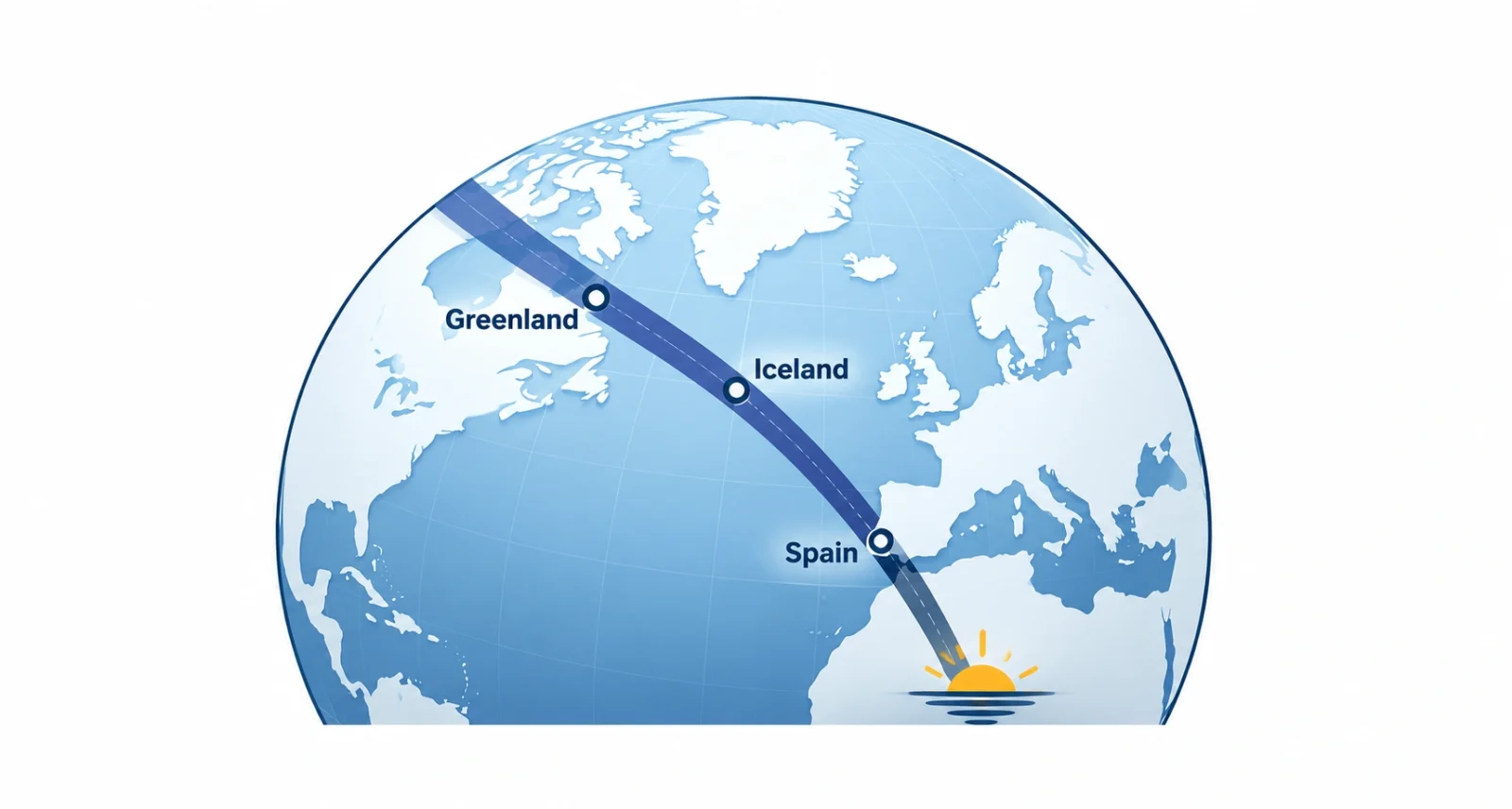
| The Essentials Here is everything in a nutshell. The total solar eclipse happens on Wednesday, August 12, 2026. The path of totality sweeps across Greenland, Iceland, northern Spain, and a small corner of Portugal, with totality lasting up to 2 minutes and 18 seconds. Most of Europe gets a deep partial eclipse, with over 90 percent of the sun covered in cities like London, Paris, and Dublin. North America sees only a small bite taken out of the sun. And wherever you are, you need certified eclipse glasses to look at the sun safely. |
and crosses northern Spain, ending at sunset in the Mediterranean. At its longest, off the coast of Iceland, totality lasts 2 minutes and 18 seconds.
Where to See Totality
To see the full spectacle, you must stand inside the narrow path of totality. That is where the sun vanishes behind the moon and the ghostly corona blazes around it. Everywhere else gets a partial eclipse, which is a completely different experience. Here are the key spots, with timings compiled by Space.com.
| Location | Totality Lasts | Local Time | Sun’s Height |
| Scoresby Sund, Greenland | 1 min 46 sec | 4:35 p.m. | 24 degrees |
| Snæfellsjökull, Iceland | 2 min 10 sec | 5:45 p.m. | 25 degrees |
| Reykjavik, Iceland | 1 min 1 sec | 5:48 p.m. | 25 degrees |
| Gijón, Spain | 1 min 46 sec | 8:26 p.m. | 10 degrees |
| Burgos, Spain | 1 min 44 sec | 8:28 p.m. | 8 degrees |
| Mallorca, Spain | 1 min 36 sec | 8:31 p.m. | 2.7 degrees |
Notice that last column, because it hides the catch. Spain is the most popular choice thanks to its reliably sunny August weather. But the eclipsed sun will sit very low in the sky there. If a hill, a building, or a bank of cloud blocks your view of the western horizon, you will miss the whole thing. Choose your spot with care.
The Sunset Eclipse: The Rarest Sight of All
Here is what makes this eclipse genuinely special. Over the Balearic Islands, Mallorca, Menorca, Ibiza, and Formentera, totality arrives just minutes before the sun sets. On Mallorca’s northwest coast, the sun will be completely eclipsed at 8:31 p.m. local time for 1 minute and 36 seconds, hanging a mere 2.7 degrees above the horizon, roughly 20 minutes before sunset.
The effect should be extraordinary. As BBC Sky at Night Magazine explains, the corona, normally a ghostly white, will glow orange in the thick air near the horizon. Two kinds of twilight will collide: the natural sunset darkening the sky from below, and the moon’s shadow darkening it from above. About 18 minutes later, the still-eclipsed sun will sink into the Mediterranean.
There is one more prize for anyone standing there. Observers in the Balearics are the last people on Earth to witness this totality. The moon’s shadow is literally leaving the planet above their heads. Eclipse expert Dr. Tyler Nordgren advises watchers to “turn around and look at the sky behind you” the instant totality ends. The departing shadow may show up against distant haze. A sunset eclipse over a holiday island is so rare that it has barely been captured in the digital age.
Will You See It From Where You Live?
Not travelling to the path? You can still catch a dramatic show. A deep partial eclipse will be visible across most of Europe, with the moon covering the vast majority of the sun. Here is how much of the sun disappears from major cities.
| City | Sun Covered |
| Madrid, Spain | 99.96% |
| Barcelona, Spain | 99.82% |
| Nice, France | 95% |
| Dublin, Ireland | 94% |
| Lisbon, Portugal | 94% |
| Paris, France | 92% |
| London, UK | 91% |
| Berlin, Germany | 84% |
| Oslo, Norway | 83% |
Do not be fooled by those big numbers, though. Even at 99 percent, the sliver of sun still shining is blindingly bright. Outside the path of totality, it never becomes safe to look without protection.
What North America Will See
If you are in the United States or Canada, temper your expectations, but do not skip it. No part of North America sees totality this time, unlike the great eclipse of April 2024. Instead, the moon takes a modest bite out of the sun. Alaska and the far northeast get the best views, according to figures reported by Forbes.
| Location | Sun Covered |
| Iqaluit, Nunavut | 61% |
| St. John’s, Newfoundland | 53% |
| Fairbanks, Alaska | 37% |
| Halifax, Nova Scotia | 31% |
| Presque Isle, Maine | 28% |
| Boston, Massachusetts | 16% |
| New York City | 9% |
A key point for North American viewers. The daylight will not noticeably dim, and there is no safe moment to look at the sun with the naked eye. Your eclipse glasses must stay on the entire time.
How to Watch the Total Solar Eclipse 2026 Safely
This part matters more than any other, because looking at the sun without protection can permanently damage your eyes. The good news is that watching safely is simple. Follow this guidance from NASA.
- Wear certified eclipse glasses. Only use solar viewers that meet the ISO 12312-2 international standard. They are thousands of times darker than sunglasses.
- Never use regular sunglasses. No matter how dark they look, ordinary sunglasses are never safe for looking at the sun. Not even stacked together.
- Take them off only during totality. Inside the path of totality, and only while the sun is fully covered, you can look with your bare eyes. The moment the first sliver of sunlight returns, the glasses go straight back on.
- Keep them on everywhere else. If you are seeing a partial eclipse, including anywhere in North America, there is no safe moment to look unprotected. Ever.
- Never look through a camera, telescope, or binoculars while wearing eclipse glasses. The concentrated light will burn straight through the filter and injure your eyes.
- Filter your gear at the front. Cameras, binoculars, and telescopes need a proper solar filter fitted securely over the front of the lens.
- Try a pinhole projector instead. Punch a small hole in a card and, with your back to the sun, project its image onto a surface. Leafy trees do the same trick naturally.
- Scout your horizon in advance. In Spain and the Balearics, the sun sits very low, so find a spot with a clear, unobstructed view to the west.
| Heads Up Buy eclipse glasses only from reputable sellers, and check that they carry the ISO 12312-2 certification. Counterfeit glasses are a real problem around big eclipses. If yours are scratched, torn, or damaged, throw them away and get a new pair. |
A Bonus: The Perseids the Same Night
Here is a wonderful coincidence. On the very same night, the Perseid meteor shower reaches its annual peak. This year it does so under a dark, moonless sky. After midnight, you could see roughly 50 meteors an hour from a dark location. Watch the eclipse in the evening, then stay out for the shooting stars. It is one of the best skywatching double-headers of the year, and a great reason to plan a trip somewhere with dark skies. If you enjoy space events, our piece on the interstellar comet 3I/ATLAS is worth a read too.
The total solar eclipse 2026 is shaping up to be unforgettable. Europe gets its first mainland totality in 27 years. Iceland and Greenland offer dramatic Arctic backdrops, and the Mediterranean delivers a sunset eclipse chasers have dreamed about for years.
Wherever you watch from, pick your spot early, protect your eyes, and look up. Moments like this do not come around often. For more from the world of astronomy, see our roundup of the latest James Webb telescope discoveries.
Frequently Asked Questions
When is the total solar eclipse 2026?
The total solar eclipse takes place on Wednesday, August 12, 2026. Totality reaches Greenland in the late afternoon, Iceland in the early evening, and northern Spain at around 8:30 p.m. local time, just before sunset.
Where can I see totality?
The path of totality crosses eastern Greenland, western Iceland, northern Spain, and a small corner of Portugal. Spain is the most popular destination for its clear August weather, though the sun sits very low in the sky there.
Is the 2026 eclipse visible from the US?
Only as a partial eclipse, and a modest one. No part of North America sees totality. Alaska, Maine, and Atlantic Canada get the best views, while New York City sees just 9 percent of the sun covered.
Do I need special glasses to watch the eclipse?
Yes. You need eclipse glasses certified to the ISO 12312-2 standard. Regular sunglasses are never safe. The only exception is during totality itself, inside the path, when the sun is completely covered.
How long will the eclipse last?
Totality lasts up to 2 minutes and 18 seconds at its longest point, off the coast of Iceland. Most locations in the path get well under two minutes, so the experience is brief and worth savouring.
What is a sunset eclipse?
It is a total eclipse that happens with the sun extremely low in the sky, just before it sets. On August 12, viewers in the Balearic Islands will see totality with the sun only 2.7 degrees above the horizon, a genuinely rare sight.

