It tops the best-diet rankings almost every year, doctors keep recommending it, and yet nobody seems able to say plainly what it involves. Ask ten people what is the Mediterranean diet and you will get ten answers, most of them involving olive oil and a vague sense of Greek holidays.
Here is the useful version: what it actually is, what the research supports, and how to begin without throwing out your kitchen or spending a fortune.
What Is the Mediterranean Diet, Really?
Start with the thing most articles skip. There is no official rulebook.
The Mayo Clinic describes it as a way of eating based on the traditional cuisine of countries bordering the Mediterranean Sea, and states plainly that no single definition exists. It also makes a distinction worth holding onto: this is less a diet, in the sense of a restricted way to eat, and more a lifestyle.
The idea came from observation rather than a laboratory. In the 1960s, researchers compared populations in southern Italy, Greece, northern Europe, and the United States. People around the Mediterranean had markedly lower rates of heart disease, despite eating plenty of fat. The difference was where the fat came from, and olive oil was the answer.
| Quick Take Think of it as a direction rather than a destination. Nobody eats a perfect Mediterranean diet, and there is no test to pass. Moving your everyday meals toward more plants and better fats is the whole idea, and partial credit counts here. |
What You Actually Eat
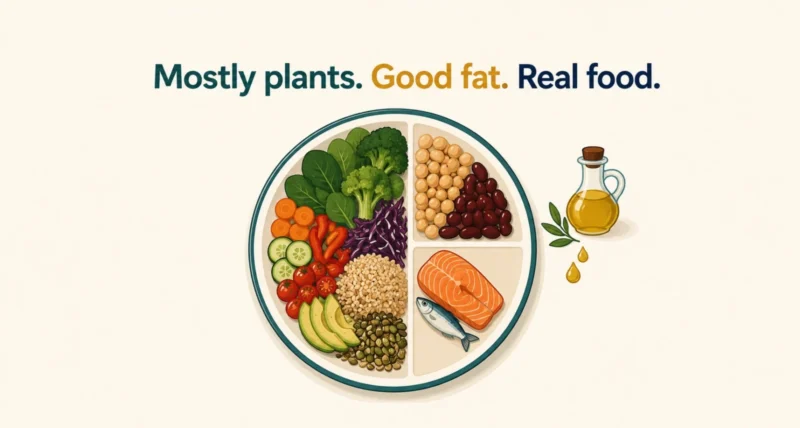
The pattern is easier to grasp as a hierarchy than as a list of rules. Plants form the base, and everything else sits on top of them in decreasing quantity.
| How Often | What It Covers |
| The foundation, most meals | Vegetables, fruits, whole grains, beans, lentils, nuts, seeds |
| The main added fat | Olive oil, used where you would otherwise reach for butter |
| Regularly through the week | Fish and seafood |
| In moderation | Dairy, poultry, and eggs |
| Occasionally | Red meat and sweets |
| Instead of the salt shaker | Herbs and spices for flavor |
Harvard Health frames the same pattern as an emphasis on minimally processed, plant-based foods, including whole-grain pasta and bread alongside the vegetables and beans. That last point surprises people. Bread and pasta are not banned, they are simply the whole-grain kind, and they share the plate rather than owning it.
The Half of It Nobody Mentions
Almost every article treats this as a shopping list. The clinical descriptions do not, and the difference matters.
Mayo Clinic lists non-food elements as part of the pattern: sharing meals with family and friends, and getting regular exercise. Its health system guidance gets more specific. Sit down at a table for at least two lunches or dinners a week, take twenty minutes or so over them, and eat with other people as often as you can.
That sounds soft next to a nutrient chart, but it is doing real work. Meals eaten slowly, at a table, in company, tend to differ from the ones eaten standing over a sink. If the food changes feel daunting, this is the easiest place to start, and it costs nothing.
What Is the Mediterranean Diet Good For?
This is a genuinely well-studied pattern rather than a trend, which is unusual in nutrition.
Mayo Clinic notes that it is one of the eating plans recommended by the Dietary Guidelines for Americans. Olive oil provides monounsaturated fat, which lowers total cholesterol and LDL cholesterol. The Cleveland Clinic reports that it can lower the risk of cardiovascular disease and several other chronic conditions. Research has also linked the pattern to lower risk of stroke, type 2 diabetes, and cognitive decline.
The headline figures deserve context. A widely cited review in the journal Public Health Nutrition, led by Harvard nutrition researcher Walter Willett, estimated something striking. A large share of coronary heart disease, stroke, and type 2 diabetes could be avoided through food choices consistent with the traditional Mediterranean diet. Read that carefully, though. The estimate combines diet with exercise and not smoking, and it describes populations rather than individuals.
| A Quick Note No eating pattern is a guarantee. Genetics, sleep, stress, activity, and healthcare all shape long-term health. Food is one input among many. The realistic claim is that this pattern stacks the odds a little better than most, over years rather than weeks. |
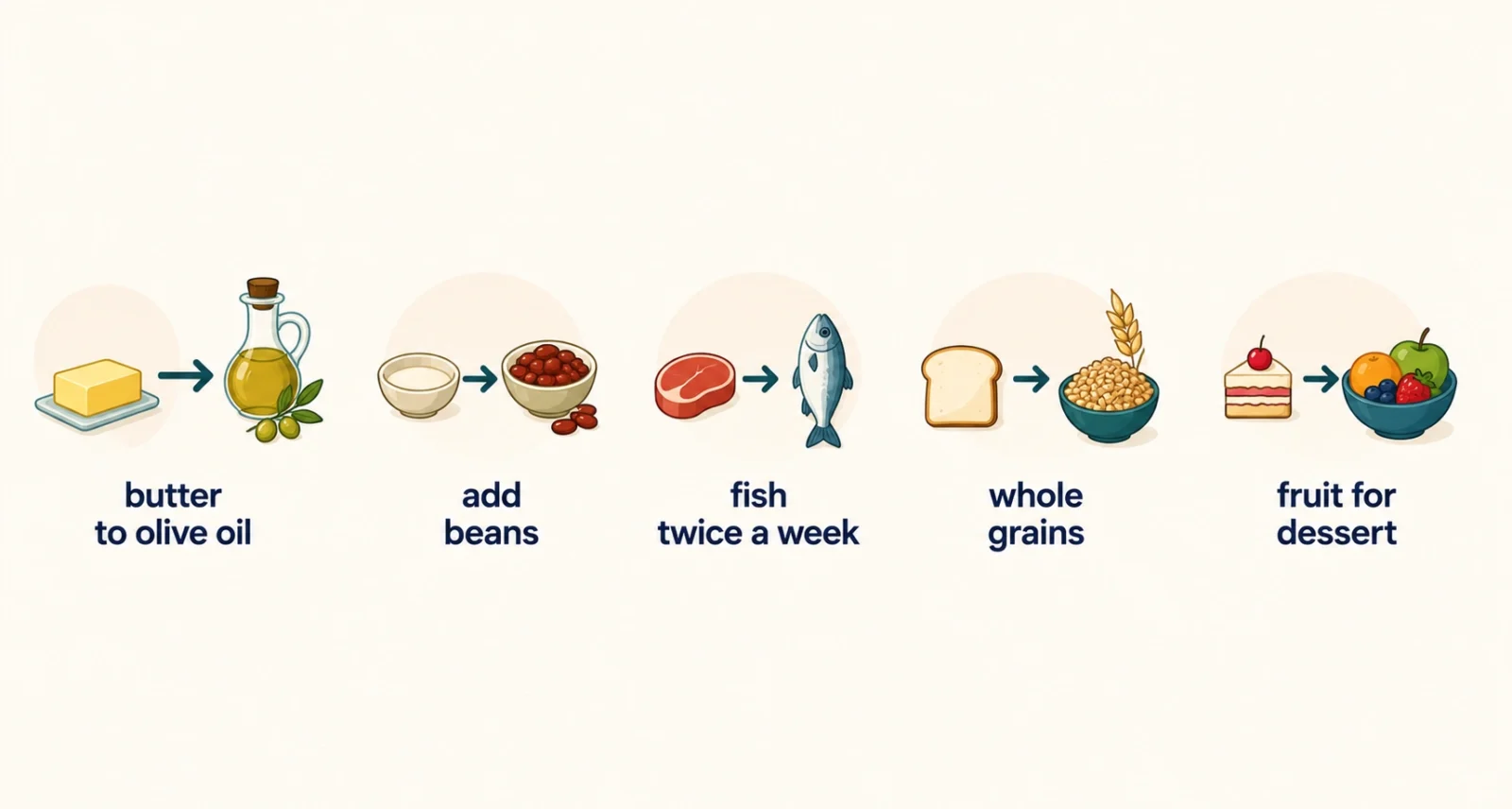
How to Start: Five Swaps, One at a Time
Overhauling everything on a Monday is how these things fail. Pick one swap, let it become normal, then add another.
Swap 1: Cook with olive oil
Use it where you would reach for butter or a neutral vegetable oil. This is the single change that most defines the pattern, and it needs no new recipes at all.
Swap 2: Put beans in something you already make
Add lentils to a soup, chickpeas to a salad, or white beans to a pasta sauce. You are not learning new dishes, only bulking out familiar ones with something cheap and filling.
Swap 3: Eat fish twice a week
Tinned sardines, mackerel, and salmon count fully, at a fraction of the fresh price. Two meals a week is the standard advice from heart health organizations.
Swap 4: Choose whole grains
Whole-grain bread, brown rice, whole-wheat pasta, oats, barley. Same meals, more fiber, no sense of deprivation.
Swap 5: Let fruit be dessert
Not every night, and not as a punishment. Simply making fruit the default and keeping sweets for occasions matches how the traditional pattern actually works.
Notice what none of these ask you to do. Nothing here counts, weighs, or forbids. The pattern works by crowding out, which is to say the less helpful foods take up less room because something better got there first.
How to Do This Without Spending a Fortune
Most guides quietly assume imported oil and a fish counter. The traditional pattern was peasant food, and the cheap versions are the authentic ones.
| Instead of | Try |
| Fresh fish from the counter | Tinned sardines, mackerel, or salmon |
| Out-of-season fresh produce | Frozen vegetables, which keep their nutrients well |
| Pre-cooked tinned beans only | Dried lentils and beans, far cheaper in bulk |
| Boutique extra virgin olive oil | A large store-brand bottle for everyday cooking |
| Pine nuts and specialty nuts | Peanuts, sunflower seeds, or whatever is on offer |
One more saving hides in plain sight. Because meat moves from the center of the plate to the edge of it, a week of Mediterranean-style meals often costs less than what you were spending before, not more.
What About the Wine?
The traditional pattern includes wine with meals, and descriptions of it usually mention moderation. That deserves a straight answer rather than a wink.
If you already drink, the pattern suggests keeping it modest and with food. If you do not drink, no health authority suggests starting for the benefits, and the evidence around alcohol has grown more cautious rather than less. Every other part of this pattern works perfectly well without it, so treat wine as optional scenery rather than an ingredient.
When to Check With a Doctor First
For most people this is simply ordinary food, and no permission is required to eat more vegetables. Some situations call for a conversation first.
Talk to your doctor or a registered dietitian if you take blood thinners, since leafy greens affect some of them. Do the same if you manage diabetes, kidney disease, or a heart condition where diet interacts with medication. The same applies during pregnancy, when fish choices need care, and if you have a history of disordered eating, where any structured approach to food is worth navigating with support. As the Cleveland Clinic notes, a dietitian can tailor the pattern to your circumstances, which is more useful than any article.
The reason this pattern keeps topping the rankings is not that it is clever. It is that it is livable. There is nothing to count, nothing to buy, no phase to complete, and no way to fail it on a Tuesday.
Frequently Asked Questions
What is the Mediterranean diet in simple terms?
It is a way of eating based on the traditional cuisine of countries around the Mediterranean Sea. Meals rest mainly on vegetables, fruits, whole grains, beans, nuts, and olive oil. Fish appears regularly, dairy, poultry and eggs in moderation, and red meat only occasionally. There is no single official definition, and it includes lifestyle habits such as shared, unhurried meals.
What foods are not allowed?
Nothing is strictly forbidden, which is part of why people stay with it. Red meat, sweets, and heavily processed foods simply appear less often rather than never. The pattern works by adding good things until they crowd out the rest, not by maintaining a banned list.
Can I eat bread and pasta?
Yes. Harvard Health explicitly includes whole-grain pasta and bread in its description of the pattern. The change is the type and the proportion, so whole grains rather than refined, sharing the plate with vegetables and beans instead of dominating it.
How long before it makes a difference?
This is a long game rather than a quick fix. The research describes reduced risk of chronic conditions over years, not changes you can observe in a fortnight. Many people report feeling better fairly quickly, but the meaningful benefits are cumulative, which is exactly why a sustainable version beats a strict one.
Is it expensive?
It does not have to be. Tinned fish, dried beans and lentils, frozen vegetables, oats, and a large everyday bottle of olive oil cover most of it. Because meat moves off the center of the plate, many people find their grocery spending stays flat or falls.
Do I have to drink wine?
No. Wine appears in descriptions of the traditional pattern, usually with a note about moderation, but no health authority recommends taking up drinking for health reasons. If you do not drink, every other part of the pattern still applies exactly as it would otherwise.