
Here is a question that keeps security teams up at night. When you send sensitive data to an AI in the cloud, how do you know it stays private while the AI is actually using it? Locking data away in storage is easy. Protecting it in the split second it is being processed is the hard part. This is the exact gap that Confidential Computing closes, and Google Cloud just announced several big upgrades. This guide explains what it all means, in plain language.
| The Short Version Confidential Computing protects your data while it is being used, not just when it is stored or sent. It does this inside a locked, hardware-based space called a Trusted Execution Environment, and it can cryptographically prove the space is genuine. Google Cloud just announced new tools that bring this protection to powerful AI chips worldwide, encrypt your AI prompts end to end, support Apple’s Private Cloud Compute, and let different companies safely train AI on shared data without ever revealing it. |
The Problem: Data Has Three States, and One Is Hard to Protect
To get why this matters, picture your data living in three different states. Most security tools only cover the first two.
| State of Data | What It Means | Is It Easy to Protect? |
| At rest | Stored on a disk or in a database | Yes, with standard encryption |
| In transit | Moving across the internet | Yes, with standard encryption |
| In use | Being actively processed in memory | Historically very hard |
That third state is the tricky one. For software to work with your data, it normally has to unlock it in the computer’s memory. At that moment, the data is exposed. Confidential Computing solves this by keeping the data protected even while it is in use. That is a huge deal for AI, which constantly processes sensitive prompts, documents, and models.
What Is Confidential Computing? A Simple Explanation
At its heart, Confidential Computing uses special hardware to create a Trusted Execution Environment, or TEE. The easiest way to picture a TEE is as a locked, tamper-proof room built inside the computer’s processor. Your data and code go inside, and the door locks. Nothing outside can peek in, not other programs, not the cloud provider, not even someone with physical access to the machine.
But a locked room is only useful if you can trust it is the real thing. That is where the second key idea comes in: attestation. Before sending in any secrets, your software can ask the room to prove itself. It responds with a cryptographic certificate confirming it is genuine and untampered. Only then is the sensitive data released. This combination, a private space plus proof you can verify, is what the announcement means by verifiable trust.
| In Short Two ideas power everything here. A TEE is a locked, private room inside the processor where data stays protected even while in use. Attestation is the verifiable proof that the room is genuine before any secrets go in. Together, they let you trust the cloud without just taking its word for it. |
A Quick Jargon Decoder
This topic is full of acronyms. Here is a plain-language cheat sheet you can refer back to as you read.
| Term | What It Really Means |
| TEE | Trusted Execution Environment: the locked, private room inside the chip where data is protected while in use |
| Attestation | A cryptographic proof that the secure environment is genuine and has not been tampered with |
| Confidential VM | A cloud virtual machine that runs entirely inside one of these protected environments |
| Inference | When a trained AI model is actually used to answer a prompt or make a prediction |
| Multi-party computation | Several organizations jointly computing on combined data without revealing their data to each other |
What Google Cloud Just Announced: 5 Key Upgrades
The update is a set of improvements that make this protection more powerful, more global, and easier to use. Here is each one in plain terms, and why it matters.
Confidential AI on Powerful GPUs, Worldwide
The headline news: Google Cloud is bringing Confidential Computing to powerful NVIDIA Blackwell AI chips (the new Confidential G4 machines, currently in preview), available in every region its standard counterpart is. Built on AMD secure-processor technology, it protects data while the AI works on it. It even encrypts the data as it moves between the main processor and the GPU, all with minimal performance impact.
| Why It Matters Until now, using a cutting-edge AI accelerator often meant choosing between top performance and strong privacy. This brings them together, so you can run AI on highly sensitive data, private models, or confidential prompts without giving up speed. |
End-to-End Encryption for Your AI Prompts
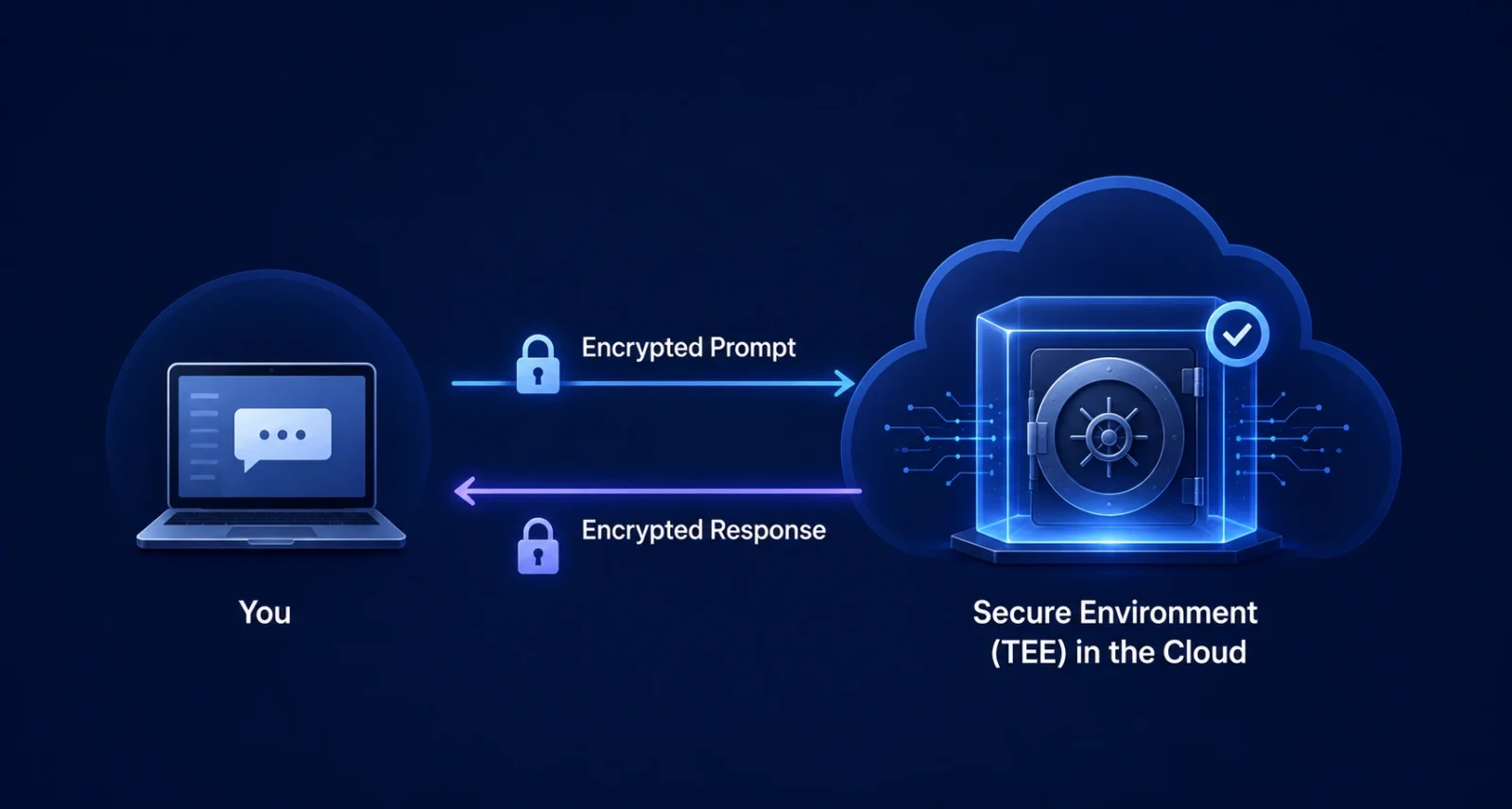
Securing the AI engine is not enough, because your prompts and the AI’s responses can contain secrets too. So Google released free, open-source Prompt Encryption tools (available on GitHub). They encrypt your prompt from the moment it leaves your device until it reaches the secure room. The response is protected the whole way back, too. Think of it as a sealed, private tunnel for your entire AI conversation.
Support for Apple Private Cloud Compute
In a notable collaboration, Google Cloud now helps power Apple’s Private Cloud Compute, the system Apple uses to handle certain AI requests privately. Google Cloud supports Apple’s strict privacy commitments using a layered mix of confidential-computing hardware and its own Titanium security architecture. It sends a strong signal that the industry trusts this technology at the highest levels.
Stronger, Easier Confidential Foundations
Google is also weaving this security deeper into its everyday cloud machines. New Intel-based Confidential VMs (the C4 series) are coming soon, and a feature called Live Migration is now fully available, which lets Google perform maintenance without interrupting your protected workloads or exposing their memory. Best of all, you can often switch this protection on with a few clicks and no code changes.
Safely Sharing Data Between Companies
Finally, a tool called Confidential Space got two upgrades. It lets multiple organizations combine their data for a shared goal, like jointly training an AI model. No party sees the others’ raw data, and Google sees none of it. It now supports independent third-party verification, via Intel, and powerful NVIDIA Hopper GPUs. This makes secure teamwork on sensitive data faster and more trustworthy.
| The Big Picture Notice the pattern across all five updates: protect the AI engine, protect the prompts, partner on privacy, build it into the foundations, and enable safe collaboration. Together they make private AI something you can verify, not just hope for. |
Who Actually Needs This?
This technology matters most for organizations that handle confidential information and want to use cloud AI without the risk. A few clear examples show where it shines.
| Industry | Why Confidential Computing Helps |
| Healthcare | Train AI on patient records or medical images while keeping that data fully protected and compliant |
| Financial services | Run fraud detection or shared analytics on sensitive financial data with bank-grade privacy |
| Government and public sector | Process classified or citizen data in the cloud while meeting strict regulatory rules |
| Any AI-driven business | Protect private prompts, proprietary models, and customer data during AI processing |
As AI takes on more sensitive work, simply trusting that your data is private is no longer enough. Google Cloud’s latest Confidential Computing updates are about making that privacy provable, powerful, and easy to use. It protects data while it is in use, encrypts AI prompts end to end, and lets organizations verify the security for themselves. With that, this technology is quietly becoming an essential foundation for trustworthy AI. For any business that handles sensitive data, it is fast turning private AI from a hopeful promise into something you can actually prove. Get our coverage of the latest Google and AI updates.
Frequently Asked Questions
What Is Confidential Computing in Simple Terms?
Confidential Computing is a technology that keeps your data protected even while it is being actively used or processed. That covers more than just data being stored or sent. It does this by running your data and code inside a secure, hardware-based area called a Trusted Execution Environment. This blocks access from other programs, the cloud provider, and even people with physical access to the server.
What Is a Trusted Execution Environment (TEE)?
A Trusted Execution Environment, or TEE, is a secure, isolated area inside a computer’s processor. You can think of it as a locked, tamper-proof room where sensitive data and code can be processed privately. Nothing outside the TEE can read what is happening inside, which is what allows data to stay protected while it is in use.
How Does Confidential Computing Protect AI?
AI constantly processes sensitive prompts, documents, and models, all of which are exposed during normal processing. Confidential Computing runs these AI workloads inside a TEE. As a result, the data stays encrypted and protected even while the model is using it. Google Cloud’s new tools also encrypt the AI prompts and responses themselves and extend this protection to powerful AI chips.
What Is Attestation and Why Does It Matter?
Attestation is a cryptographic proof that a secure environment is genuine and has not been tampered with. Before any sensitive data is released into a Trusted Execution Environment, your software can request this proof. It matters because it lets you verify the cloud is trustworthy, rather than simply taking the provider’s word for it. That ability to check is the core of verifiable trust.
Do I Need to Rewrite My Apps to Use It?
Often, no. Google Cloud highlighted an important point. For several of these options, you can turn Confidential Computing on with just a few clicks and no code changes. This makes it far easier to protect existing applications. Organizations can add strong, hardware-based data protection without a major engineering effort.
What Is Confidential Space Used For?
Confidential Space lets multiple organizations securely combine and compute on their data without revealing it to each other or to Google Cloud. It is used for things like jointly training a machine learning model or running shared analytics. Each party benefits from the combined data while keeping their own information private and protected throughout.