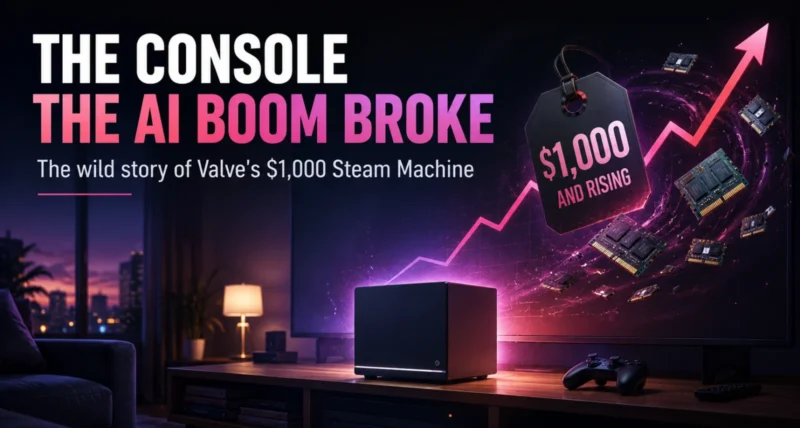
This was supposed to be a happy ending. Valve, the company behind Steam, set out to build the dream living-room gaming machine. The plan was to sell it at a fair price. Then the world changed underneath it. By the time the Steam Machine finally got its price tag in June 2026, that number had ballooned past 1,000 dollars. The internet collectively gasped. This is not just another spec sheet and a launch date. This is the story of a great idea that ran headfirst into the worst possible timing. It also says a lot about the future of gaming itself.
| The Short Version Valve’s Steam Machine is a compact, console-style PC for your TV that runs SteamOS and plays your Steam library, with about six times the power of the Steam Deck. It launches June 30, 2026, but the headline is the price: it starts at 1,049 dollars and climbs to 1,428 dollars for the top bundle. Valve always said it would be priced like a PC, not a console, and then a global memory shortage driven by the AI boom pushed the cost even higher. Analysts now call it a niche device. |
Act One: The Dream of the Living-Room PC
To understand why this story matters, you have to understand the dream. For years, PC gaming meant sitting at a desk. Consoles owned the couch. Valve wanted to tear down that wall. Its answer was a small box that brings the huge world of PC gaming, and your existing Steam library, straight to your TV. They called it the Steam Machine.
Revealed in late 2025 alongside a new Steam Controller and a VR headset, it stood out. It was the centerpiece of Valve’s boldest hardware push yet. After the surprise success of the handheld Steam Deck, this was the next step. It would be a proper living-room machine, running the same friendly SteamOS software, powerful enough to feel like a real upgrade. On paper, it is a neat little powerhouse.
| The Steam Machine at a Glance | Detail |
| What it is | A compact console-style PC for the TV, running SteamOS |
| Power | Around six times the performance of the Steam Deck |
| Chips | Custom AMD processor and graphics (Zen 4 and RDNA 3) |
| Goal | Smooth 4K gaming at 60 frames per second using FSR upscaling |
| Launch | June 30, 2026, with reservations to limit scalping |
| Quick Take Think of the Steam Machine as a Steam Deck for your TV, a small, quiet box that plays your PC game library on the big screen without the hassle of building or managing a full gaming PC. That simplicity was always the dream. The price became the problem. |
The Philosophy: Priced Like a PC, Not a Console
Here is the choice that shaped everything. Most consoles, like the PlayStation and Xbox, are sold at a loss. The makers lose money on the hardware and earn it back through game sales. Valve decided to do the opposite. From the start, it said the Steam Machine would be priced like a PC, not a console, meaning it would not lose money on each unit.
Valve’s reasoning was simple. It wanted the price to honestly reflect the parts inside, roughly what you would pay to build a similar PC yourself. As one Valve designer put it, the goal was for it to be a good deal at that level of performance. It was never meant to be a cheap loss-leader. It was a principled stand. But it also meant one dangerous thing. If the cost of parts suddenly spiked, that pain would land directly on the buyer. And that is exactly what happened next.
Act Two: The Villain Nobody Saw Coming
Enter the antagonist of our story: a global shortage of memory chips, the RAM and storage every computer needs. The cause is the AI boom. Tech giants are buying up staggering amounts of memory to build AI data centers. That frenzy has drained the supply available for everything else. The industry has a nickname for it: RAMageddon.
The timing for Valve could not have been crueler. Reports say the price of RAM quadrupled in the weeks just after the Steam Machine was announced. It has barely come back down since. Because Valve refused to sell at a loss, the math was brutal. Every dollar that memory went up was a dollar added to the final price. The dream machine was getting more expensive by the month, through absolutely no fault of its design.
| 4x | how much RAM prices reportedly jumped in the weeks after the reveal |
| $0 | loss Valve takes per unit, so component cost spikes hit the buyer directly |
Valve was refreshingly honest about it. The company admitted the machine ended up costing more than it had ever planned to charge, and pointed straight at the memory and storage shortage as the reason. A device once rumored to land somewhere around 600 to 750 dollars was now heading into very different territory.
The Road Not Taken: The Barebones Machine That Never Was
Here is one of the most fascinating wrinkles in the whole saga. Faced with spiraling memory costs, Valve reportedly considered a barebones version of the Steam Machine, a stripped-down model sold without the expensive RAM and storage, letting buyers add their own cheaper parts. In theory, it could have hit a much lower price and dodged the shortage entirely.
So why did it never ship? Valve has not fully explained, but the thinking points to its love of simplicity. A barebones box asks people to install their own components. That cuts against the whole plug-and-play, it-just-works promise that made the Steam Deck so beloved. Valve seemingly decided that a confusing, build-it-yourself product was not the experience it wanted to put its name on. That held true even if it would have been cheaper. It is a revealing choice: Valve protected the experience, and let the price take the hit.
| Worth Knowing The barebones idea is the great what-if of this story. A simpler, cheaper, add-your-own-memory model might have kept the Steam Machine affordable through the shortage. Valve chose polish over price, betting that a seamless experience matters more than the lowest possible sticker. |
Act Three: The Price That Shocked the Internet
Then came the moment everyone was waiting for. In June 2026, Valve finally revealed the numbers, and they were steep. The Steam Machine starts at 1,049 dollars for the entry model and climbs from there. Here is the full lineup.
| Model | Storage | Price |
| Steam Machine (entry) | 512GB | $1,049 |
| Steam Machine (larger) | 2TB | $1,349 |
| Steam Machine + Controller bundle | 2TB | $1,428 |
To see why people were stunned, just compare it to today’s consoles. The PlayStation 5 Pro launched at 699 dollars and the Xbox Series X at 499 dollars. The Steam Machine’s entry price is roughly double the traditional console starting point. It is widely seen as the first console-style device to blow past the 1,000-dollar mark. That is a milestone many gamers hoped would never arrive.
There was a small silver lining. Analysts had braced for an even higher price, with some predicting around 1,200 dollars. So the 1,049-dollar tag actually came in a touch below the worst fears. Still, steep is steep. To buy one, you join a reservation system. Valve is using a randomized sign-up to fight scalpers rather than a chaotic first-come rush.
The Verdict: Is the Steam Machine Worth It?
So is it a flop or a smart buy? The honest answer is that it depends entirely on who you are. Industry analysts were quick to label the Steam Machine a niche device, a product for a specific, dedicated slice of gamers rather than the mainstream living room. One analyst noted it is a much harder sell than the Steam Deck. The Deck, after all, had an obvious purpose as a handheld.
But niche does not mean bad. For the right person, it makes real sense. The key is to stop comparing it to a PlayStation and start comparing it to a gaming PC. That is what it truly is. Seen that way, the value picture changes.
| This Machine Is For You If | Maybe Skip It If |
| You have a big Steam library you want on your TV | You mainly want the cheapest way to play games |
| You want PC gaming without building a PC | You expect PlayStation or Xbox style pricing |
| You value the simple, polished SteamOS experience | You need cutting-edge, native 4K and ray tracing |
| You would otherwise spend more building an equivalent PC | You can wait and hope memory prices fall later |
In fact, several reviewers pointed out that at 1,049 dollars, the Steam Machine is actually cheaper than building an equal-spec PC in today’s inflated market. Judged as a compact, no-fuss gaming PC, it is a reasonable deal. Judged as a console, it looks shockingly expensive. Both things are true at once, and that tension is the whole story.
What It All Means for the Future of Gaming
Step back, and the Steam Machine becomes a warning sign for the entire industry. If the AI-driven memory shortage can push Valve’s machine past 1,000 dollars, the same forces are coming for everyone. The next PlayStation and Xbox could face the same brutal math, and several analysts now believe future consoles crossing the 1,000-dollar line is a real possibility.
There is a bigger shift here too. Console gaming and PC gaming are slowly merging. Rumors suggest the next Xbox will run software much closer to a regular PC, blurring the line even further. In that light, the Steam Machine is not just an expensive box. It is an early look at where living-room gaming is heading, for better and for worse. Whether it succeeds or stumbles, it has already made history. It is the device that showed us the age of the cheap console may be ending.
The Steam Machine is a fascinating, frustrating, and oddly poignant piece of hardware. It is a genuinely clever device, a polished living-room PC that delivers on Valve’s long-held dream. And yet it arrives wearing a price tag shaped by forces far beyond gaming. The AI boom did not just raise the cost of graphics cards; it reshaped an entire console launch. For PC enthusiasts with a big Steam library, it may well be worth the splurge. For everyone else, it is a stark sign of the times. Either way, the story of the Steam Machine is the story of modern technology in a nutshell. It is brilliant ambition, colliding with a world that refused to cooperate. You may also like our deeper look at Valve’s Steam Machine.
Frequently Asked Questions
What Is the Steam Machine?
The Steam Machine is a compact, console-style gaming PC made by Valve, the company behind Steam. It connects to your TV, runs the SteamOS operating system, and plays games from your Steam library. The device offers roughly six times the performance of the Steam Deck and is built for couch gaming without needing a full desktop PC.
How Much Does the Steam Machine Cost?
The Steam Machine starts at 1,049 dollars for the 512GB model. A larger 2TB model costs 1,349 dollars, and a 2TB bundle that includes a Steam Controller costs 1,428 dollars. The prices are notably high for a console-style device, largely because of a global memory shortage.
When Does the Steam Machine Release?
The Steam Machine launches on June 30, 2026. To buy one, you sign up for a reservation in advance. Valve uses a randomized selection process, rather than first-come-first-served, to give buyers a fair chance and reduce scalping.
Why Is the Steam Machine So Expensive?
Two reasons. First, Valve chose to price it like a PC rather than selling it at a loss like traditional consoles do. Second, a global shortage of memory and storage chips, driven by demand from AI data centers, pushed component prices sharply higher. Valve passed that cost on rather than absorb it.
Is the Steam Machine Better Than a PS5 or Xbox?
It is different rather than simply better. The Steam Machine is really a compact gaming PC, so it plays a huge PC library and runs SteamOS. However, it costs much more than a PS5 or Xbox. Its graphics rely on FSR upscaling to reach 4K rather than rendering it natively. It is best viewed as a living-room PC, not a traditional console.
Is the Steam Machine Worth Buying?
It depends on you. If you have a large Steam library and want PC gaming on your TV without building a PC, it can be worth it. It is often cheaper than building an equivalent PC right now. If you just want the lowest-cost way to play games or expect console-level pricing, it may not be the right fit.