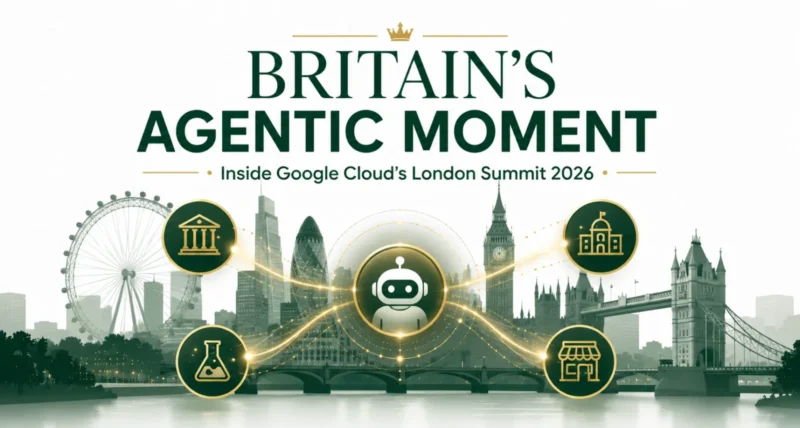
A year ago, the buzzword was potential. Companies were experimenting with chatbots, dabbling, asking what AI might one day do. This week in London, that question changed. At Google Cloud’s London Summit 2026, held in the historic vaults of Tobacco Dock, the talk was different. It was not about what AI could do someday. It was about what AI is already doing, right now, across British banks, startups, councils, and shops. As Google Cloud described it, Britain has moved from AI potential to agentic reality. Let me take you on a tour of what that actually looks like.
| The shift is from systems that simply chat with us to systems that can reason, plan, and execute. That is the whole story in one line. |
First, What Does Agentic Even Mean
Before the tour, one idea worth getting straight, because the whole summit hinges on it. For the past couple of years, most business AI was a clever assistant. You asked, it answered. Helpful, but it still left the actual work to you.
An AI agent is different. It does not just answer a question, it takes on a job. It reasons through the steps, makes decisions, and carries a multi-step task to completion. That jump, from a tool that talks to a worker that acts, is what people mean by the agentic enterprise. This shift to the agentic enterprise is the prize Google is chasing. According to Google, it could help drive a projected 400 billion pound boost to the UK economy from AI by 2030.
| The big number: Google cites a projected 400 billion pound AI boost to the UK economy by 2030, the prize driving all of this. |
Stop One: The Bank
Start with money, because banking is where trust and AI meet head-on. The headline deal of the summit was HSBC, one of the biggest banks on earth, signing a multi-year partnership to weave Google’s agentic AI through its global operations.
This is not a gimmick chatbot on a website. HSBC’s teams will work directly with Google Cloud and Google DeepMind engineers on three concrete fronts. The first is smarter, hyper-personalised wealth advice. The second is sharper detection of financial crime. The third is better tools for the relationship managers who actually serve customers. When a bank this size moves, the rest of the industry watches.
Stop Two: The Startup Chasing a Superlearner
Next, the frontier. A London lab called Ineffable Intelligence picked Google Cloud to power its mission, and its approach is genuinely fascinating.
It is led by David Silver, a former DeepMind researcher who helped build the famous AlphaGo. The team is trying something bold. Instead of training AI on mountains of human-written text, they want to build a system that learns mostly from its own experience. It would learn through trial and error, the way you learn to ride a bike. They call the goal a superlearner.
The ambition is backed by serious money and muscle. There is a record 1.1 billion dollar European seed round, plus one of the largest computing clusters of its kind running on Google Cloud to train those models. Whether or not it works, it is the kind of moonshot that puts British AI on the map.
| A superlearner that develops knowledge through trial and error. That is a very different bet from today’s chatbots. |
Stop Three: The Town Hall
Now the part that touches ordinary life most directly: government. This is usually where technology goes to move slowly. Not here.
Take planning applications, the paperwork behind every new home and extension. A tool called Extract, built with Google technology, has cut document processing from two hours down to two minutes. A separate AI planning tool is being trialled with local councils in Barnet, Dorset, and Camden. It aims to halve decision times on everyday applications. The Department for Transport is also using Gemini to speed up its analysis of public consultations, a change projected to save four million pounds a year.
| From hours to minutes: Extract cut planning document processing from two hours to two minutes, a 60-fold speed-up. |
Google also stressed the guardrails. It pointed to stronger UK data residency, including in-country AI processing for sensitive cases. That lets public bodies use these tools inside strict compliance rules.
Stop Four: The High Street
Finally, the everyday. The shops, banks, and services you actually use are quietly being rewired too.
- Shopping that converts. THG Ingenuity’s AI shopping assistant reportedly delivered an 8x higher conversion rate. That means far more browsers becoming buyers.
- Spending intelligence. Starling Bank is giving customers instant analysis of their spending habits.
- Search a home in your own words. Rightmove launched a beta where you can hunt for property in plain language, powered by Gemini.
- Bigger players, too. Vodafone is in a billion-dollar partnership on network performance. WPP is using AI across creative work, and Unilever is applying it across its supply chain.
The thread tying these together: these are not demos. They are live, in production, affecting real customers today.
The Engine Room: Startups and Small Firms
It is easy to focus on the giants, but Google made a point of the smaller players, where a lot of Britain’s growth really lives. Its research suggests AI could lift productivity for small and medium firms by 20 percent and unlock 198 billion pounds for the economy.
More than half of smaller firms are already asking for help. So Google launched an upskilling push called AI Works for Britain, and it continues to back founders through its London AI Hub partnership. The message is that the agentic era should not leave small businesses behind. It is a theme we have explored before in our wider AI coverage.
A Garden Made of Code
One detail from the summit is too charming to skip. Google announced The Model Garden at Platform 37, a new London hub opening late in 2026.
It blends the look of a classic English garden with high-tech touches, like living digital walls and a three-story atrium. The result is a physical space built to show off ideas. And it sits alongside Google’s wider UK investment, including a new data centre in Waltham Cross and a two-year, five billion pound commitment to the country’s AI economy. The symbolism is hard to miss: something very old and very British, grown around something brand new.
The Quiet Rulebook Behind It All
Under the excitement, Google laid out three principles it says should guide any company going agentic. They are worth remembering, because they are the difference between AI that helps and AI that backfires.
| Principle | What It Really Means |
| Culture | Get people excited and equipped to work with AI, this is collaboration, not just replacing jobs |
| Responsibility | Build in safety and security from day one to protect users, customers, and your brand |
| Sustainability | Scale AI in a way the planet can afford, backed by a goal of 24/7 carbon-free energy |
So, What Should You Take From This
Strip away the corporate gloss and a clear signal remains. The conversation in business AI has graduated. The interesting question is no longer whether AI can do this. It is who is putting it to work well, and who is being careful about it. That is the real test of any agentic enterprise.
Britain, on this evidence, is leaning in hard, from the trading floors of the City to a council planning desk to your local online checkout. The agentic era is not coming. By this account, it has quietly already arrived.
The story of Britain’s AI moment is no longer about promise, it is about practice. Banks, startups, councils, and shops are quietly handing real work to AI agents, in mixed parts ambition and caution. Whether the bold numbers hold up is something only time will tell. But the direction is unmistakable. You can read Google Cloud’s full London Summit recap on its official blog.
Frequently Asked Questions
What Is an Agentic Enterprise
An agentic enterprise is a business using AI agents. These are systems that do not just answer questions but reason, plan, and complete multi-step tasks on their own. They move AI from a helper to an active worker.
What Was the Google Cloud London Summit 2026
It was a Google Cloud event in London. It showcased how UK organizations, from HSBC to startups to government, are using agentic AI in real, production deployments rather than experiments.
What Is HSBC Doing With Google AI
HSBC signed a multi-year partnership to use Google’s agentic AI across its global operations. The focus is personalised wealth advice, financial crime detection, and tools for relationship managers.
What Is Ineffable Intelligence
It is a London AI startup led by former DeepMind researcher David Silver. It builds systems that learn through their own trial and error rather than human-written data, aiming for what it calls a superlearner.
How Is the UK Government Using AI
UK bodies are using AI in several ways. They are speeding up planning applications from two hours to two minutes, trialling faster planning decisions with local councils, and analysing public consultations. The result is saved time and money.
Is This Just Hype
Many examples are live, in-production deployments with reported results. But the figures and outcomes come from Google and its partners. Treat them as promising vendor claims rather than independent proof.