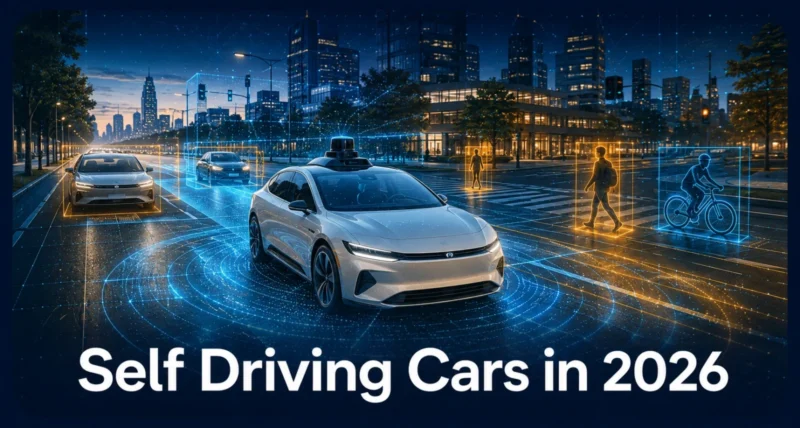
Self-driving cars are already here, just not everywhere yet.
Waymo operates over 500,000 paid rides per week across 10+ US cities, including Phoenix, San Francisco, and Austin. Tesla launched its robotaxi in Austin in January 2026. Amazon’s Zoox is launching a paid service later this year.
But “common” means different things:
- Right now available in select cities
- From 2027 to 2030, expanding to most major metros
- From 2030 to 2035, you can buy personal cars
- 2040 onward, replacing most human driving
The growth is real. US autonomous rides are expected to jump from 15 million in 2025 to 36 million in 2026.
Challenges remain, including weather, regulations, costs, and public trust, as well as recent safety incidents involving Waymo and Tesla.
The short answer? You can ride one today in certain cities. Owning one is still a decade away.
Key Takeaways
Four Definitions of “Common”
The answer to “when will self-driving cars be common” depends on definition. Available in some cities is happening NOW in 2026, with Waymo operating in 11 US cities and over 500,000 weekly rides. Reaching your city will likely happen between 2027 and 2030 for major metros. Buying a personal vehicle with this capability will likely arrive in 2030 to 2035 with significant restrictions. Replacing most human driving will likely happen by 2040 or later with substantial uncertainty.
Waymo and Tesla Lead with Different Strategies
The 2026 commercial reality is dominated by Waymo and Tesla, with very different approaches. Waymo operates expensive sensor arrays combining lidar, radar, and cameras across company owned fleets that reach approximately 3,000 vehicles in 11 cities. Tesla uses cameras only with neural network learning and potential for individual owner participation. Tesla’s January 2026 shift to fully unsupervised operation in Austin marks a major milestone despite continued expansion delays.
Five SAE Autonomy Levels Explained
The 5 SAE autonomy levels define industry capability progression from Level 0 (no automation) through Level 5 (full automation anywhere). Current deployments sit at Level 4 (high automation in geofenced areas) for robotaxis like Waymo and Tesla Robotaxi. Mercedes Drive Pilot received Level 3 approval (conditional automation) for specific highways. Level 2 (partial automation) remains the highest level available for consumer vehicles you can purchase today.
Seven Bottlenecks Slowing Deployment
Seven major bottlenecks slow deployment. Regulatory complexity creates varying state requirements. Infrastructure costs cover maintenance, charging, and control rooms. Safety oversight tightened after recent Waymo recalls following Texas school bus incidents. Weather limitations remain real since most current robotaxis avoid heavy snow or rain. Sensor cost economics are declining but still substantial. Insurance and liability frameworks are still developing. Public acceptance varies with mixed trust in autonomous technology.
Year by Year Timeline Through 2040
A realistic timeline projects gradual expansion. Between 2026 and 2027, major operators will expand from 10 to over 30 cities. From 2028 to 2030, the industry will reach 50+ cities with personal vehicle Level 4 options emerging in limited models. By 2030 to 2035, most major US metros will gain coverage along with a growing personal vehicle market. Beyond 2035, the industry approaches mainstream availability, though full universal coverage remains uncertain through 2040.
The 4 Definitions of “Common”
The question “when will self-driving cars be common?” requires defining “common.” Four different definitions produce four different timeline answers, ranging from “now” to “decades from now.”
Definition 1: Available in Some Cities (Status: NOW 2026)
What it means: Self-driving cars are operating commercially in at least some metropolitan areas and are accessible to ordinary people through smartphone apps.
Current reality: This is happening NOW in 2026. Waymo operates a fully driverless commercial service in 11 US cities. Tesla operates a robotaxi service in Austin and is expanding. Amazon’s Zoox launches paid service in the latter half of 2026.
Anyone in the right city: Phoenix, San Francisco Bay area, Los Angeles, Austin, Atlanta, Miami, Dallas, Houston, San Antonio, Orlando, and others can use these services today through smartphone apps.
The verdict: Self-driving cars are common in this sense NOW.
Definition 2: Available in Your City (Status: 2027-2030)
What it means: Self-driving cars operating commercially in your specific metropolitan area, accessible without traveling to special markets.
Current reality: Depends entirely on where you live: – Available now. Residents of major early-adopter cities (SF Bay Area, Phoenix, LA, Austin, etc.) have access. – Coming 2026-2027. Major metros announced by Waymo and Tesla. – 2027-2030. Most major US metros are likely to have at least one service. – Beyond 2030. Smaller cities and rural areas.
The pattern: Service expands city by city based on the regulatory environment, infrastructure costs, and operational complexity.
The verdict: Available in YOUR city likely between 2027 and 2030, sooner in major metros, later in smaller cities.
Definition 3: Available as Personal Vehicles You Can Buy (Status: 2030-2035)
What it means: Cars you can buy from a dealership that can fully drive themselves under realistic conditions, with Level 4 or Level 5 autonomy.
Current reality: Consumer vehicles currently top out at Level 2 (partial automation) with some Level 3 in specific conditions (Mercedes Drive Pilot in approved highway scenarios).
The challenges for personal Level 4+: Cost of sensor suite (though declining) – Insurance and liability frameworks – Maintenance requirements – Regulatory approval for non-fleet-managed operation – Software update and security challenges
The timeline: Tesla’s vision of individual owners adding cars to robotaxi fleets approaches this. Other companies focus on fleet operations. Personal Level 4 vehicles likely 2030-2035 with significant restrictions.
The verdict: Buying a fully self-driving personal car is likely by 2030-2035 with limited initial models.
Definition 4: Replacing Most Human Driving (Status: 2040+)
What it means: Self-driving cars are handling the majority of road miles, with human driving becoming uncommon.
Current reality: This is the most aspirational definition. Even the most optimistic industry projections place this in 2040 or later.
Why so far out?: Hundreds of millions of existing human-driven vehicles – Mixed traffic environments are difficult – Rural areas have different economics – Some users prefer driving themselves – Cars typically last 12+ years – Cultural and behavioral factors
The trajectory: Even with aggressive deployment, replacing existing fleets and changing driving patterns takes decades.
The verdict: Universal replacement of human driving likely 2040+ with substantial uncertainty.
Why The Multi-Definition Approach Matters
The “self-driving cars are coming” vs “we’ll always need human drivers” debate often happens because people use different definitions.
Optimists. Often use Definition 1 (available somewhere) or Definition 2 (available in major cities) and conclude that self-driving cars are imminent.
Skeptics. Often use Definition 3 (personal ownership) or Definition 4 (replacing all driving) and conclude that self-driving cars are far away.
Both are right within their definitions. The honest answer requires specifying which definition you mean.
Where Self-Driving Cars Are TODAY (2026)
Real current deployments provide the foundation for understanding timelines.
Waymo: The Current Leader
Cities served (May 2026): 11 US cities with 20+ more planned for 2026, including Tokyo and London internationally.
Active US markets: Phoenix, Arizona (since 2018, longest-running) – San Francisco Bay Area (large unified zone with 260+ miles of coverage) – Los Angeles – Austin, Texas – Atlanta – Miami – Dallas – Houston – San Antonio – Orlando – Other expansion ongoing
Operational scale: Approximately 3,000 robotaxis deployed – 500,000+ paid rides per week (early 2026) – 1,000 vehicles in San Francisco alone – Targeting 1 million weekly rides by the end of 2026 – San Jose Mineta Airport: first major California airport with 24/7 Waymo service
Technical approach: Expensive sensor suite (lidar, radar, cameras), company-owned fleet, no human in vehicle, no remote operator with steering capability.
Funding: Seeking funding at a $100+ billion valuation.
Tesla Robotaxi: The Different Bet
Cities served (May 2026): Austin, Texas, primarily—limited expansion to additional Texas cities.
Operational scale: Approximately 30-44 modified Model Y vehicles in Austin – Coverage area expanded 3 times since launch – Service through the Tesla app
Key milestone: January 2026 transition to genuinely unsupervised operation (no human safety monitor in vehicle).
Expansion challenges: Announced 7 additional cities for the first half of 2026 (Dallas, Houston, Phoenix, Miami, Orlando, Tampa, Las Vegas), but April 2026 updates show 5 of these moved from a specific timeline to “preparations underway.”
Cybercab: Purpose-built robotaxi began production in April 2026. Tesla expects it to become the highest-volume vehicle: no steering wheel or pedals.
Technical approach: Camera-only (no lidar), neural network learning from fleet data, eventual goal of individual owner participation.
California status: Filed for California Public Utilities Commission permit, not yet approved for driverless commercial operation.
Amazon’s Zoox: The Purpose-Built Entrant
Current operations: Approximately 50 robotaxis in San Francisco and Las Vegas.
Status: Free rides for waitlist members in parts of SoMa, Mission, and Design District (SF)—paid service launch planned for the latter half of 2026.
Vehicle design: Carriage-style, purpose-built vehicle. No steering wheel or pedals. Wireless phone chargers and personal screens for each passenger, and a larger battery than in retrofitted vehicles.
Ambitions: CTO Jesse Levinson stated Zoox aims to build a “multi-hundred-billion-dollar company” in autonomous transportation.
Uber: The Platform Player
Strategy: Integrate autonomous vehicles into the existing ride-hailing platform rather than build its own fleet.
Partnerships: With Waymo (in some cities), NVIDIA, and multiple autonomous-driving firms.
Targets: 10+ markets with robotaxi services by the end of 2026.
Late 2026 plan: “Uber-exclusive robotaxi” launch through partnership with luxury electric vehicle maker.
Chinese Competitors
Baidu Apollo: Major Chinese autonomous driving leader. Significant deployments in Chinese cities.
Pony.ai: Autonomous driving operations in China and pilot in the US (before regulatory complications).
WeRide: Chinese AV company with public listings and international ambitions.
AutoX: Robotaxi operations in Chinese cities.
Other Notable Players
Cruise (GM): Once a major player. Scaled back significantly after the 2023 SF incidents.
Aurora: Focused on autonomous trucking rather than passenger robotaxis.
Motional (Hyundai-Aptiv): Robotaxi development with various pilots.
Mobileye (Intel): Provides sensors and software to multiple automakers.
Wayve: UK-based AI-first approach.
Recent Safety Issues
Waymo Texas school bus recall: Texas officials documented at least 19 incidents during the 2025-2026 school year in which Waymo cars failed to handle school buses properly. Resulted in a voluntary software recall.
SF Waymo gridlock incident: Waymo vehicles caused traffic problems in San Francisco. Service suspended briefly.
Low-speed collision with child: Regulatory review.
Tesla FSD lawsuit: A California judge found that Tesla engaged in deceptive marketing for its FSD and Autopilot systems, so California is threatening a sales ban.
These incidents represent normal growing pains of new technology, but also highlight ongoing safety challenges.
The Honest Assessment
Self-driving cars in 2026 are Real and commercially operating – Limited to specific cities and geofenced areas – Growing but slowly relative to ambitious projections – Better than many skeptics expected, worse than most enthusiasts predicted – Demonstrating clear technical feasibility within constrained conditions – Still working through scaling challenges.

The 5 SAE Autonomy Levels Explained
The Society of Automotive Engineers (SAE) defines five levels of vehicle autonomy. Understanding these helps interpret news, marketing, and timeline projections.
Level 0: No Automation
Description. The driver controls everything. The vehicle may provide warnings (blind spot, lane departure), but doesn’t act autonomously.
Examples. Most cars from before approximately 2010.
Status. Becoming rare. Most new vehicles have at least some Level 1 features.
Level 1: Driver Assistance
Description. Single-function automation. A vehicle can control either speed (adaptive cruise control) or steering (lane keeping), but not both simultaneously.
Examples. Standard adaptive cruise control. Basic lane keep assist.
Status. Standard on most new vehicles.
Level 2: Partial Automation
Description. The vehicle can control both speed AND steering simultaneously, but the driver must remain attentive and ready to take over.
Examples. – Tesla Autopilot – Tesla Full Self-Driving (FSD) – GM Super Cruise – Ford BlueCruise – Mercedes Drive Pilot (in some modes) – Most modern luxury vehicles
Key feature. The driver is still responsible. Hands must remain available. Eye tracking enforced.
Status. Available now in many vehicles. Most “autonomous” features in consumer cars are Level 2.
Common misconception. Tesla FSD is marketed as a higher level, but it’s legally Level 2. California’s lawsuit against Tesla focuses on this discrepancy.
Level 3: Conditional Automation
Description. Vehicle handles all driving tasks in specific conditions (typically highways at certain speeds). The driver can disengage but must take over when the system requests.
Examples. – Mercedes Drive Pilot (approved in Nevada and California for specific highway conditions) – Limited and growing list of vehicles – Some Audi A8 implementations internationally
Key constraints. Geographic, speed, weather, and time-of-day restrictions are typical.
Status. Emerging. Approved for limited operations but not yet widespread.
Liability question. When the system is engaged and an accident occurs, the manufacturer typically bears responsibility (significant legal development).
Level 4: High Automation
Description. Vehicle handles all driving tasks within the defined operational design domain (specific areas and conditions). No driver needed within those parameters.
Examples. – Waymo robotaxis (geofenced cities) – Tesla Robotaxi (where operating unsupervised) – Zoox (defined service areas) – Other commercial robotaxi services
Key feature. Within a defined area: no human driver. Outside the defined area: doesn’t operate.
Status. Currently, the highest level of commercially operating autonomous vehicles is working. Multiple companies are actively deploying.
Level 5: Full Automation
Description. Vehicle handles all driving tasks in all conditions, everywhere. No human driver ever needed.
Examples. None is commercially available as of 2026.
Status. The aspirational goal. Some technical demonstrations exist, but no commercial Level 5 vehicles.
Timeline. Most industry experts place Level 5 at least 5-15+ years out, with substantial uncertainty.
Why Level Distinctions Matter
For consumers. Knowing what a vehicle actually does prevents dangerous misuse. Level 2 isn’t autonomous despite marketing.
For regulators. Different levels require different oversight frameworks.
For investors. Understanding what’s technically possible vs. what’s marketed helps evaluation.
For policy. Different levels create different infrastructure and legal requirements.
Common confusion. Many “autonomous” features marketed are Level 2. True Level 4 service is the current state of the art in commercial practice.
8 Major Self-Driving Car Companies in 2026
Understanding who’s driving this technology helps assess realistic timelines.
1. Waymo (Alphabet/Google)
Approach. Lidar + radar + camera sensor arrays. Company-owned fleet model.
Position. Current market leader in commercial robotaxi deployment.
2026 status. 11 US cities, ~3,000 vehicles, 500K+ weekly rides, expanding to 20+ cities, Tokyo and London targeted.
Strengths. Furthest along in true driverless deployment. Proven Level 4 in geofenced zones.
Weaknesses. High infrastructure costs. Expensive sensor suite (though declining). Recent safety recalls.
2. Tesla
Approach. Camera-only neural networks. Future vision of individual owner participation.
Position. Different bets on the path to autonomy.
2026 status. Austin robotaxi service, fully unsupervised since January 2026, ~30-44 Model Y vehicles, expansion delayed in 5 of 7 announced cities.
Strengths. Mass-scale fleet data collection. Vertical integration. Cybercab production is starting.
Weaknesses. Repeatedly missed timeline promises. California regulatory issues. The camera-only approach is controversial. FSD lawsuit and threatened sales ban.
3. Amazon’s Zoox
Approach. Purpose-built robotaxi (carriage style). Custom vehicle from scratch.
Position. Late commercial entrant with a distinctive vehicle.
2026 status. ~50 vehicles in SF and Las Vegas. Paid service launching 2H 2026.
Strengths. Purpose-built vehicle advantages. Amazon’s resources. Distinctive product.
Weaknesses. Smaller fleet. Late commercial start. App adoption challenges.
4. Uber
Approach. Platform aggregator. Integrate other companies’ vehicles.
Position. Market platform leveraging existing ride-hailing infrastructure.
2026 status. Partnerships with Waymo, NVIDIA, others. 10+ markets planned by the end of 2026. Uber-exclusive robotaxi late 2026.
Strengths. Existing platform. Customer base. Operational expertise.
Weaknesses. Dependent on partners. Margin pressures from partner economies.
5. Baidu Apollo (China)
Approach. Chinese autonomous driving leader.
Position. Major player in the Chinese market with international ambitions.
Status. Significant deployments in Chinese cities. The Apollo platform is widely used.
Strengths. Strong Chinese market position. Government support.
Weaknesses. Limited US market access due to regulatory complexity.
6. Pony.ai
Approach. Chinese-American AV company.
Position. Founded by former Baidu engineers.
Status. Chinese operations. US operations are affected by regulatory issues.
Strengths. Technical capabilities. International presence.
Weaknesses. Geopolitical complexity affecting US expansion.
7. Aurora Innovation
Approach. Focused on autonomous trucking rather than passenger vehicles.
Position. A distinct strategy emphasizing the freight market.
Status. Commercial trucking operations on specific routes.
Strengths. Different market with potentially better economics. Long-haul highway driving is simpler than urban driving.
Weaknesses. Not in the robotaxi market. Different scaling challenges.
8. Motional (Hyundai-Aptiv)
Approach. Joint venture between Hyundai and Aptiv.
Position. Established players combining strengths.
Status. Various robotaxi pilots.
Strengths. Established automaker backing. Technology expertise.
Weaknesses. Slower pace than Waymo and Tesla. Multiple stakeholders are complicating decisions.
Other Notable Players
Cruise (GM). Once a major player, it scaled back significantly after SF incidents.
Mobileye (Intel). Sensor and software provider to multiple automakers.
Wayve. UK-based AI-first approach. Different technical philosophy.
WeRide. Chinese AV company with public listings.
AutoX. Chinese robotaxi operator.
Ghost Autonomy. Edge case-focused approach.
Plus various AI partners. NVIDIA, Mobileye, Qualcomm, and others are providing chips and software.
The Competitive Dynamics
The 2026 landscape shows several patterns:
Waymo dominates the current US robotaxi market. Most cities, most vehicles, most rides.
Tesla pursues a different approach. Camera-only, with eventual owner participation.
Multiple Chinese players are growing. Significant deployments in Chinese cities with international ambitions.
Specialization emerging. Trucking (Aurora), passenger (Waymo, Tesla, Zoox), platform (Uber).
Consolidation likely. Some current players are unlikely to survive to mass deployment.
The 5 Stages to “Everywhere”
The path from current deployment to widespread availability passes through five distinct stages.
Stage 1: Limited Geofenced Services (NOW)
Status. Currently operating in 2026.
Characteristics. – Operating in 10-15 US cities and growing – Geofenced (limited geographic boundaries) – Specific weather and condition restrictions – Smartphone app-based access – Fleet-operated (no personal ownership)
Examples. Current Waymo, Tesla Robotaxi, Zoox services.
Limitations. Available only where deployed. Limited by geofence boundaries.
Stage 2: Multi-City Expansion (2026-2028)
Status. Beginning now, accelerating.
Characteristics. – 30-50+ US cities with robotaxi service – Expanded geofences within cities – More vehicles per city – Multiple companies competing – International expansion (Tokyo, London)
Triggers. Regulatory approvals, infrastructure investment, and proven safety record.
Likely timeline. Most major US metros will gain at least one service by 2028.
Stage 3: Broader Urban and Suburban (2028-2031)
Status. Future. Beginning to emerge.
Characteristics. – Most major and mid-sized US cities served – Service expansion into suburbs – Some highway and intercity operations – Multiple companies in most markets – Personal vehicles with Level 4 capability emerging
Triggers. Cost reductions, regulatory frameworks maturing, public acceptance growing.
Estimated timing. This is when “available in your city” becomes true for most US residents.
Stage 4: Personal Level 4 Vehicles Available (2030-2035)
Status. Aspirational but increasingly visible.
Characteristics. – Limited models of personal vehicles with Level 4 capability – Operational restrictions (geofenced, conditions, etc.) – Premium pricing initially – Insurance frameworks established – Some “robotaxi network” participation possible
Major question. Whether Tesla’s vision of personal vehicles joining the fleet is realized, or whether fleet-only operations dominate.
Stage 5: Mainstream Adoption (2035+)
Status. Long-term future.
Characteristics. – Personal Level 4+ vehicles widely available – Mainstream pricing – Most major roads covered – Significant displacement of human driving in some areas – New mobility paradigms (subscription models, shared ownership)
Caveats. Substantial uncertainty about timing and exact form. It could accelerate or take longer.
Why Stages Rather Than Continuous Improvement
Each stage requires solving qualitatively different problems:
Stage 1 to 2. Scaling within a proven approach.
Stage 2 to 3. Handling more varied conditions and infrastructure.
Stage 3 to 4. Solving personal ownership economics and regulation.
Stage 4 to 5. Achieving mainstream economic viability.
Each stage transition may take 3-7 years rather than continuous gradual improvement.
What This Means for “When Will They Be Common”
Available somewhere. Already happening (Stage 1 NOW).
Available in major cities. Stage 2-3, mostly 2027-2031.
Available as personal vehicles. Stage 4, 2030-2035.
Replacing most driving. Stage 5, 2035-2045 at the earliest.
The honest “common” timeline depends entirely on which stage you mean.
The 7 Bottlenecks Slowing Faster Deployment
Honest assessment of obstacles helps set realistic expectations.
Bottleneck 1: Regulatory Complexity
The challenge. Each US state has different autonomous vehicle laws. International expansion adds more complexity.
Specific issues. – Texas: Permissive (why Tesla launched in Austin) – California: More restrictive (slower Tesla approval) – New York: Lost permits – International: Substantial variation
Impact. Companies must navigate complex multi-jurisdiction approvals.
Progress. Frameworks are evolving, but slowly.
Bottleneck 2: Infrastructure Costs
The challenge. Operating a robotaxi service requires substantial infrastructure beyond just vehicles.
Specific costs. – Vehicle maintenance facilities – Charging infrastructure – Operations centers – Remote monitoring capabilities – Customer support – Mapping and data infrastructure
Impact. High capital expenditure makes scaling difficult. Waymo’s “high CAPEX operations” are described by a Deutsche Bank analyst.
Progress. Costs are declining but remain substantial.
Bottleneck 3: Safety Oversight and Recent Incidents
The challenge. Public and regulatory scrutiny intensifies with incidents.
Recent issues. – Waymo Texas school bus incidents (19 documented, voluntary software recall) – Waymo SF gridlock incident – Waymo low-speed collision with child – Tesla FSD lawsuit and California threatened sales ban – General public scrutiny
Impact. Companies must invest in safety, accept slower expansion, and navigate public concerns.
Progress. Safety records are generally improving, but each incident slows progress.
Bottleneck 4: Weather Limitations
The challenge. Current robotaxis struggle with severe weather.
Specific limits. – Heavy snow – Heavy rain – Fog – Some weather conditions altogether – Night vision in some scenarios
Impact. Limits geographic expansion to favorable climates. Phoenix and Florida work; Buffalo and Seattle work harder.
Progress. Improving with better sensors and AI, but full weather independence remains a future.
Bottleneck 5: Sensor Cost Economics
The challenge. Lidar and other sensors cost thousands per vehicle.
Specifics. – Lidar sensors traditionally $5,000-$10,000+ per unit – Multiple sensors per vehicle – Cost declining substantially – Tesla’s camera-only approach attempts cost reduction
Impact. Limits the economic viability of personal vehicles with full sensor suites. Limits the geographic expansion of economics.
Progress. Sensor costs are falling significantly. Solid-state lidar approaching mass market viability.
Bottleneck 6: Insurance and Liability Frameworks
The challenge. Who bears liability for autonomous vehicle decisions?
Current state. – Manufacturer liability evolving – Insurance products developing – Regulatory frameworks unclear – Different approaches in different jurisdictions
Impact. Companies are cautious about liability exposure. Insurance limited.
Progress. Mercedes Drive Pilot precedent (manufacturer responsibility when engaged). Other frameworks are being developed.
Bottleneck 7: Public Acceptance
The challenge. Public trust varies significantly.
Patterns. – Higher acceptance in tech-forward cities – Lower acceptance in many areas – Generation differences (younger, more accepting) – Cultural variations – Affected by news of incidents
Impact. Slower adoption in markets with skeptical populations. Political resistance is possible.
Progress. Acceptance grows with positive experiences. Some regions are resistant.
How These Bottlenecks Interconnect
These bottlenecks don’t operate independently: – Safety incidents → regulatory scrutiny → slower deployment – Infrastructure costs → limited city expansion → public access limited – Sensor costs → personal vehicle economics → mainstream adoption delayed – Weather limitations → geographic constraints → market size limited – Public acceptance → political support → regulatory framework speed
Solving each individually helps, but a combined solution requires coordinated progress.
Why The Bottlenecks Slow But Don’t Stop Progress
These aren’t reasons self-driving cars won’t happen. There are reasons it takes longer than enthusiastic projections suggest. Progress continues: – Sensor costs falling – Regulatory frameworks maturing – Safety records generally improving – Public acceptance growing – Infrastructure investments continuing – Insurance products developing.
The trajectory is positive, just slower than some marketing suggests.
The Honest Year-by-Year Timeline (2026-2040)
Cutting through marketing to provide realistic expectations.
2026 (Current Year)
Reality. – Waymo in 11 cities, 500K+ weekly rides, ~3,000 vehicles – Tesla Robotaxi in Austin (unsupervised), limited expansion attempts – Zoox paid launch latter half – Uber 10+ markets through partnerships – US autonomous rides ~36 million (up from 15M in 2025)
Setbacks. Continued safety incidents. Tesla expansion delays. Various regulatory friction.
2027
Expected. – 30+ cities with robotaxi services – Multiple companies competing in major markets – International expansion (Tokyo, London) – Sensor costs continue to decline – Some highway autonomous operations expanding
Possible. First major personal Level 4 model announcement.
2028
Expected. – 50+ US cities with robotaxi service – Most major metros served – Robotaxi annual rides exceeding 100 million – Multiple companies competing in most markets – Cybercab and other purpose-built vehicles scaling
Possible. First personal Level 4 vehicles available for purchase with restrictions.
2029-2030
Expected. – Most major US metros have service – Suburban areas increasingly served – Personal Level 4 vehicles available in limited models – Significant cost reductions in operations – New mobility paradigms emerging (subscriptions, etc.)
Possible. First Level 5 technical demonstrations on limited roads.
2031-2033
Expected. – Service in most US metros 100K+ population – Personal Level 4 vehicles more widely available – Established insurance frameworks – Continued cost reductions – Mainstream adoption beginning in early-adopter regions
Possible. Some Level 5 commercial operations are limited to certain conditions.
2034-2037
Expected. – Widespread service availability in developed markets – Personal Level 4 vehicles becoming mainstream – Significant displacement of traditional ride-hailing – Some replacement of personal car ownership in dense areas – Continued international expansion
Possible. Substantial behavioral changes in transportation patterns.
2038-2040
Expected. – Personal Level 4 vehicles widely affordable – Most major roads in developed markets covered – Mainstream economic alternative to traditional driving – Significant societal transformation in some areas
Uncertain. Whether “replacing most human driving” has been achieved or is still progressing.
Beyond 2040
Highly uncertain. Full Level 5 widespread availability. Universal replacement of human driving. Major societal restructuring around autonomous mobility.
Important Caveats
These could be faster. Breakthrough developments could accelerate timelines.
These could be slower. Significant setbacks (major safety incidents, regulatory backlash) could delay.
Geographic variation. Different regions will progress at different rates.
Definitions matter. “Self-driving cars are common” means different things at different times.
What This Means For You
Suppose you live in a major US metro. You likely have robotaxi access already or will soon.
Suppose you live in a smaller city. Expect access in the 2028-2032 range.
Suppose you want to buy a self-driving car. Plan for 2030-2035 for meaningful options.
Suppose you wonder about the transformation of driving. This is a multi-decade evolution, not an overnight change.
Where You Can Ride a Self-Driving Car Today (May 2026)
For concrete current access information:
Waymo Service Areas (May 2026)
Phoenix. Original market. Most established service.
San Francisco Bay Area. Largest single geographic zone. 260+ miles of coverage. Freeway access. San Jose Airport 24/7.
Los Angeles. Significant service area.
Austin. Major expansion market.
Atlanta. Recent expansion.
Miami. New 2026 launch.
Dallas. New 2026 expansion.
Houston. New 2026 expansion.
San Antonio. New 2026 service.
Orlando. Recent launch.
Plans for 2026-2027. Detroit, San Diego, Las Vegas, Denver, Seattle, NYC, Washington DC, plus international (Tokyo, London).
Access. Download the Waymo One app. Invitation-based for new markets initially.
Tesla Robotaxi (May 2026)
Austin, Texas. Primary service. Fully unsupervised since January 2026.
Limited expansion. Dallas and Houston are in development. Other Texas cities are possible.
Access. Tesla app. Limited availability.
Zoox
San Francisco. Free rides in parts of SoMa, Mission, and Design District.
Las Vegas. Service area.
Paid service. Launching in the latter half of 2026.
Uber Partnerships
Various cities. Waymo vehicles are available through the Uber app in some markets.
Coming. 10+ markets by the end of 2026.
Internationally
Tokyo. Waymo testing/deploying.
London. Waymo expansion planned.
China. Baidu Apollo, Pony.ai, AutoX, and WeRide in various Chinese cities.
How to Try It
- Check the service area. Visit the Waymo One website, the Tesla app, or the specific service.
- Download the appropriate app: Waymo One, Tesla app, Zoox app, Uber.
- Request a ride. Like traditional ride-hailing.
- Manage expectations. Service may have wait times, area restrictions, and occasional issues.
- Provide feedback. Helps improve service for everyone.
Cost:
Generally comparable to traditional ride-hailing. Some markets offer competitive pricing. Premium models are more expensive.
What People Get Wrong About Self-Driving Cars
Myth 1: Self-driving cars are five years away (forever). Partly false. While “five years away” has been the joke for a decade, by 2026, they’re actually here in 11 US cities. They’re “common” in some sense NOW.
Myth 2: Self-driving cars are completely safe. False. Real incidents occur (Waymo school bus issues, SF gridlock, etc.). Safety is improving, but not perfect.
Myth 3: Tesla FSD is fully autonomous. False. Tesla FSD remains Level 2 (requires driver attention). Tesla Robotaxi service in Austin is different and operates unsupervised, but only in a defined area.
Myth 4: All self-driving cars are the same. False. Different companies use different sensors (lidar vs camera only), different fleet models, and different geographic strategies.
Myth 5: Self-driving cars will replace human driving immediately. False. Even the most optimistic projections show this taking decades. Multiple stages must be navigated.
Myth 6: Cities with self-driving cars are dangerous to walk in. Mostly false. Statistical data generally shows autonomous vehicles cause fewer incidents per mile than human drivers, though individual incidents do occur.
Myth 7: You can buy a self-driving car today. False. Consumer vehicles top out at Level 2 (with some Level 3 in limited conditions). True self-driving personal vehicles are 5 to 10+ years away.
Myth 8: Self-driving technology is mature and solved. Actually, false. In reality, substantial engineering, regulatory, and operational challenges remain. However, real progress continues, although the technology is far from “done.”
Practical Conclusions for 2026
If you’ve read this far and want a practical understanding of self-driving cars in 2026, here are honest conclusions.
For consumers wanting to try self-driving cars. First, check if you live in one of the 11+ Waymo cities, Austin (Tesla), or SF/Vegas (Zoox). If so, download the apps and try them. Increasingly, the experience feels mainstream.
For consumers waiting to buy a self-driving car. Next, plan for 2030 to 2035 for meaningful personal vehicle options. However, don’t expect Tesla FSD or similar current options to reach Level 4+ solely through software updates.
For commuters concerned about future driving. Similarly, you’ll likely continue driving for at least 5 to 10 more years, even if you live in a major metro. Ultimately, self-driving cars supplement rather than immediately replace current options.
For investors. Self-driving cars represent a real opportunity but also entail substantial company specific risks. Currently, Waymo leads, although Tesla’s different approach could pay off in the long term. As a result, multiple winners are likely for different applications.
For policy makers. Additionally, self-driving cars require evolving regulatory frameworks. Moreover, other jurisdictions can learn from current deployment cities about both benefits and challenges.
For technology professionals. Autonomous vehicle development represents a major engineering opportunity. Specifically, skills in AI, sensor fusion, robotics, and related areas are highly valuable.
For everyone interested in technology. Finally, understanding self-driving cars helps interpret news, predictions, and policy discussions. In fact, both genuine progress and unwarranted hype circulate.
The Bigger Picture
Overall, self-driving cars in 2026 are real, commercially operating in a growing number of cities, and demonstrating clear technical feasibility. However, they also face significant remaining obstacles to universal availability. Therefore, the decade ahead will see substantial expansion but not complete replacement of human driving.
When Will Self-Driving Cars Be Common?
The honest answer to “when will self-driving cars be common” depends entirely on what “common” means:
- Available somewhere: NOW (2026)
- Available in major US cities: 2027 to 2030
- Available as personal vehicles: 2030 to 2035
- Replacing most human driving: 2040+
- Universal Level 5 everywhere: highly uncertain
Ultimately, self-driving cars in 2026 represent technology that has finally moved from a perpetual “five years away” promise to actual commercial operation, although widespread availability remains some years out for most people.
The Bottom Line
In conclusion, self-driving cars have crossed from research and pilots to a genuine commercial reality in 2026. However, they’re not yet “everywhere” by any reasonable definition. Still, they’re actually here in ways previous decades only promised. Ultimately, the decade ahead will determine how rapidly that “available in some cities” reality expands to “available everywhere.”